Families keeping an eye on sugar intake
You’re looking for juice with no added sugars, while bearing in mind the sugars naturally found in oranges. The DGCCRF distinguishes between these two points on fruit juice labels.


For a large family, choose pure orange juice if you want a product made from orange juice, then pick a pack size that suits how quickly your household gets through it after opening. ‘No added sugars’ does not mean ‘sugar-free’: compare the ‘of which sugars’ figure using the same unit. A drink with a lower fruit content may have a different composition, so check its product description and ingredients before comparing it with pure juice.
You’re looking for juice with no added sugars, while bearing in mind the sugars naturally found in oranges. The DGCCRF distinguishes between these two points on fruit juice labels.
You’re choosing between a 2 L carton and several 1 L bottles. How quickly your household gets through an opened product matters just as much as the total volume.
You want to tell pure juice apart from a drink that also contains water or other ingredients. Check the product description and ingredients to make sure it’s the right one for you.
Check the product category and sugar content using the same unit, then choose a pack size your household can finish within the time stated on the packaging.
| What to consider | What to check | Who it’s for |
|---|---|---|
| Sugars | Read the ‘of which sugars’ figure and compare values using the same unit: per 100 ml or per 100 g, as shown on the label. | I want to account for the sugars actually present, not just the absence of added sugars. Around 36% of shoppers would prioritise this distinction. |
| Pack size for your shop | Compare the total volume and number of containers, for example 2 L or 2 × 1 L. | I want to stock up between shops without opening the whole amount at once. This would be the top priority for around 29% of shoppers. |
| Type of recipe | Look for ‘pure juice’, ‘nectar’ or ‘drink’, then check the fruit percentage and ingredients. | I prefer orange juice as an ingredient rather than a drink with a lower fruit content; around 21% of shoppers would put composition first. |
| After opening | Check whether it contains pulp and read the storage instructions for the exact product. | If an opened bottle will stay in the fridge for several days, I choose a container that suits my household’s pace. Convenience would be the priority for around 14% of shoppers. |
Orange juice with no added sugars still contains the sugars naturally found in fruit. The DGCCRF reserves the wording ‘contains naturally occurring sugars’ for fruit juices.
To compare two products, check the ‘of which sugars’ figure in the nutritional information rather than relying only on the wording on the front of the pack.
Pure juice and a drink containing water or other ingredients won’t suit the same preferences. A different fruit content alone doesn’t tell you how much sugar you’ll consume.
Start by checking the product description and ingredients, then compare the nutritional values using the same unit.
The product details for Auchan 2 L and Andros 1 L pure juices say to keep them in the fridge and consume them within five days of opening.
Before choosing one large container or several smaller ones, estimate how much your household will drink within the time stated for the product you’re buying.
A 2 L pack of orange juice without pulp, described by Carrefour as having no added sugars.
Auchan offers a 2 L pack of orange juice without pulp.
Joker pure orange juice without pulp is available in a 2 × 1 L multipack, among other sizes.
A 1 L pack of chilled pure orange juice without pulp.
E.Leclerc lists a 2 L pack of Jafaden pure orange juice without pulp.
This 1 L pack with pulp is worth considering if you’d rather open a smaller container than a large family-sized one. Check the date before you buy.
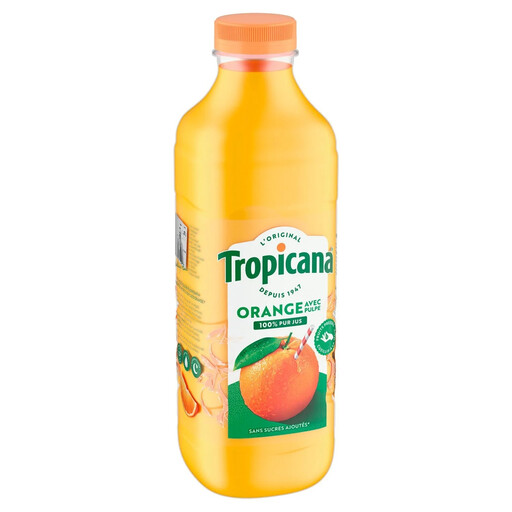 Image unavailable
The 1 L pack with pulp may suit your household if you prefer to open a smaller amount at a time.
This product is marked as short-dated: check the date on the packaging and the storage instructions before you buy.
No: the sugars naturally found in oranges are still present in the juice. The DGCCRF reserves the wording ‘contains naturally occurring sugars’ for fruit juices. To find out how much sugar it contains, read the ‘of which sugars’ figure.
Start by checking the product description and ingredients, then compare the nutritional information using the same unit. As the DGCCRF points out, nutritional values are given per 100 g or per 100 ml, so check the unit before comparing two figures.
No. Having no added sugars doesn’t make juice a substitute for water. Manger Bouger recommends limiting all fruit juices to no more than one glass a day and choosing whole fruit where possible.
Follow the storage instructions and use-by period shown on the product you buy. The Auchan listing for its 2 L pure juice and the Andros listing for its 1 L pure juice say to keep them in the fridge and consume them within five days of opening.