People training again soon
You’re considering having juice after a demanding workout and want to know how to include it in a snack alongside water and other foods before your next session.


After a demanding workout, pure orange juice can be part of a snack if you’re looking for a source of carbohydrates. However, as Anses reminds us, ‘no added sugar’ doesn’t mean ‘sugar-free’. If your priority is to limit liquid sugars, choose water and consider having a whole piece of fruit instead. If you do opt for juice, check the portion size, have some water too and choose the rest of your snack to suit your needs.
You’re considering having juice after a demanding workout and want to know how to include it in a snack alongside water and other foods before your next session.
You want to distinguish juice with no added sugar from a sugar-free drink, and take account of how much you actually drink.
You’re looking for a product whose description, ingredients, pack size and storage instructions suit the way you plan to use it.
If you’re considering orange juice after exercise, your choice will depend first on how much space you want liquid sugars to take up in your snack. The product description and portion size can then help you compare bottles.
| Criteria | What to check | Who it’s for |
|---|---|---|
| Carbohydrates after exercise | Check the carbohydrate and sugar figures per 100 ml, then for the portion you’re considering. Plan water and other snack items separately. | If I have another session soon after a demanding workout, I’m looking to include carbohydrates in my snack. Around 40% of consumers may prioritise this need. |
| Liquid sugars | Compare the ‘of which sugars’ figure and the portion size: according to Anses, ‘no added sugar’ doesn’t mean there are no naturally occurring sugars. | I prefer to limit the sugars I drink, even when no sugar has been added to the juice. This may be the top priority for around 30% of consumers. |
| Type and pack size | Check the product description, ingredients, volume and instructions for after opening, especially for a large bottle. | For an occasional snack, I want to know what I’m buying and be able to finish the container in line with its storage instructions. Nearly 30% of consumers may prioritise these points. |
Naturally occurring sugars remain in the juice. For example, Auchan’s product listing for Joker with no pulp gives a sugar content of 8.6 g per 100 ml.
Check the ‘of which sugars’ figure and how much you plan to drink, rather than relying solely on the claim on the front of the pack.
Juice can provide carbohydrates, but it doesn’t replace the other foods and drinks you plan to have after exercise.
If you choose juice, make sure the rest of your snack suits the workout you’ve done, and drink water too.
A claim on the front of the pack doesn’t tell you by itself whether you’re buying juice, nectar or another orange drink. The DGCCRF distinguishes between these product descriptions.
Read the product description, ingredients and nutrition information before comparing products.
Storage instructions after opening vary by product. Auchan’s listing for Andros 1 L pure juice says to keep it refrigerated and consume it within five days of opening.
Choose a pack size you can finish while following the instructions on its own label.
These details apply to the specific products mentioned, not every drink from each brand. Compare their labels with the product in front of you.
Le Fruit Orange with no pulp is worth considering if you’re looking for orange juice with no added sugar.
The no-pulp pure juice featured by Carrefour gives you another orange juice with no added sugar to compare.
The 2 L no-pulp product is worth comparing if you plan to use one bottle for several snacks.
The 4 × 1 L multipack of no-pulp pure juice is a useful option to compare if you’re looking at several bottles.
The 1 L no-pulp pure juice is an example of how storage instructions can affect your choice of pack size.
This juice with pulp is for people considering orange juice after exercise. As it’s marked as short-dated, it’s especially important to check the date on the packaging.
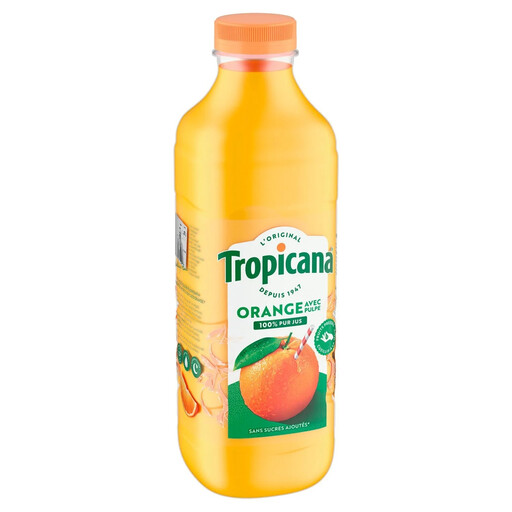 Image unavailable
Worth considering if you’d like orange juice with pulp as part of a snack after exercise.
The title notes that it’s short-dated: check the date on the packaging before buying.
No. Anses explains that ‘no added sugar’ doesn’t rule out naturally occurring sugars. To find out how much it contains, check the ‘of which sugars’ figure per 100 ml and for the portion you’ll drink.
Juice can be part of a snack after exercise, but it shouldn’t be mistaken for the whole snack or for the water you drink. Take account of the workout you’ve done and how soon you might train again when choosing other foods.
Manger Bouger recommends limiting fruit juice to a maximum of one glass a day and choosing water as your main drink. If you have juice after exercise, include it in your daily intake.
Start by checking the product description: the DGCCRF distinguishes between products such as juices and nectars. Then check the ingredients and the ‘of which sugars’ figure to choose according to what matters to you, rather than relying on the packaging or the word ‘diet’ alone.
Follow the storage conditions and use-by period on the bottle you’ve bought. As an example for this specific product, Auchan’s listing for Andros 1 L pure juice says to keep it refrigerated and consume it within five days of opening.