Hosts keeping an eye on sugar
If you’re looking for juice for the buffet and want to distinguish between no added sugar and sugar-free, compare the “of which sugars” figure per 100 ml with the amount actually served.


For a Bastille Day buffet, choose orange juice by checking its product description, ingredients and sugar content per 100 ml. “No added sugar” does not mean “sugar-free”. Then pick a pack size that suits the glasses you plan to serve, and check the storage instructions for after opening. Manger Bouger recommends limiting fruit juice and having no more than one glass a day.
If you’re looking for juice for the buffet and want to distinguish between no added sugar and sugar-free, compare the “of which sugars” figure per 100 ml with the amount actually served.
Individual portions can make it easier to keep track of how much is served. For children, Manger Bouger recommends no more than half a glass of juice a day before the age of 11, and one glass a day thereafter.
If several guests will be having juice, choose a bottle size to suit the portions you’ve planned, their preference for juice with or without pulp, and whether you can refrigerate the bottle after opening.
When choosing orange juice for your buffet, first check the ingredients and sugar content, then choose the pack size and texture to suit how you plan to serve it.
| What to check | What to look for | Who is it for? |
|---|---|---|
| Sugar | Check the “of which sugars” figure per 100 ml, then factor in the size of the glass you’ll serve. “No added sugar” does not mean zero sugar. | If I want to limit the amount of sugar served, the ingredients alone aren’t enough: I also need to consider the size of my glass. Around 36% of consumers are said to prioritise this. |
| Pack size | Match the bottle size to the number of glasses you plan to serve, and check the instructions for after opening. A smaller pack can make individual servings easier. | To serve several guests without buying a bottle that’s far too large, I start with the portions I plan to offer. Pack size is said to be the top priority for nearly 29% of consumers. |
| Ingredients and origin | Check whether it’s juice or nectar, read the ingredients, then look for the origin of the oranges if it’s given. An organic label, if present, tells you something different from the sugar content. | If the ingredients or origin guide my choice, I want to be able to check them on the specific product rather than relying on the brand alone. Around 21% of consumers are said to prioritise these factors. |
| Pulp and storage | Choose juice with or without pulp to suit your guests, and check how soon it should be consumed after opening. | If texture preferences and managing leftovers are what guide my choice, I check the exact bottle. These are said to be the main concerns for around 14% of consumers. |
Orange juice can contain naturally occurring sugars, even when no sugar has been added.
Compare the “of which sugars” figure per 100 ml and consider the amount you’ll serve, rather than relying on the claim on the front of the pack.
“Juice”, “nectar” and “orange drink” don’t automatically mean the same thing. If you’re specifically looking for pure orange juice, check the product description and ingredients.
Read both details on the product you’ve chosen before deciding what it contains.
How long juice can be kept after opening depends on the product. Carrefour, for example, says one of its bottles of pure orange juice can be kept in the fridge for five days.
Choose a bottle size to suit the number of glasses you plan to serve, and follow the instructions on the bottle you buy.
An oversized bottle could leave you with juice that hasn’t been used before the recommended time is up.
These brands offer products worth comparing individually. Ingredients, pack sizes and storage instructions can vary across each range.
Worth considering if you’d like to serve orange juice with pulp.
A brand to consider if you can find a pure juice that suits your buffet.
An option for guests who prefer orange juice without pulp.
Compare its pure orange juice without pulp if you’re planning to serve juice for a group.
A retailer with a range of pure orange juice products in different pack sizes.
Worth a look if you’d prefer to serve individual portions.
For guests who enjoy pulp, this 1 L bottle is a good size to share. Pay particular attention to the “short-dated” label before buying.
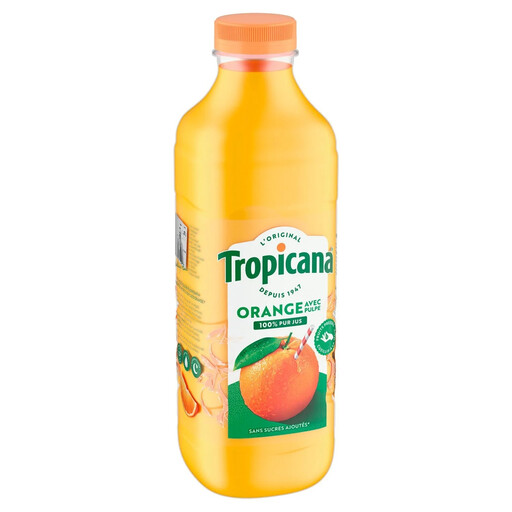 Image unavailable
This size could work well if you’re serving juice with pulp to several guests. The Joybuy listing describes it as made from 100% squeezed oranges. Before buying, check the best-before date on the bottle, along with the nutrition information and instructions for after opening.
No. Orange juice contains naturally occurring sugars, so no added sugar doesn’t mean the “of which sugars” figure will be zero. To compare two bottles, check this figure per 100 ml and factor in the amount you’ll serve.
Plan your shopping around the glasses you intend to serve, rather than treating a large bottle as a single portion. Manger Bouger recommends limiting fruit juice as much as possible and having no more than one glass a day. Offer water too.
Make sure the volume suits the number of guests, then check whether it contains pulp, the sugar content per 100 ml and the instructions for after opening. Carrefour’s five-day guidance for one of its 1,5 L products may not apply to another bottle.
Serve small glasses rather than leaving juice out as the only drink. Manger Bouger recommends no more than half a glass a day before the age of 11, and one glass a day from age 11 onwards.