What should you look for?
Start with noise if the dishwasher will run near your living space, then make sure its capacity suits your usual loads. The energy label lets you compare noise, consumption and Eco programme duration together.
| Factor |
What to check |
Who should consider it |
| Noise levels |
Compare the stated dB levels and noise classes of appliances with a similar format and capacity. The acoustics of the room can affect how loud the dishwasher seems. |
If the cycle runs near the living room or a bedroom, I want to be able to put the dishwasher on without disrupting nearby activities. Around 33% of consumers put peace and quiet first. |
| Format and capacity |
Work out how much washing-up builds up between loads, then check the stated place settings and the dimensions of the space available. |
In a small kitchen, I need to fit the appliance in without having to run more cycles because there isn’t enough room for my washing-up. Format and capacity are the main consideration for around 25% of consumers. |
| Water and electricity |
Check the kWh per 100 cycles, litres per cycle and Eco programme duration for the stated capacity. According to the European Commission, these figures appear on dishwasher energy labels. |
For everyday washing-up, I want to understand what each cycle involves and how often I’ll need to run the appliance. Around 25% of consumers prioritise water and electricity consumption. |
| Maintenance and support |
Check the repairability information for the model, along with the parts and service available, then keep a copy of its description and your proof of purchase. |
If I plan to keep the appliance for a long time, I want to know how to arrange a repair or report a fault. For around 17% of consumers, maintenance and support come before other considerations. |
Dishwashers to suit your available space
These Joybuy models include freestanding appliances for larger loads and tabletop appliances for kitchens short on floor space. For each one, match the capacity to your washing-up and check the noise information for the exact model.
 Image unavailable
Whirlpool WFP5O41PLGX, 60 cm, 14 place settings
Worth considering if you have room for a freestanding appliance and regularly produce a large load of washing-up.
The model name indicates a width of 60 cm, 14 place settings and a C energy rating. For an open-plan kitchen, also check its noise class and the dimensions of the space available.
View on Joybuy
 Image unavailable
Samsung DW60M6050FS, 14 place settings
Worth considering for larger loads if a freestanding appliance suits your kitchen.
The model name lists 14 place settings and 7 programmes. Before choosing it for a living space, compare its dB level and noise class with those of appliances with a similar capacity.
View on Joybuy
 Image unavailable
Indesit D2F HK26 S, 60 cm, 14 place settings
This capacity could suit you if your everyday washing-up regularly fills a 60 cm freestanding appliance.
The model name indicates 14 place settings and an E energy rating. Check the noise information and kWh per 100 cycles on the label for the model on offer.
View on Joybuy
 Image unavailable
Heinrich's HTG 8840 Schwarz, 6 place settings
A tabletop model is worth considering if you’re short on floor space, provided your worktop can accommodate it.
The model name lists 6 place settings, 7 programmes, 47 dB and a D energy rating. Its capacity may mean more frequent cycles for larger loads, so check its dimensions and noise class.
View on Joybuy
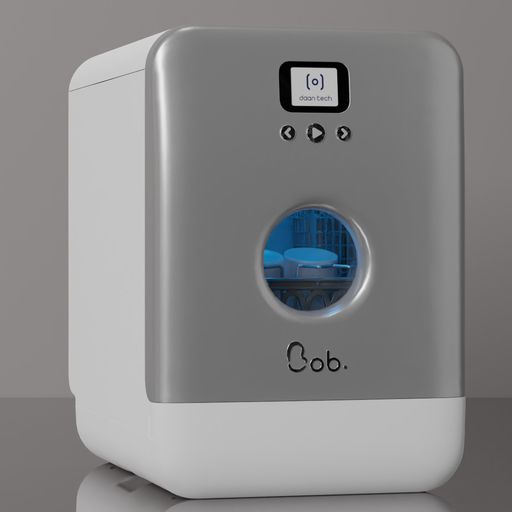 Image unavailable
Bob Mini Dishwasher, 3 place settings, 34 cm
Worth considering if you have a small amount of washing-up and space for it on your worktop.
The product name indicates 3 place settings and a width of 34 cm. This capacity may mean running several cycles if you have more washing-up, so also check the noise level and consumption figures for the relevant programme.
View on Joybuy
Frequently asked questions
How do you compare dB levels and noise classes?
Check both figures on the energy labels of models with a similar format and capacity. The dB figure gives the stated noise level, while the noise class makes it easier to compare at a glance. ADEME says that appliances rated A or B are particularly quiet, although how noticeable the noise is also depends on the room.
Is a 45 cm dishwasher always better for a small kitchen?
It helps if width is an issue, but its capacity still needs to suit your loads. UFC-Que Choisir describes built-in 45 cm models with capacities of 9 to 10 place settings. If your washing-up builds up quickly, check how often you’ll need to run a cycle and how noisy the model you’re considering is.
When should you consider a mini dishwasher?
A mini model could be a good option if you don’t have room for a standard appliance and its capacity suits your usual washing-up. UFC-Que Choisir describes models with 2 or 3 place settings that sit on a worktop. Check the available space, water supply and specifications of the exact model.
Does the energy label describe every programme?
No. According to the European Commission, it shows information such as energy use per 100 cycles, water use per cycle and the duration of the Eco programme. These figures give you a shared basis for comparison, but don’t automatically describe the consumption of every other programme.
Does the legal guarantee of conformity cover a dishwasher bought from a professional seller in France?
Yes. The DGCCRF says it applies to new, used and refurbished goods sold by a professional to a private individual. Keep your proof of purchase and the dishwasher’s description so you can explain the fault to the seller.


