What should you compare?
First check which appliance can be installed and what capacity will suit you. Then compare the Eco programme figures on the energy label for models that meet your needs.
Integrated or fully integrated
Consider this if: you have a suitable housing unit and want the appliance to blend in with your kitchen cabinets.
What to bear in mind: integration means checking the door front, plinth and installation. Bosch recommends using a professional for installation.
Freestanding
Consider this if: your kitchen doesn’t have a matching cabinet front or you don’t want to build the appliance into a unit.
What to bear in mind: you’ll still need to allow space for the appliance and its connections. Bosch notes that the installation type alone doesn’t determine washing performance.
Slimline or tabletop
Consider this if: limited space rules out a larger appliance.
What to bear in mind: lower capacity may mean running more cycles if your household’s usual load is too large.
| What to compare |
What to check |
What I need |
| Noise |
Compare the decibel levels and noise class shown on the energy label for the specific models. Also check when you could use any delay-start function to run a cycle. |
I want to schedule washes so the appliance isn’t running at times when its noise would bother me in the living area. |
| Water and energy |
According to ADEME and the European Commission, the energy label shows energy use in kWh per 100 reference cycles and water use in litres per reference cycle. Compare these figures for appliances with a suitable capacity, rather than looking only at the energy rating. |
I want to compare consumption on a like-for-like basis for regular cycles and choose a capacity that means I don’t have to run more washes than necessary. |
| Space and capacity |
Measure the space, including doorways and access routes. For an integrated model, check the housing, door front, plinth and connections. Then compare the number of place settings with the amount of washing-up you usually have. |
I’m interested in a compact model if the kitchen is small, but it needs to fit the dishes I expect to wash between cycles. |
| Cycle duration and timing |
Check the Eco programme duration on the energy label: it doesn’t show the duration of every programme. Separately check whether the model has a delay-start function and what time range it offers. |
If I need to delay a cycle, I’m looking for a setting that fits my schedule. Off-peak hours are only relevant if my tariff includes them. |
A few pointers by brand
These examples of ranges and models can help you identify what to compare. They don’t replace checking the energy label and instructions for the model you’re considering.
Bosch
Bosch offers freestanding and integrated dishwashers, with guides explaining the differences in installation.
- The brand lists models in its range at between 38 and 42 dB. Check the noise level for the specific model you’re considering.
- An integrated installation means checking the housing unit, door front and connections, whatever noise level you’re looking for.
Miele
Miele offers a range of freestanding and integrated models in different sizes.
- Miele’s details for the 45 cm integrated G 5540 SCi SL Active list a noise level of 45 dB and a delay-start function.
- These specifications apply to this model. Check the capacity, energy label and dimensions of any other model you’re considering.
Beko
Beko offers freestanding and integrated dishwashers, including slimline models.
- According to Beko’s product details, the 45 cm DVS05024X has 10 place settings and a delay-start function of 3, 6 or 9 hours.
- The same details list a noise level of 49 dB for this model. A slimline design doesn’t indicate how noisy other models will be.
Dishwashers for different kitchen layouts
This selection from Joybuy includes tabletop appliances, a freestanding model and an integrated model. Compare their capacity and installation requirements, then check the noise and consumption figures for the model you’re interested in.
 Image unavailable
Heinrich's HTG 8840 Schwarz, tabletop dishwasher, 6 place settings
Worth considering if a tabletop appliance with 6 place settings suits the available space and the amount of washing-up you have between cycles. The title lists 7 programmes, a 24-hour delay-start function, 47 dB and a D energy rating. Check the dimensions and energy label figures before comparing its consumption with another model.
View on Joybuy
 Image unavailable
Hotpoint H4FD641A, 60 cm freestanding, 14 place settings
This 14-place-setting model is for households with enough space for a 60 cm freestanding appliance. The title lists a noise level of 41 dB and a C energy rating. Check the connections and consult the energy label to compare energy and water consumption, as well as the Eco programme duration.
View on Joybuy
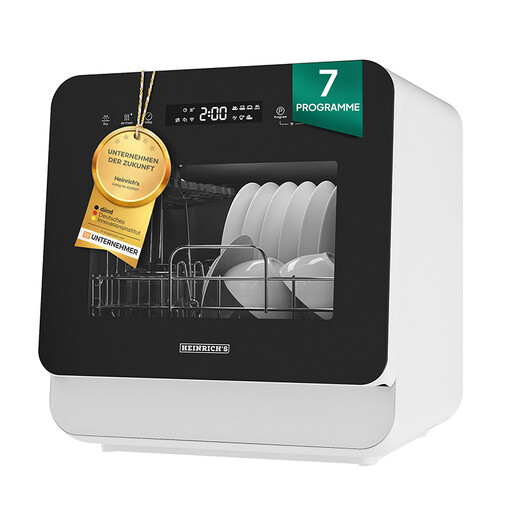 Image unavailable
Heinrich's HTG 8855, mini dishwasher, 3 place settings
This tabletop model could suit a very small space if 3 place settings are enough between washes. The title lists 7 programmes, a 24-hour delay-start function, 56.3 dB and a C energy rating. For an open-plan kitchen, compare its stated noise level with the figures on other models’ energy labels.
View on Joybuy
 Image unavailable
Samsung DW80H72YBB0U1, 60 cm integrated, 13 place settings
Consider this model if your kitchen has a suitable space for a 60 cm integrated dishwasher and 13 place settings will suit your household’s routine. The title lists a B energy rating. Before choosing it for an open-plan kitchen, check the noise level on the energy label, as well as the housing unit, door front, plinth and connections.
View on Joybuy
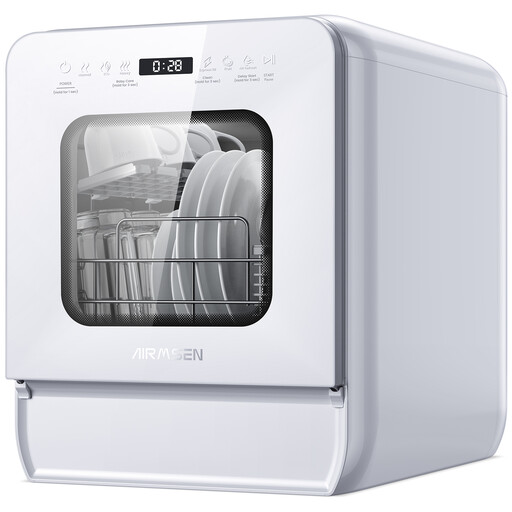 Image unavailable
AIRMSEN, tabletop dishwasher with 5 L water tank
The integrated water tank may appeal if you’re considering a tabletop installation without a permanent connection to the water supply. The title lists 9 programmes, dimensions of 37 × 50 cm, a delay-start function from 1 to 24 hours and a D energy rating. Check the exact dimensions for this model, which connection accessories are needed, and its noise and consumption figures before making your choice.
View on Joybuy
Frequently asked questions
What should I compare on a dishwasher’s energy label?
Compare the energy rating, kWh per 100 cycles, litres of water per cycle, capacity in place settings, Eco programme duration, decibel level and noise class. According to ADEME and the European Commission, these figures are based on the reference cycle, so they may not describe every programme.
Is an integrated dishwasher always quieter than a freestanding one?
No. The installation type alone doesn’t tell you how noisy a model will be. Bosch mainly distinguishes these formats by how they’re installed and how they look. For an open-plan kitchen, compare the decibel levels and noise classes of the models you’re considering.
What should I check before installing a dishwasher?
Check the dimensions of the space and whether you can connect the appliance to water, electricity and drainage. For an integrated model, also check the door front, plinth and installation instructions. Bosch recommends using a professional for installation.
Does delay-start make a dishwasher quieter?
No. It delays the start without changing the appliance’s noise level. It can help you avoid running a wash while people are using the living area. Check that the model’s delay-start settings fit your schedule.


