House shares where people often eat together
If plates, glasses, pans and serving dishes pile up between cycles, start by checking the capacity and basket layout. A 60 cm model is worth considering if your kitchen has room for one.


If several people often eat together, first consider a 60 cm dishwasher if you have the space and the right connections. Models with a larger capacity give you more room for cookware and the dishes that build up. A 45 cm model suits a narrower space, while a compact dishwasher is best for smaller loads. In an open-plan kitchen, also compare the dB rating, noise class and Eco programme duration of the model you’re considering.
If plates, glasses, pans and serving dishes pile up between cycles, start by checking the capacity and basket layout. A 60 cm model is worth considering if your kitchen has room for one.
If there isn’t room for a 60 cm model, compare 45 cm dishwashers with compact models based on the dishes you need to wash. Beko and Candy’s ranges include 45 cm models with capacity for 10 place settings; Candy and Electrolux also offer compact models for 6 place settings.
If the dishwasher will be running while people are chatting, working from home or relaxing, compare its dB rating and noise class on the label. UFC-Que Choisir highlights the importance of noise when a dishwasher is in a shared living space.
Consider it: for frequent shared meals, if you have a suitable space. Candy and Whirlpool’s French ranges include models with capacity for 14 to 15 place settings in this size.
The trade-off: it takes up more width than a 45 cm or compact model. Its size alone doesn’t tell you how much energy it uses or how noisy it is.
Consider it: when there isn’t enough width for a 60 cm model, but an integrated or freestanding dishwasher will fit.
The trade-off: Beko and Candy offer models for 10 place settings; check that the baskets can also fit your serving dishes and pans.
Consider it: when there’s no space for a 45 or 60 cm model and your loads are small.
The trade-off: Candy and Electrolux’s compact models for 6 place settings offer less room for dishes from shared meals. A freestanding model may also need a water connection.
| Factor | What to check | How you’ll use it |
|---|---|---|
| Capacity | Compare the number of place settings, the basket layout and the space for serving dishes. Think about how much washing-up builds up between cycles. | After a shared meal, I need room for pans too, not just plates. |
| Noise | Check the dB rating and noise class for the exact model on its label. Consider when the dishwasher will be running. | The kitchen opens onto the living space, so I want to be able to run a cycle without disturbing the other people in the house. |
| Water, energy and programme duration | Check the kWh per 100 cycles, litres per cycle and Eco programme duration. ADEME and the European Commission say these details are shown on the energy label; compare models with similar capacities and programmes. | We need to know when the dishes will be ready and compare the stated energy and water use, without assuming that a smaller appliance uses less per cycle. |
| Installation | Measure the height, width, depth and any available space. Confirm the installation type, whether a furniture door is needed, and the water, electricity and drainage connections. | Before choosing an integrated or freestanding compact model, I want to make sure it’ll fit the existing kitchen. |
A capacity of 6 place settings, as with the compact models offered by Candy and Electrolux, could mean running more cycles or washing some dishes by hand after a shared meal.
Estimate how many dishes a shared meal creates, including pans, then compare that with the model’s capacity and basket layout.
The energy rating letter doesn’t tell you how much water is used per cycle, the kWh per 100 cycles, the Eco programme duration or the capacity. ADEME recommends checking these details on the label.
Compare the Eco programme figures on the labels of the models you’re considering, taking their capacities into account.
In an open-plan kitchen, a marketing claim doesn’t replace the stated noise emissions. According to ADEME, an increase of 3 dB means the noise is almost twice as loud.
Compare the dB ratings and noise classes, then think about when the dishwasher will be running.
An appliance may not fit the existing space or cabinetry. Bosch notes that a dishwasher needs water, electricity and drainage connections; Candy says its freestanding compact CP 6E51LS connects directly to a water supply.
Measure the space and the appliance, check whether a furniture door is needed, and read the installation instructions for the exact model.
Depending on the model and kitchen, you may need to adapt the connections, add a furniture door or arrange professional installation.
These examples of ranges and models can help you identify the sizes available; their features don’t apply to every appliance from the same brand.
Worth considering for a fitted kitchen where a 45 cm integrated model is required.
Worth considering if a 45 cm appliance with capacity for 10 place settings suits your space and household’s needs.
Candy’s French range includes large-capacity, 45 cm and compact tabletop dishwashers.
Worth considering if your kitchen has room for an integrated compact model.
These five models, each with capacity for 14 place settings, are worth considering if you’re looking for a larger dishwasher for shared meals. Four are freestanding and one is fully integrated. Check that the space and connections are suitable before comparing your options.
 Image unavailable
Its advertised capacity of 14 place settings is worth considering for washing up after several people. The description states 44 dB, 95 kWh per 100 cycles and 10.5 L per cycle, as well as a third rack and a delay timer. Check the noise and energy and water use on the exact model’s label, and look at the Eco programme duration if having dishes ready at a particular time matters to your household routine.
 Image unavailable
This model, with capacity for 14 place settings, is worth considering if a freestanding appliance suits your shared kitchen. The description states 41 dB, 75 kWh per 100 cycles and 9.5 L per cycle. However, the detailed dimensions conflict with the nominal width of 60 cm. Confirm the overall dimensions before buying, then check the noise rating and Eco programme duration in the product details for the exact model.
 Image unavailable
Its advertised capacity of 14 place settings makes this model an option for shared meals, space permitting. The description states 41 dB and around 9.5 L of water for the Eco cycle. If you have an open-plan kitchen or want to compare energy and water use, check the label for the noise rating, Eco programme duration and kWh per 100 cycles.
 Image unavailable
Its advertised capacity of 14 place settings addresses the need for space after shared meals. The description states 46 dB, 9.5 L of water, a delay timer of 1 to 8 hours and a Push&Go cycle advertised as taking 85 minutes; this isn’t the Eco programme duration. Check the label to compare the noise rating, Eco programme duration and energy use per 100 cycles.
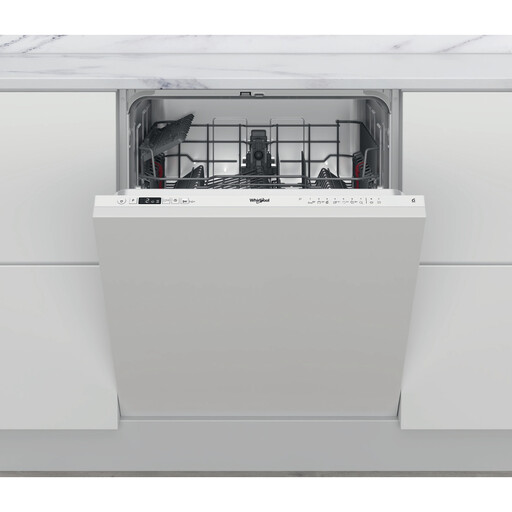 Image unavailable
This model, with capacity for 14 place settings, is designed for a kitchen with a suitable space for a fully integrated appliance. The description states 46 dB and a delay timer. Check the dimensions of the space, the furniture door and the connections. To compare it with other models, also check the label for water and energy use, Eco programme duration and noise.
Start by comparing 60 cm models if your kitchen has room for one: Candy and Whirlpool’s French ranges include appliances for 14 to 15 place settings. If space is tight, Beko and Candy offer 45 cm models for 10 place settings. A compact model for 6 place settings leaves less room for serving dishes and may mean running more frequent cycles.
Compare the dB rating and noise class on each model’s label, taking into account when it will be running. According to ADEME, an increase of 3 dB means the noise is almost twice as loud; how much it bothers you also depends on the layout of the room.
In a shared kitchen, it helps you plan when everyone can unload their dishes. The European Commission says the energy label shows this duration alongside the capacity, water use per cycle, energy use per 100 cycles and noise level. Compare these figures for the models you’re considering, and don’t confuse the Eco programme duration with that of a quick cycle.
Don’t assume so: Candy says its freestanding compact CP 6E51LS needs a direct connection to a water supply. Check the instructions for the model you choose, along with the options for water supply and drainage in your kitchen.