
Livraison le jour même ou le lendemain

Qualité garantie

Débloquez vos offres de bienvenue: Livraison GRATUITE | Jusqu'à -80 % | 30 jours d'essai gratuits à JoyPlus
Téléchargez l'application
Upgrading your gaming monitor is a pivotal moment for anyone looking to take their gaming experience to the next level. But faced with a jungle of technologies and spec sheets, choosing the right OLED gaming monitor can feel like a puzzle. Between QD-OLED panels, dizzying refresh rates, and the dance of resolutions, it's easy to get lost.
This guide is here to bring clarity. We will break down the essential criteria and present a selection of monitors that meet the standards of the most demanding gamers and e-sports pros. Our mission: to give you all the keys to making the right choice, with concrete information and without the usual marketing fluff.
Before diving into our selection, let's review the technical characteristics that make a screen a true high-performance gaming monitor.
This is the pair that determines both image sharpness and in-game immersion.
In fast-paced games, every millisecond counts. Two values are fundamental here:
For a perfectly smooth gaming experience without screen tearing, adaptive sync technologies like FreeSync Premium Pro (AMD) and G-Sync compatibility (NVIDIA) are essential. Their role is to synchronise the screen's refresh rate in real-time with the frames sent by the graphics card.
OLED technology shines with its infinite contrast. The secret? Each pixel produces its own light and can turn off completely to create true black. QD-OLED (Quantum Dot OLED) technology takes the concept even further by integrating a layer of quantum dots. The result: even more vibrant colours and higher peak brightness than on classic OLED panels. For creatives, a certification like Pantone Validated is the guarantee of professional-grade colour accuracy.
Let's zoom in on three models from the Samsung Odyssey range that stand out from the crowd, designed for three distinct gamer profiles.
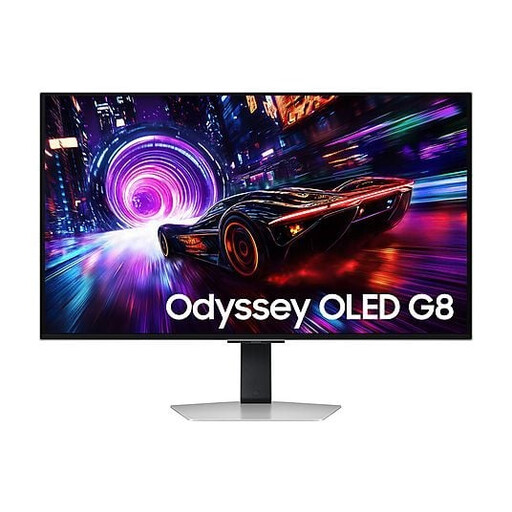
Why it stands out: This monitor pulls off an incredible feat: marrying a 4K UHD resolution with a 240 Hz refresh rate. Its 32-inch QD-OLED panel delivers stunning image quality, and its Glare Free anti-reflection treatment ensures optimal gaming comfort, even in a well-lit room.
Advantages:
Who is it for? For the uncompromising gamer who refuses to choose between the visual punch of 4K and the ultimate responsiveness for competitive games. It's also a prime ally for creatives, who will benefit from a vast 4K workspace with accurate colourimetry.
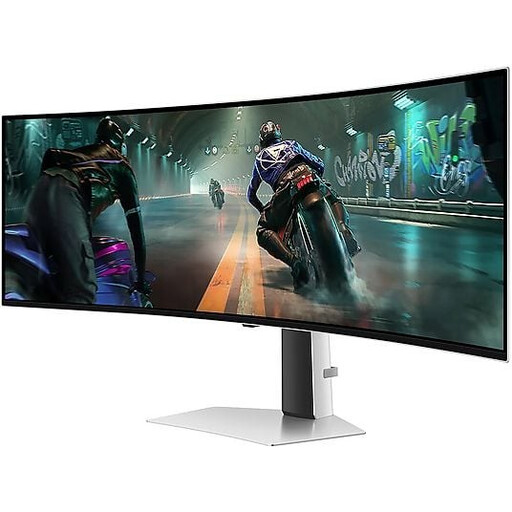
Why it stands out: The Odyssey G9 is a true marvel with its 32:9 super ultrawide format. This 49-inch curved gaming screen offers a panoramic field of view that literally plunges the player into the heart of the action, for unparalleled immersion in simulations and adventure games.
Advantages:
Who is it for? For fans of simulation (racing, flight) and strategy games, who will make the most of this XXL field of view. It's also a productivity powerhouse, capable of effortlessly replacing a dual-monitor setup.
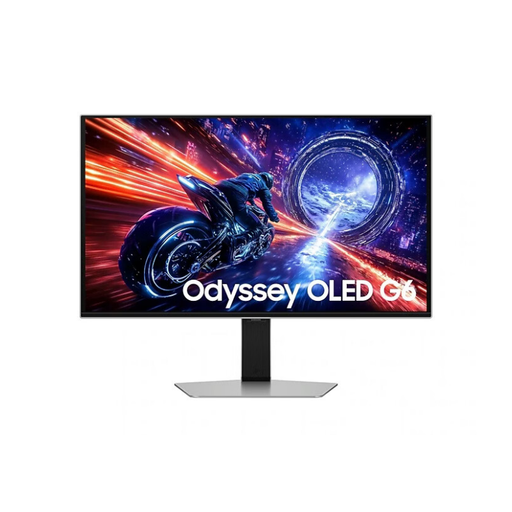
Why it stands out: This model is a pure speed demon, entirely dedicated to performance. With its stratospheric 500 Hz refresh rate, it directly targets competitive gamers and e-sports pros, for whom every single frame can make a difference. Combined with the responsiveness of the QD-OLED panel, this speed makes it a formidable weapon.
Advantages:
Who is it for? For competitive gamers and e-sports professionals looking to gain the decisive edge in responsiveness and fluidity. Its 27-inch / QHD combo is simply the standard on the professional scene.
Our selection highlights high-performance OLED models. If these screens don't check all your boxes, whether in terms of budget or features, feel free to explore our full range of PC gaming monitors to find the hidden gem that will perfectly complement your setup.
Simply put, classic OLED technology (often called WOLED) relies on white sub-pixels that pass through filters to create colours. QD-OLED technology, on the other hand, starts with a blue light source that excites a layer of quantum dots to directly generate pure red and green without a filter. Ultimately, this process generally offers richer colours and better brightness.
Yes, and more relevant than ever! This type of screen is aimed at gamers equipped with a very high-end graphics card, capable of running the most demanding games in 4K with a very high frame rate. The appeal is combining the best of both worlds: enjoying the visual punch of 4K in single-player games while maintaining competitive-level fluidity for multiplayer titles. It's an excellent future-proof investment.
Recent OLED monitors integrate numerous technologies to mitigate this risk. The Samsung Odyssey models, for example, include systems that detect static interface elements (logos, taskbars) to locally reduce their brightness. They are also equipped with active cooling and a screen saver. On your end, a few best practices can help preserve your panel: vary the content displayed, use an animated wallpaper, and, most importantly, avoid leaving a static image on the screen for excessively long hours.