To reduce electricity consumption, start by looking at an old fridge or freezer: ADEME points out that these appliances run continuously. However, which appliance should come first depends on what needs replacing and how much capacity your household needs. If your dishwasher or oven is used heavily, compare its figures per cycle. If an appliance has broken down, consider getting it assessed for repair before buying a replacement.
Who needs to choose between several appliances?
Households with several ageing appliances
If you’re considering replacing more than one appliance, compare how each one works and how you use it before deciding which to prioritise. A consumption figure only makes sense when you know its unit and the appliance’s capacity.
People with an old fridge or freezer
Cooling appliances deserve a closer look because they run continuously, as ADEME points out. When choosing a replacement, the European Commission says the energy label includes details such as annual consumption, storage volumes and noise levels.
Households dealing with a broken dishwasher or oven
If an appliance breaks down, first decide whether to repair or replace it. If you need to buy a new one, compare dishwashers using the eco programme figures and ovens by their consumption per cycle, for a relevant capacity and cooking mode.
How do you decide which appliance to replace first?
First check whether the appliance still meets your household’s needs, then compare models within the same category: energy labels don’t all show consumption over the same period.
| Priority |
What to check |
What I need |
| Fridge or freezer |
According to the European Commission, the energy label shows consumption in kWh/year, storage volumes and noise levels. Compare the capacity you need and, if known, your current appliance’s consumption with those of a model suited to the same use. |
If my fridge or freezer is getting old or isn’t working well, I want to know whether a replacement will suit my storage needs. ADEME points out that it runs continuously; that fact alone doesn’t quantify the savings for my household. |
| Dishwasher |
Compare kWh per 100 eco cycles, litres of water per cycle and place settings. The European Commission also says the energy label shows the eco programme duration and noise levels. |
My dishwasher gets frequent use, or needs replacing after a breakdown. I’m looking for a capacity that suits my washing-up needs, without assuming that the eco programme figures apply to every programme. |
| Oven |
For ovens of a similar capacity, check the kWh per cycle for conventional and fan-assisted cooking. The European Commission includes both modes among the figures shown. |
I use my oven frequently, or it isn’t working properly. I want to compare a relevant usage pattern and cooking mode, rather than infer annual consumption from a single cycle. |
| Hob |
Consider the type of hob, compatible cookware and your kitchen’s requirements. The European Commission says hobs don’t have an EU energy label. |
If my hob needs replacing, I want to check that it’s compatible with my kitchen and cookware, rather than look for an A–G energy rating. |
| Repair |
If an appliance has broken down, ask for an assessment and check whether a repair could restore it to working order for your needs. ADEME points out that a breakdown doesn’t always mean the whole appliance needs replacing. |
Before replacing my appliance, I want to know whether the fault is confined to one part and whether the appliance would still meet my needs once repaired. |
What should you avoid before buying?
-
Comparing kWh figures without checking what they measure
An annual figure for a fridge or freezer, a figure per 100 eco cycles for a dishwasher and a figure per cooking cycle for an oven don’t describe the same period of use.
First compare models in the same category on a like-for-like basis, then take into account how often you use them.
-
Automatically replacing an appliance when it breaks down
According to ADEME, a breakdown doesn’t necessarily mean the whole appliance needs replacing.
Find out what caused the fault before deciding whether a repair could let you keep an appliance that still suits your household.
-
Assuming a larger fridge will use less energy
ADEME recommends taking the size and features of a fridge or freezer into account. Extra capacity meets a storage need; on its own, it won’t reduce consumption.
Work out how much usable storage you need, then compare the kWh/year and noise levels of suitable appliances.
-
Looking for an energy rating for a hob
The European Commission says hobs don’t need an energy label. So an oven’s energy rating can’t be used to rate a hob.
Instead, check the type of cooking you want, which cookware you can use and any requirements of your kitchen installation.
Brand references
There are no brand references to display.
Appliances to explore on Joybuy
This selection includes fridge-freezers, a separate freezer and a countertop dishwasher. It gives you options to explore for cooling and washing, without assuming which appliance you should replace first in your home.
 Image unavailable
Samsung RB33B612EBN, 344 L black fridge-freezer, energy class E
Worth considering if you’re replacing a fridge or freezer and need a total capacity of 344 L. Check the kWh/year and usable storage volumes on the energy label, then compare them with those of the appliance you’re replacing and your own needs.
View on Joybuy
 Image unavailable
Sonlu CC-520WE, 444 L frost-free fridge-freezer, energy class E
Consider whether this 444 L capacity suits your actual storage needs: extra capacity is only useful if you’ll use it. The product name describes it as frost-free; also check the kWh/year and dimensions before choosing.
View on Joybuy
 Image unavailable
Heinrich´s, 161 L No-Frost freezer, energy class C
An option to consider if you need a separate 161 L freezer. The product name mentions a No-Frost system and a reversible door hinge; check the energy label to compare its annual consumption with other freezers suited to your needs.
View on Joybuy
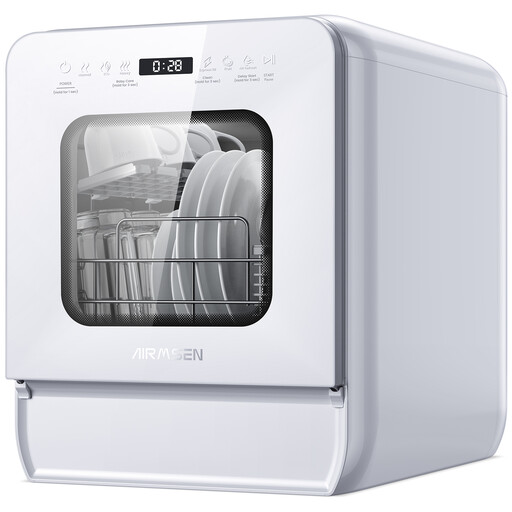 Image unavailable
AIRMSEN, countertop dishwasher with 5 L tank, energy class D
This countertop model could be worth considering if space is a key factor when choosing a dishwasher. The product name lists dimensions of 37 × 50 cm and nine programmes; check the capacity, connections and kWh per 100 eco cycles before comparing it with other models.
View on Joybuy
Frequently asked questions
Can you directly compare the kWh figures for a fridge, dishwasher and oven?
No. According to the European Commission, the energy label shows consumption in kWh/year for cooling appliances, per 100 eco cycles for dishwashers and per cooking cycle for ovens. First compare appliances in the same category, then consider how often you use them.
Does a hob have an energy label?
No. The European Commission says there are no energy labelling requirements for hobs. When choosing a replacement, consider the type of hob, your cookware and your kitchen’s requirements, rather than looking for an A–G rating.
Is the energy rating enough to choose a dishwasher?
No. ADEME and the European Commission say the label also shows kWh per 100 eco cycles, water use per cycle and capacity. It also gives the eco programme duration and noise levels. Choose a capacity that suits your washing-up needs, and remember that the consumption figures are for the reference programme.
Should you replace a broken kitchen appliance straight away?
Not necessarily: ADEME points out that the fault may be in a part of the appliance that can be repaired. An assessment can help establish whether a repair could restore it to working order and still meet your needs before you decide to replace it.


