
Livraison le jour même ou le lendemain

Qualité garantie

Débloquez vos offres de bienvenue: Livraison GRATUITE | Jusqu'à -80 % | 30 jours d'essai gratuits à JoyPlus
Téléchargez l'application
An oil-free fryer, also known as an air fryer or hot-air fryer, can make everyday meals much simpler: chips, vegetables, fish, chicken or snacks all cook in a stream of hot air, with little or no added oil. However, not all models meet the same needs.
Certain mistakes crop up time and again when buying. A capacity marketed as family-sized can hide a shallow basket, while high wattage can push up your electricity consumption without noticeably reducing cooking time. As for automatic programmes, they don’t always replace manual settings that suit the quantity and thickness of your food.
Here are the criteria to consider before you choose, along with a selection of models for different user profiles.
A 5 L, 7 L or 9 L fryer tells you the volume of the basket or baskets, but not necessarily how many chips you can cook evenly. An overfilled basket stops the hot air from circulating properly and can leave food unevenly browned.
For two people, 3 to 5 L may be enough. A family could look at a 5 to 7 L model, paying particular attention to the shape and surface area of the basket. Larger gatherings or meals that need several different dishes will appreciate a dual-basket fryer, which lets you separate your cooking.
Six or eight automatic programmes make it easy to get started, but they rely on generic settings. The result also depends on the quantity you use, the starting temperature and the type of food. So check that manual temperature and time controls are available.
A range of 80 to 200 °C suits most everyday cooking. A lower minimum temperature can be useful for reheating certain foods or gentle cooking. A timer that goes up to 60 minutes also gives you more flexibility.
An easy-to-clean oil-free fryer should have a removable basket, a non-stick coating that’s properly maintained and, if possible, parts that are dishwasher-safe. The electrical base must never be submerged.
The appliance also needs plenty of space around it: don’t block the air intake or outlet, and leave enough room between the fryer and walls, furniture and flammable objects. A viewing window can be handy, but it doesn’t mean you can ignore the manufacturer’s instructions.
A single drawer can make it easier to cook a large batch of one thing. Two independent baskets, on the other hand, let you cook fish and vegetables at the same time, or synchronise two different cooking times.
Measured in watts, the power tells you about heating capacity, but it isn’t enough to predict the result. The models shown range from 1,450 W to 2,400 W for hot-air appliances. A 1,500 W model can be perfectly fine for daily use, while higher wattage will cope better with a large volume.
Also compare the temperature range, the timer, the air circulation and whether there’s overheat protection. For use in the UK, check compatibility with a domestic supply of 220 to 240 V, and make sure the safety information is clear and complete.
A touchscreen makes settings easy to read, but physical buttons can be simpler to use with damp hands. The really useful features include:
The phrase healthy oil-free cooking is often just marketing speak. In practice, a hot-air fryer mainly lets you reduce the amount of added oil compared with traditional deep-frying. It doesn’t automatically turn every recipe into a balanced meal.
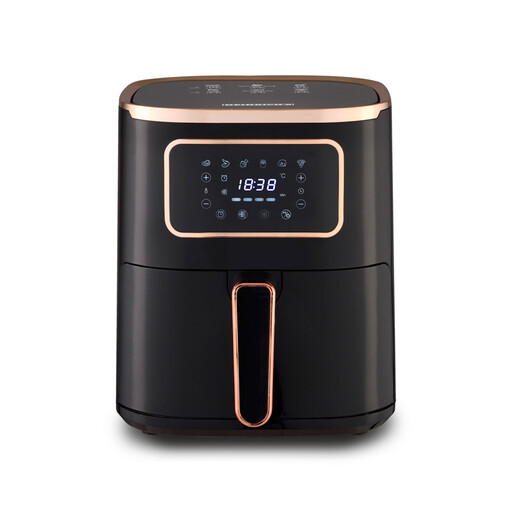
Why this choice suits this profile: its 5 L capacity, touchscreen and six automatic programmes make everyday meals easy to prepare.
The manual setting from 80 to 200 °C means you’re not reliant only on the pre-set programmes.
Removable non-stick basket said to be dishwasher-safe, timer and LED display.
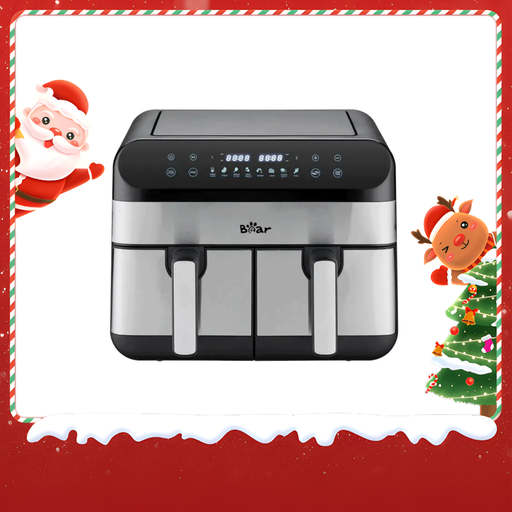
Why this choice suits this profile: its two 4.5 L baskets are ideal for households that want to separate different foods and enjoy a touchscreen with eight programmes.
The capacity is split between two drawers, so you don’t have to mix foods with different cooking times.
9 L total, 2,400 W, independent settings and removable non-stick baskets according to the product listing.
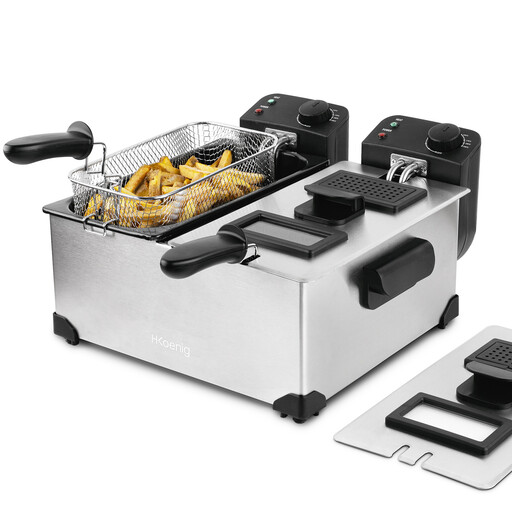
Why this choice suits this profile: this is a traditional oil fryer designed for large quantities and two simultaneous preparations, with a power of 3,600 W.
The listing clearly distinguishes oil frying from hot-air cooking: this model is not suitable for those looking for an oil-free fryer.
Two independent thermostats up to 190 °C, viewing windows, odour filters and removable parts.
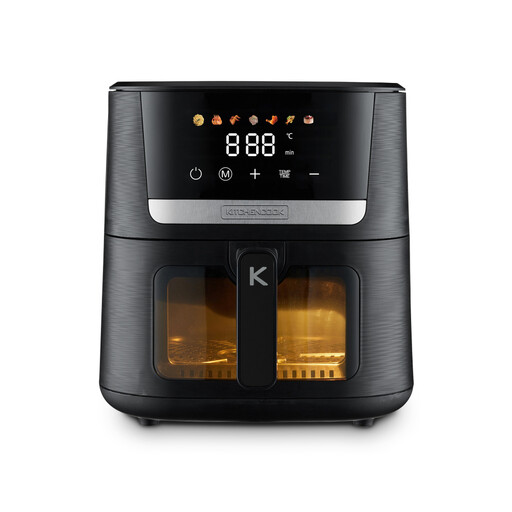
Why this choice suits this profile: its cooking window lets you keep an eye on your food without constantly removing the basket, while the 7 L capacity is ideal for family portions.
Its 7 L capacity and automatic shut-off when the basket is removed meet the demands of frequent use.
1,600 W, touchscreen, seven programmes, removable basket and viewing window.
We’ve put together a comprehensive, real-time updated list of products that fully meet these strict selection criteria and European safety regulations.
It depends on the wattage, how long you run it and the quantity you’re cooking. For a small portion, the smaller volume of an air fryer can reduce the heating time. For several batches, the oven may still be the better option. Compare the wattage and the actual cooking time for your recipes rather than relying on the marketing claim alone.
Yes, but only if the manufacturer allows it and without covering the entire base of the basket. The paper must be held down by the food to stop it rising up towards the heating element. Never block the air circulation openings or use an accessory that isn’t suitable for the temperature you’ve selected.
That depends on how often you use it, how you clean it, how you look after the coating and whether you follow the instructions. Let the appliance cool down before cleaning it, avoid metal utensils on non-stick baskets and never submerge the electrical base in water. Before you buy, also check the warranty period and whether spare parts or accessories are available.