
Livraison le jour même ou le lendemain

Qualité garantie

Débloquez vos offres de bienvenue: Livraison GRATUITE | Jusqu'à -80 % | 30 jours d'essai gratuits à JoyPlus
Téléchargez l'application
Personalising pebbles, decorating wood or drawing on glass isn’t just about picking a pretty colour palette. Ohuhu acrylic markers are designed with multiple nib types and a coordinated assortment, but not all creative pens are suited to the same tasks.
Before you place an order, it’s worth checking the ink’s compatibility with your surface, the nib widths and the storage conditions. Here are the criteria to run through so you avoid buying something that doesn’t quite match your projects.
A water-based ink pen, like those intended for paper, can give a lovely finish on a sheet but won’t necessarily work on wood, glass or ceramic. Acrylic paint pens generally contain a more opaque ink, designed to lay down a coloured film on different surfaces.
However, be aware: the term ‘multi-surface’ doesn’t guarantee the same result everywhere. A smooth, dusty or greasy surface can stop the ink from adhering properly. Clean it thoroughly and let it dry before you start.
A 24-colour acrylic marker set can suit many projects, but a large palette doesn’t make up for a limited selection of nibs. A fine nib is for outlines and details, while a round or chisel nib lets you fill in areas more quickly and draw wider lettering.
A set equipped with two types of nib can therefore be more versatile than a larger assortment limited to just one width.
Waterproof paint pens are formulated to resist water better once dry, according to the manufacturer’s instructions. That doesn’t mean they’ll hold up indefinitely against UV light, rubbing, frost or the elements.
For a decoration that’s going to stay outdoors, let the piece dry completely and consider applying a finish suitable for the surface. Always test on an inconspicuous area, especially on varnished items or plastics.
Acrylic markers with a fine and chisel nib let you switch from precise lines to filling in larger areas. In the Ohuhu set featured here, the 24 fine-nib markers have a width of 0.7 mm. The other 24 are fitted with a reversible nib: one round end of 1.8 to 2 mm and one chisel end of 4 mm.
This combination works well for outlines, details, flat colour areas, headings and personalising objects. However, do check the nib-changing system: a reversible nib needs careful handling to avoid damaging it.
Ohuhu ink is described as water-based, pigmented and acrylic. The product listing also presents it as water-resistant and lightfast. These statements match the characteristics claimed by the manufacturer and don’t constitute a guarantee of preservation in all conditions.
Acrylic pens for stone and wood can be used on clean pebbles, decorative panels and certain wooden items. For acrylic markers for glass and ceramic, the surface must be perfectly degreased. If the object is intended to hold food or drink, avoid drawing on areas that will come into contact with them, unless the manufacturer explicitly states the product is suitable for that use.
Acrylic ink needs to be mixed before first use. For the Ohuhu set, it’s recommended to shake the marker, then press down on the nib several times to start the ink flow. Close each cap carefully after use and store the markers flat, following the instructions provided.
The transparent bodies with an ink level indicator make it easy to keep an eye on how much ink is left. The stated capacities are 3.7 ml for the fine nibs and 6.8 ml for the reversible-nib markers.
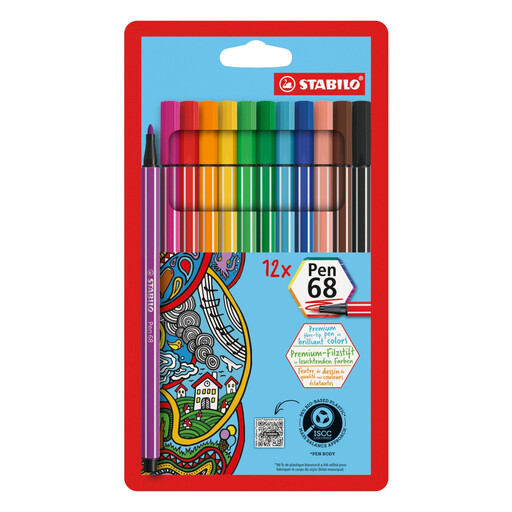
Why this choice suits this profile: A compact assortment to start drawing, colouring and creative journaling on paper, without investing in a multi-surface set.
The 1 mm bullet nib and water-based ink clearly indicate its main use: drawing and colouring on paper, rather than decorating smooth surfaces.
12 coordinated colours, a robust 1 mm nib and anti-dry technology claimed to last up to 24 hours without the cap.
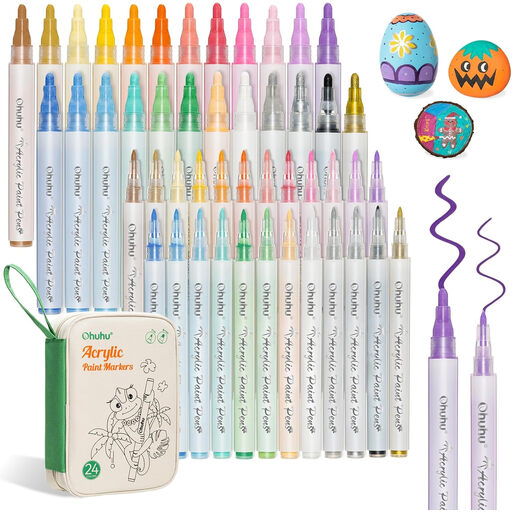
Why this choice suits this profile: A complete set for switching between precision and coverage on stone, wood, fabric, ceramic, glass, plastic and paper.
The two nib formats prevent you from filling large areas with a fine tip or attempting details with a broad tip.
48 markers, 24 coordinated shades and nibs of 0.7 mm, 1.8 to 2 mm and 4 mm, with water-based pigmented acrylic ink.
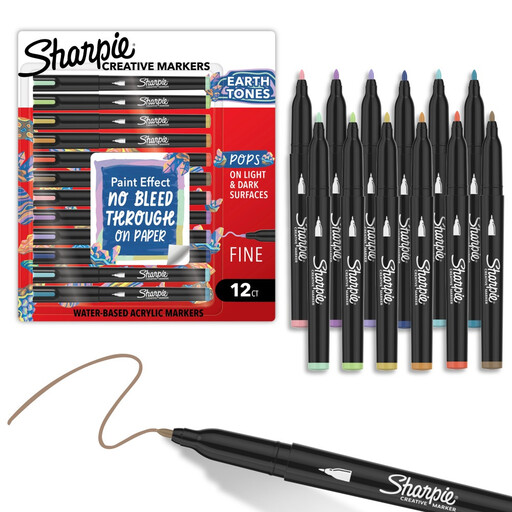
Why this choice suits this profile: A format designed for details, customisation, drawing on stone, glass, ceramic, wood and projects that mix several surfaces.
The fine tip is clearly intended for small details, so you won’t expect it to fill large areas quickly.
A water-based paint-effect ink, colours claimed to be opaque and application without shaking, according to the product listing.
We’ve put together a complete, real-time updated selection of products that meet these demanding criteria and comply with European safety regulations.
The product listing indicates compatibility with glass and ceramic. Clean and dry the surface thoroughly before application, then let the ink dry completely. For an item that’s washed regularly, check the recommendations regarding a finish and test on a small area first.
It depends on how often you use them, whether the cap is closed properly and the storage conditions. Ohuhu markers have an ink level indicator, but no universal lifespan can be guaranteed. A well-closed cap and flat storage help preserve the ink flow.
Acrylic markers lay down a paint-type ink, which is generally more opaque and suited to a wider range of surfaces. Regular water-based felt-tip pens are mainly designed for paper and may be less resistant to moisture or rubbing. The choice therefore depends on the surface and the finish you’re after.