
Livraison le jour même ou le lendemain

Qualité garantie

Débloquez vos offres de bienvenue: Livraison GRATUITE | Jusqu'à -80 % | 30 jours d'essai gratuits à JoyPlus
Téléchargez l'application
A cluttered desk slows down your search for a file, reduces your available workspace and makes daily tasks more difficult. However, choosing office storage furniture isn't simply about comparing prices and appearance. Dimensions, weight capacity, mobility and document security are just as important.
Before buying a mobile filing cabinet, an office storage cupboard or a shelving unit, take the time to identify the most common pitfalls.
A piece of furniture may look compact but offer little internal volume due to thick walls, bulky runners or poor design. For documents, check that the drawers and compartments actually accept the A4 format, cardboard folders and ring binders you use.
Depth also matters. A unit that is too shallow may leave files sticking out, while one that is too deep will waste space around your desk.
A maximum overall weight load does not mean every drawer can support the same weight. For a filing cabinet, check the capacity per drawer, the strength of the runners and the stability of the unit when several compartments are open.
Small, heavy items — tools, samples, rolls or supplies — need a more robust structure than simple storage for lightweight documents.
A lockable filing cabinet lets you keep contracts, invoices and personal documents separate. However, check the type of lock and whether keys are supplied. For tall cupboards, an anti-tip kit and wall fixing are strongly recommended, especially in a home with children or a workshop that is regularly used.
Castors should also have brakes when the unit is used to support a printer or equipment.
Measure the available space, taking into account the opening of drawers and doors. For home office storage, allow enough room to move around and use your chair comfortably.
Metal is suitable for regular use and can generally be cleaned with a soft cloth. A metal storage unit can also work well in a garage or workshop, provided it is protected against persistent damp.
Wood-derived panels with a melamine finish are often lighter and fit easily into an office. However, check the edge protection, the quality of the joints and the surface's resistance to stains.
A pre-assembled unit reduces installation time, while a self-assembly model can be easier to carry up stairs or through narrow spaces. In either case, consult the instructions, check the number of parts and see whether wall fixing is required.
The load should be evenly distributed. Avoid placing a heavy appliance on a shelf if the product specification does not state the permitted static load.
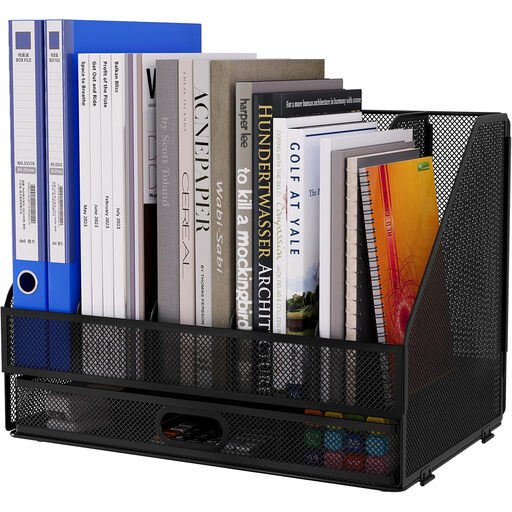
Why this choice suits this profile: This desktop format is ideal for a student, a remote worker or anyone who wants to start organising their files without installing bulky furniture.
Its five vertical compartments and drawer let you group A4 documents and small supplies together in a footprint of approximately 40 × 26 × 30 cm.
A black metal structure, easily accessible compartments and rubber feet that protect your desk surface.
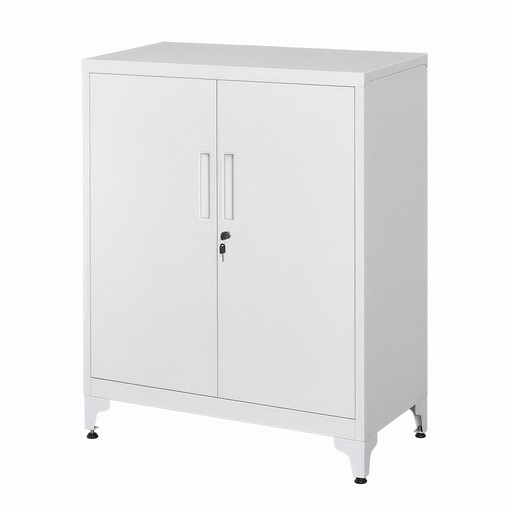
Why this choice suits this profile: This cabinet is suitable for a professional office, a fitted workspace or any area that needs generous storage capacity and a lockable closure.
The two adjustable shelves let you adapt the space to files and supplies, while the two-key lock restricts access to the contents.
A steel construction, dimensions of 80 × 40 × 90 cm, a stated static load of 30 kg for the top and 25 kg per shelf.
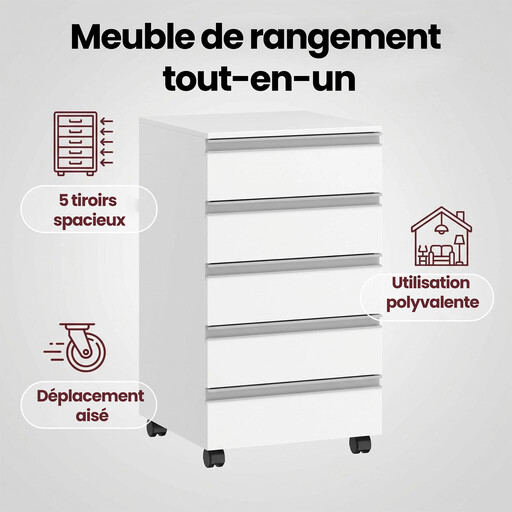
Why this choice suits this profile: This cabinet is designed for studios, workshops and offices where files, tools, samples or accessories are regularly moved around.
Its five drawers, 360-degree swivel castors and two front brakes meet the needs of frequent storage and repositioning.
A size of 40.5 × 40.5 × 65.5 cm, a top that can be used as a support surface and a stated total load capacity of up to 50 kg.
We have compiled a comprehensive, real-time updated list of products that fully meet these strict selection criteria and European safety regulations.
Distribute heavy loads in the lower compartments and avoid overloading a single drawer. For castors, remove dust regularly and check that the brakes work properly. A metal surface can be cleaned with a slightly damp cloth, then dried to minimise marks and residual moisture.
For a narrow bookcase or tall cupboard, use the anti-tip device supplied and choose a wall suitable for fixing. Do not climb on the shelves and follow the manufacturer's load recommendations.
An A4 organiser placed on the desk, a narrow bookcase or a mobile filing cabinet are all suitable options. First measure the available width and check the space needed to open the drawers.
A tall cupboard or multi-level shelving unit should generally be secured according to the manufacturer's instructions. Fixing reduces the risk of tipping, especially when several compartments are open or loaded.
Sort documents by how often you use them. Place files you consult every day in an easily accessible drawer, archives in the lower compartments and everyday supplies in a separate tray. Clearly visible labels avoid unnecessary handling.