What should you check?
For a shared jar, start with the type of recipe you want, then check its nutritional information, ingredients and storage instructions. The DGCCRF states that nutrition declarations for the relevant foods are given per 100 g, providing a common basis for comparison.
| What matters |
What to check |
Who is it for? |
| Added sugars and sweeteners |
Read the exact claim and the ingredients list to distinguish between no added sugars and no sweeteners. |
Some people prefer both criteria when sharing a jar, so they do not immediately offer a sweetened recipe. Around 36% of consumers prioritise this. |
| Sugars and energy |
Compare the ‘of which sugars’ and energy figures per 100 g, rather than relying on the claim on the front of the pack alone. |
If nutritional figures guide your choice for a break, total sugar content matters more than the absence of added sugars alone. Around 29% of consumers prioritise this. |
| Allergens and sharing |
Keep the label accessible and check the allergens highlighted on the jar being served. |
When several colleagues are using the same break area, they need to be able to check whether the recipe is suitable for them. Around 21% of consumers put clear labelling first. |
| Storage and size |
Check where and for how long the product can be stored after opening, taking into account how often the jar will be used. |
If the jar will be open for a long time or there is no fridge available, its storage instructions become crucial. Around 14% of consumers make this their main criterion. |
A spreadable option on Joybuy
To go with biscuits at work, this selection features a blueberry spread. It is a fruit preparation, not a cocoa and hazelnut spread, so choose it if you are happy with this change of category.
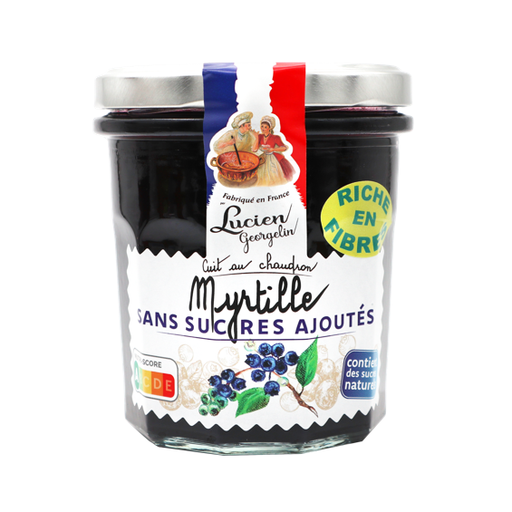 Image unavailable
Lucien Georgelin Blueberry Preparation Ssa 320 g
A blueberry preparation to consider if you would rather spread something on biscuits than choose a cocoa and hazelnut spread. Before leaving the jar in the break area, check its label for sugar content, allergens and instructions for after opening.
View on Joybuy
Frequently asked questions
Does ‘no added sugars’ mean ‘sugar-free’?
No. A recipe with no added sugars may still contain sugars from its ingredients. The 280 g Lucien Georgelin spread listed by Auchan contains 8.5 g of sugars per 100 g. Check the ‘of which sugars’ figure to find out the amount in the product you choose.
Is Nutri-Score compulsory on spreads in France?
No. According to the French Ministry of the Economy, displaying it is voluntary. To compare two jars, check their nutritional information per 100 g and ingredients lists too. The DGCCRF explains the rules that apply to nutrition declarations on pre-packed foods.
What should you check before sharing a recipe containing maltitol?
Make sure maltitol is clearly listed in the ingredients list and that the label is available to everyone. Recipes containing polyols do not meet the ‘no sweeteners’ criterion; Auchan’s product listing for the Karéléa spread warns that excessive consumption may have laxative effects.
Can you keep an opened jar in an office cupboard?
Only if the instructions for the product you choose allow it. Auchan says to store the 280 g Lucien Georgelin recipe at room temperature and consume it within 30 days of opening, while Nutripure recommends refrigerating its recipe.
How can you check allergens when sharing a biscuit tin?
Read the label on the jar being served and leave it where colleagues can access it. The DGCCRF reminds consumers that allergenic ingredients must be highlighted in the ingredients list for the relevant foods. Do not assume they are absent just because the product says ‘no added sugars’.


