
Livraison le jour même ou le lendemain

Qualité garantie

Débloquez vos offres de bienvenue: Livraison GRATUITE | Jusqu'à -80 % | 30 jours d'essai gratuits à JoyPlus
Téléchargez l'application
Invoices, client files, incoming mail, stationery and administrative documents can quickly pile up on a desk. The right office document storage solution should therefore address a practical need: storing a large number of sheets, keeping files within easy reach or freeing up valuable workspace.
To avoid unpleasant surprises, it is best to look beyond marketing claims. A bulky cabinet may not suit a small space, wall-mounted storage requires the right fixings, and a budget organiser can become frustrating to use if it is not compatible with your document format.
A cabinet or file organiser may offer numerous compartments without easily accommodating thick folders. Always check the internal dimensions, not just the external measurements. For standard French administrative documents, A4 measures 21 × 29.7 cm. Folders, punched pockets and ring binders naturally require more room.
An A4 wall-mounted document holder must be fixed to a suitable surface. A lightweight partition, door or plasterboard wall may require specific wall plugs. The screws supplied with a wall-mounted model are not always compatible with the type of surface.
For a wheeled office pedestal, also check whether it has brakes. Without a locking mechanism, the unit may move as soon as you open a loaded drawer.
Powder-coated metal can generally be cleaned with a soft cloth and withstands everyday use well. Melamine board can work well in an office or workshop, provided it is protected from persistent moisture and the edge finishing is of good quality. For PVC pockets, thickness, punching and the capacity of each compartment matter more than the material’s transparency alone.
For everyday use, prioritise A4 compatibility. If you use pockets or handle bulky documents, A4XL offers greater convenience. A4 binder dividers make it easy to organise files by client, period, project or subject.
An organiser with labels or colour-coded tabs speeds up document identification. For papers that still need attention, a mail sorter or letter tray can be organised into simple categories: “To process”, “To file” and “To archive”.
A unit intended for files and stationery must support the weight of binders, paper reams or small equipment without becoming unstable. Check the maximum load specified by the manufacturer, the type of drawer runners and whether the castors have brakes.
For confidential documents, a lockable drawer provides additional protection, although it does not replace internal data-retention policies. In a business environment, sensitive documents should remain accessible only to authorised personnel.
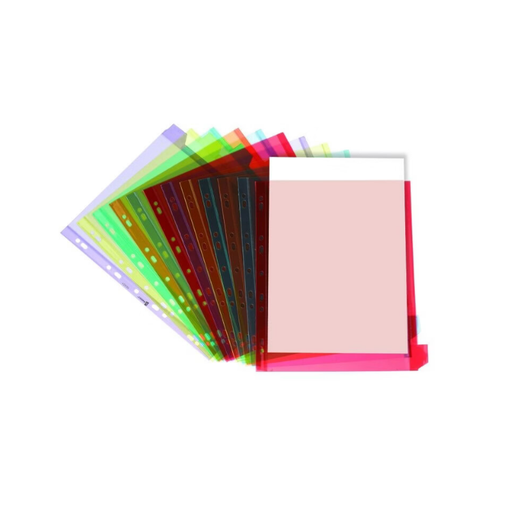
Why this choice suits the profile: this solution is ideal for students, remote workers and individuals who want to structure their binders without adding another piece of furniture.
The A4XL format leaves more room around the sheets. The nine punched holes are advertised as compatible with French binders.
Pack of 12 pockets, tabs in six colours, Bristol labels included and a stated capacity of approximately 25 sheets per pocket.
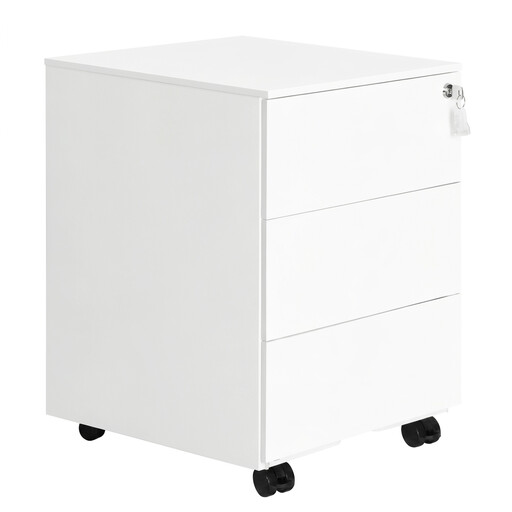
Why this choice suits the profile: this wheeled office pedestal is suitable for professionals and individuals who want to keep files, stationery and small accessories close to their workstation.
Its dimensions of 45 × 39 × 55 cm must be checked against the available space. The two braked castors should be locked when the pedestal is in position.
Steel construction, three lockable drawers, a stated load capacity of 15 kg per drawer and pre-assembled delivery, with only the castors requiring installation.
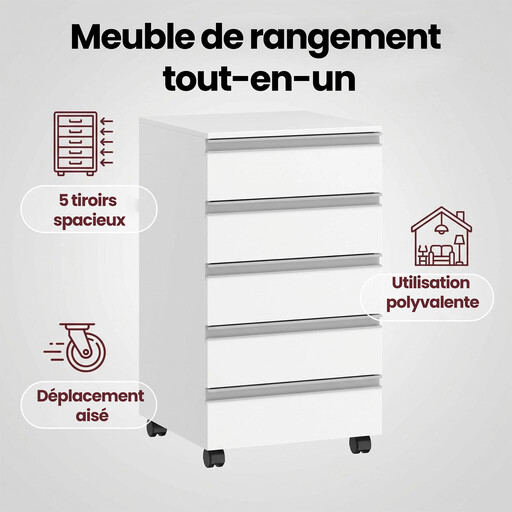
Why this choice suits the profile: workshops, studios, classrooms and businesses can store numerous files or supplies in its five deep drawers and on its top surface.
With dimensions of approximately 40 × 40 × 66 cm, this unit requires a dedicated location. Distribute the load between the drawers and lock the castors before handling the cabinet.
Five drawers, 360-degree swivel castors, two front brakes, a top surface and a stated total load capacity of up to 50 kg.
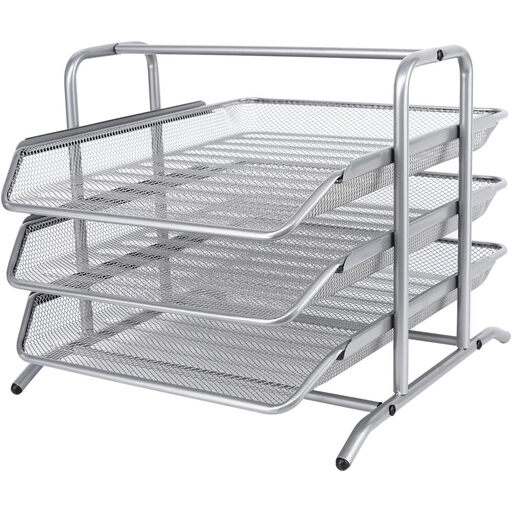
Why this choice suits the profile: this organiser is ideal for daily post, active files and papers you want to keep close at hand on your desk.
The sliding trays should rest on a level surface. Avoid overloading them and do not pull them out fully when their contents are heavy.
Three removable trays, advertised compatibility with A4 documents, rubber feet and a powder-coated metal frame.
We have brought together an updated selection of products meeting precise office storage and organisation criteria.
Whether you work from home or in an office, start by sorting documents according to their status:
A multi-tier wall organiser can accommodate one category per compartment. A mobile pedestal is better suited to archives and files that are consulted less frequently. Within each binder, coloured tabbed pockets can then provide a more detailed filing system.
For a few files consulted every day, a letter tray or desk organiser will be sufficient. If the volume increases, choose an A4 wall-mounted document holder or a drawer pedestal. Always remember to check the usable depth for folders and pockets.
Identify the wall structure, choose suitable wall plugs and distribute documents between the compartments. After installation, regularly check that the screws remain tight and do not exceed the maximum load specified by the manufacturer.
Keep papers in a dry place away from heat sources and direct sunlight. Protect plastic pockets from sharp objects and replace them as soon as they become punctured or deformed.