Selection criteria
Measure your busiest break periods before comparing machines: capacity per cycle, stated daily capacity and access to maintenance components all address different needs.
| Priority |
What to check |
Your needs |
| Break-time output |
Compare the capacity per preparation, the number of cups that can be made at once and the stated daily capacity. Tank capacity alone does not define output. |
I want to serve several colleagues without restarting the machine halfway through a break. For shared filter coffee, a full cycle may be more useful than serving one cup at a time. |
| Shared maintenance |
Check access to the water tank, grounds container, drip tray and cleaning programmes. Also check the alerts and maintenance tasks specified in the manual. |
I want to avoid a full container, limescale or residue interrupting service because nobody is responsible for dealing with it. |
| Consumables |
Identify the format used: filter, beans, coffee pods or capsules. Check the available pack sizes, storage space and waste management arrangements. |
The system must be easy for the team to order and replenish, without last-minute purchases. |
| Space and access |
Measure the worktop and allow enough clearance to remove the tank, trays and lids. Check access to water for refilling. |
I am looking for a machine that does not get in the way of the break area and remains easy to fill and clean. |
Joybuy options
These Joybuy options cover bean-to-cup and capsule machines for a small team looking for individual serving, with particular attention to available space and maintenance routines.
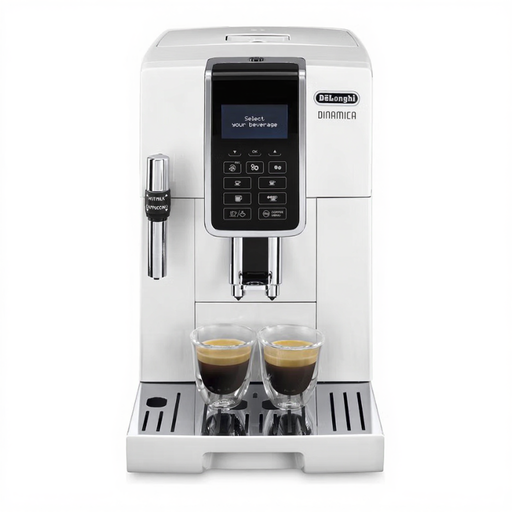 Image unavailable
White De’Longhi Dinamica ECAM350.35.W automatic coffee machine
For a small team wanting freshly ground coffee on demand, with two cups prepared at once and an assigned maintenance routine.
Removable 1.8 L tank, 250 g bean container, and grind, aroma, temperature and volume settings. Check that it suits your actual daily usage, as no maximum daily output is specified here.
The grounds container and descaling cycles still need to be assigned to an individual or a rota.
Joybuy
 Image unavailable
Black Philips EP2230/10 Series 2200 LatteGo
A bean-to-cup option for a team wanting several drinks and front access to the maintenance components.
1.8 L tank, 275 g bean container, grounds container for 12 pucks, 12-setting grinder and two-cup function. The brew group is removable and some parts are advertised as dishwasher-safe.
Check your expected daily usage and break-time peaks. The AquaClean filter is listed as compatible, but is not included.
Joybuy
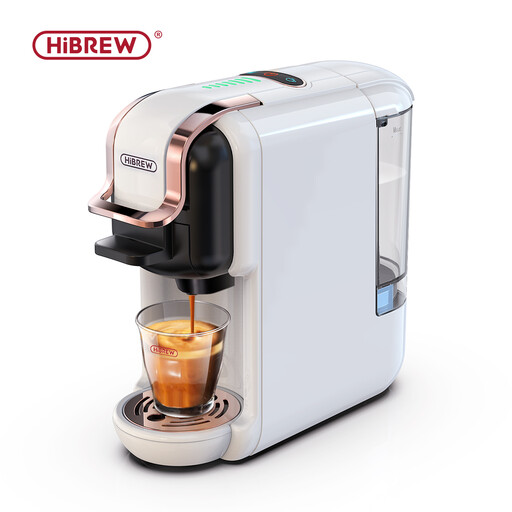 Image unavailable
HiBREW H2B 5-in-1 capsule coffee machine
For a compact office where users choose between several capsule formats, ESE pods or ground coffee.
Advertised compatibility with several capsules, ESE pods and ground coffee; 600 ml tank, hot and cold modes, 245 × 110 × 245 mm dimensions and automatic shut-off.
Check which adapter matches your team’s consumables and the capacity required during simultaneous breaks. Regular descaling is required.
Joybuy
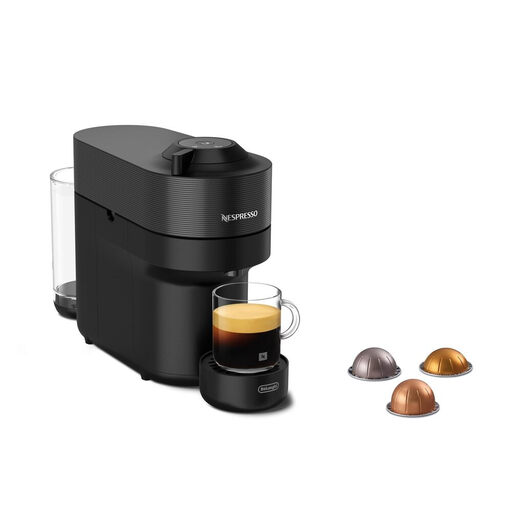 Image unavailable
Black Nespresso Vertuo Pop ENV90.B compact coffee machine
Suitable for simple individual serving in a small space, with five advertised cup sizes.
One-button operation, 0.6 L tank, automatic ejection and a container advertised as holding eight capsules. The machine includes a descaling procedure.
The small water tank and capsule container require regular refilling and emptying when used by a group.
Joybuy
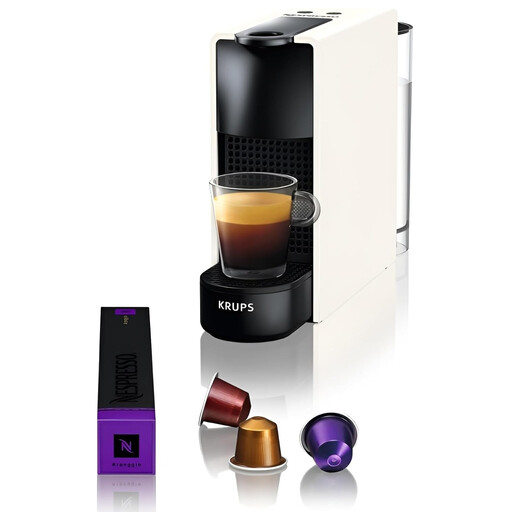 Image unavailable
White KRUPS Nespresso Essenza Mini 0.6 L
A highly compact solution for one cup at a time, with no complex settings, in a restricted break area.
Dimensions of 8.4 × 33 × 20.4 cm, removable 0.6 L tank, two programmable sizes, advertised 25-second heat-up time and a container for six capsules.
Refilling, emptying and stocking Nespresso Original or compatible capsules must be organised if several people use it.
Joybuy
Frequently asked questions
Is a coffee machine compulsory in an office in France?
No. The French Labour Code requires employers to provide drinking water that is safe and fresh; it does not require them to provide a coffee machine. Coffee is therefore an optional workplace facility and does not replace access to drinking water.
At what volume should you consider a professional machine?
Calculate daily cups and break-time peaks rather than relying solely on the number of employees. JURA recommends the WE6 for up to 30 cups a day and positions its professional range for between 10 and 200 cups per day; for a domestic machine, check whether the manufacturer publishes a daily capacity for the exact model.
Who should clean a shared coffee machine?
Appoint one person and a back-up. The task list should cover water, beans or capsules, the grounds or capsule container, the drip tray and the required programmes; De’Longhi and JURA point out that oils, limescale and residue require regular maintenance.
How can you reduce limescale-related downtime?
Set the water hardness according to the model’s manual, monitor the alerts and carry out the specified descaling procedures. In its professional guide, Javry cites limescale build-up, insufficient maintenance, unsuitable settings, wear and overuse among the possible causes of breakdowns.
Should you plan how to sort capsules and coffee grounds?
Yes. Arrange the appropriate containers and disposal route as soon as you choose the system. The French Ministry for Ecological Transition states that businesses are subject to waste-sorting obligations covering several waste streams; the practical arrangements depend on the waste produced and local collection services.


