
Livraison le jour même ou le lendemain

Qualité garantie

Débloquez vos offres de bienvenue: Livraison GRATUITE | Jusqu'à -80 % | 30 jours d'essai gratuits à JoyPlus
Téléchargez l'application
The call of the open road and the great outdoors has never been stronger. For owners of RVs, camper vans, or even just camping enthusiasts, energy independence is the key to total freedom. However, putting together your off-grid solar kit can quickly become a headache. Between marketing promises and opaque technical jargon, a costly mistake is just around the corner.
Before you dive in, let's review the most common and expensive traps that catch unwary travelers.
Fortunately, mastering a few technical concepts is all it takes to guard against these disappointments.
To build a camping power solution that is reliable and durable, focus on these three technical pillars. They are your guarantee of performance and longevity for your setup.
The heart of your system is the battery. Forget the simple nominal capacity (in amp-hours, Ah) and focus on two crucial points:
The panel is your generator. Its ability to convert light into electricity depends on several factors:
This is the technical point that is too often overlooked, yet it is crucial. Make sure all the components of your kit "speak the same language." Verify that the solar panel's output voltage is compatible with what your charge controller can accept, and that the controller is correctly configured for your battery type (LiFePO4, AGM, etc.). Finally, examine the connectors: the most common standards are MC4 for panels and Anderson or XT60 for connections to batteries or power stations. A kit that includes adapters is a significant advantage.
Rather than an impersonal list, we've matched equipment to traveler profiles to help you find the solution that truly fits your needs.
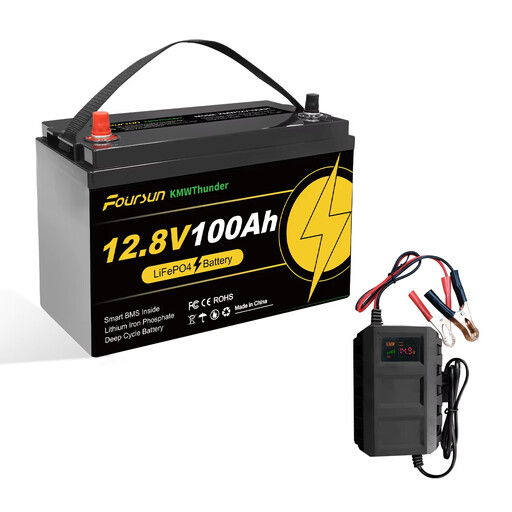
Why we chose it: For those who live in their vehicle or embark on long expeditions, a large and reliable power reserve is essential. This lithium battery for RVs is the cornerstone of a system designed to last and power multiple devices (laptop, refrigerator, lights) for several days.
It avoids the 'ghost' capacity trap. Thanks to its LiFePO4 chemistry, its 100 Ah are almost entirely usable, unlike a lead-acid battery. Its integrated BMS protects the investment over the long term.
Lifespan of over 4,500 cycles and the ability to connect in series or parallel to expand the system (up to 48 V or 800 Ah).
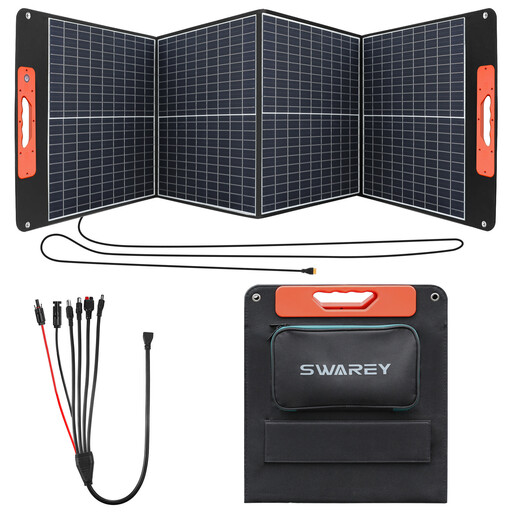
Why we chose it: Ideal for weekend getaways or as a supplement to an existing setup. Its portability and direct outputs (USB-C PD 60W) make it a versatile tool for quickly charging laptops, tablets, and phones, even without an auxiliary battery.
It overcomes the trap of low real-world efficiency. Its clever integrated 'Ray Tracer' solar sight helps you find the optimal angle in seconds, maximizing energy production and beating the illusion of 'peak' power.
High efficiency of 23% (monocrystalline cells) and wide compatibility thanks to the included 5-in-1 cable (Anderson/MC4/DC), which prevents connector issues.
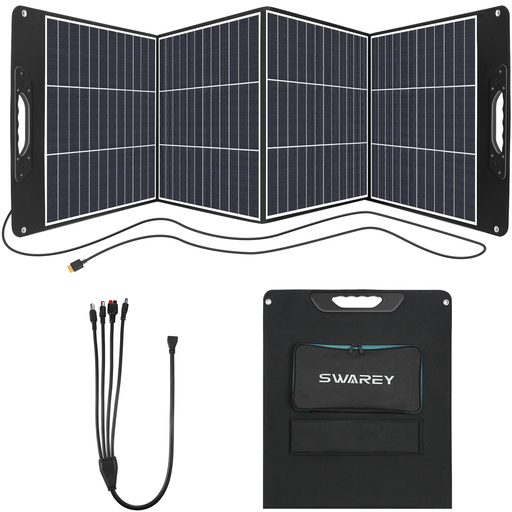
Why we chose it: For those with high energy demands (multiple laptops, tools, small appliances) who want to recharge a large-capacity battery (like the Foursun 100Ah) as quickly as possible. This is the solution for near-total independence, even in overcast weather.
It tackles the trap of underestimating your needs head-on. With 200 W of power, it ensures a fast and efficient recharge of a large battery, guaranteeing you won't run out of power, even after a cloudy day.
200 W of power for rapid charging, combined with a manageable weight (5.5 kg) and a foldable design. The self-cleaning coating helps maintain high efficiency in outdoor conditions.
We've compiled a complete, up-to-date selection of products that meet our strict selection criteria and safety standards.
The calculation depends on your consumption. Add up the wattage of all the devices you plan to use and estimate their daily usage duration. For example: a laptop (50?W) used 4h/day and an LED light (10?W) used 5h/day consume (50x4) + (10x5) = 250?Wh/day. To recharge this in 5 hours of average sunlight, you would need a panel producing at least 50?W (250?Wh / 5h). Always plan for a 20% to 30% buffer: a 100?W to 200?W panel is a good starting point for moderate use.
A good quality LiFePO4 battery is built to last. Most manufacturers advertise between 2,000 and 5,000 full charge/discharge cycles. If you use your battery daily, this represents a potential lifespan of over 10 years, far exceeding the 2 to 4 years of a traditional lead-acid battery.
For the simplest systems (foldable panel, portable power station), installation is often "plug-and-play" and requires no special skills. For a fixed installation on a vehicle's roof, involving a charge controller and connections to the 12V circuit, basic electrical knowledge is recommended to ensure safety. When in doubt, it's always wise to consult a professional.