People keeping an eye on fat limits
If you want to choose according to the regulatory ‘low fat’ criterion, compare the nutritional values per 100 ml. Regulation (EC) No 1924/2006 sets the limit for drinks at 1.5 g per 100 ml.


To choose an oat drink that meets the ‘low fat’ criterion, start with the value per 100 ml: Regulation (EC) No 1924/2006 sets a maximum of 1.5 g of fat per 100 ml of drink for this claim. Then check the sugars, ingredients and allergens of your chosen variant separately: ‘no added sugars’ does not mean 0 g of sugars, and ‘lactose-free’ does not mean allergen-free.
If you want to choose according to the regulatory ‘low fat’ criterion, compare the nutritional values per 100 ml. Regulation (EC) No 1924/2006 sets the limit for drinks at 1.5 g per 100 ml.
A plant-based drink may suit your needs, but check the recipe and allergen declaration for the specific product. Oats are still a consideration: ‘lactose-free’ does not guarantee ‘gluten-free’.
If froth or texture in a hot drink matters to you, check what the variant is designed for. Also check its fat content per 100 ml if this remains a priority.
First compare the fat content per 100 ml, then choose between variants according to your main priority: sugars, ingredients to avoid or use in coffee.
| Criterion | What to check | Who is it for? |
|---|---|---|
| Fat | Compare the value per 100 ml with the 1.5 g per 100 ml limit set by Regulation (EC) No 1924/2006 for the ‘low fat’ claim. | If my main aim is to stay within this limit, a drink that simply feels light isn’t enough. Around 33% of consumers would put this criterion at the top of their list. |
| Lactose and allergens | Read the ingredients and allergen declaration; look for an indication that applies to the specific substance you avoid. | If I’m avoiding dairy products, I need to distinguish this from the possible presence of gluten or other allergens. Around 27% of consumers would make this their priority. |
| Sugars | Check the ‘of which sugars’ line per 100 ml: ‘no added sugars’ and 0 g of sugars are not the same thing. | When comparing two drinks with no added sugars, I want to know how much sugar each one actually contains. Around 27% of consumers would make sugars their main criterion. |
| Use in coffee | Check what the variant is designed for, then look at its fat content per 100 ml. | When making a frothy coffee, I prioritise how the drink performs without assuming that a barista formula meets my fat limit. Around 13% of consumers would put this use first. |
Under Regulation (EC) No 1924/2006, the 1.5 g of fat per 100 ml limit applies to the ‘low fat’ claim on a drink. Carrefour lists 1.8 g per 100 g on its product page for Alpro Oat No Sugars. This value, expressed per 100 g, cannot be directly compared with the limit expressed per 100 ml.
For this variant, check the value per 100 ml on the label before deciding whether it meets the criterion.
The E.Leclerc product page for Bio Village Oat No Added Sugars lists 5.0 g of sugars per 100 ml. So the absence of added sugars does not, by itself, tell you how much sugar the drink contains.
If you’re looking for a specific value, compare the ‘of which sugars’ line per 100 ml.
Oat drink contains oats, and some products also declare gluten. Avoiding lactose does not automatically address a need to avoid another ingredient or allergen.
Check the allergen declaration on the packaging of the variant you buy, according to the substance you need to avoid.
Joybuy’s product page for Alpro Barista Oat lists 3 g of fat per 100 ml, above the 1.5 g per 100 ml limit set by Regulation (EC) No 1924/2006 for the ‘low fat’ claim. ‘Barista’ describes how a product is intended to be used, not a nutritional value shared by every variant.
If you want a drink for coffee while staying within this limit, check the value for the specific product.
The range includes Oat No Sugars and a Barista Oat variant.
The range includes No Sugars and Barista Edition, designed for different uses.
Carrefour offers a 1 L organic oat drink described as having no added sugars.
E.Leclerc offers a 1 L organic oat drink with no added sugars.
Auchan offers an organic oat drink with no added sugars.
These oat drinks suit different needs: a multipack, a NATRUE version labelled ‘0%’ and a Chai Latte variant. Compare the nutritional information and allergens for each product according to your priorities.
 Image unavailable
This pack of three cartons is a convenient choice if the pack size suits your needs. If you’re choosing based on a fat limit or sugar content, compare the values per 100 ml for this variant before you buy.
 Image unavailable
If you’re looking for a specific fat or sugar content, check the nutritional values on this 1 L oat drink carefully. Don’t assume the ‘0%’ claim applies to every nutrient; check the allergen declaration on the packaging too.
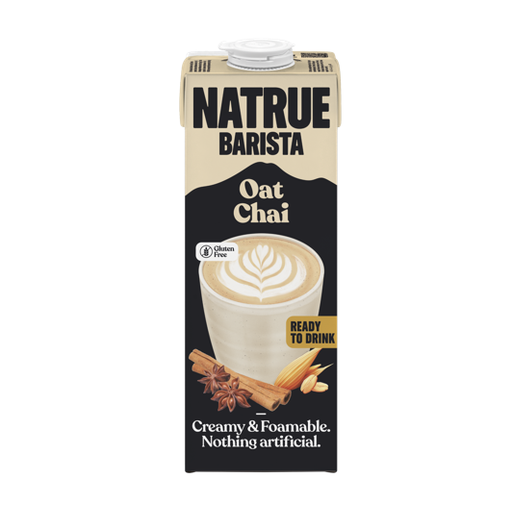 Image unavailable
This Chai Latte variant is for anyone looking for this flavour rather than a plain oat drink. If fat or sugar content influences your choice, check the values per 100 ml for the specific product, along with its allergen information.
Regulation (EC) No 1924/2006 sets a maximum of 1.5 g of fat per 100 ml for a drink carrying this claim. Compare the value per 100 ml for the variant you’re thinking of buying.
No: a drink with no added sugars may still contain sugars from its ingredients. For example, E.Leclerc lists 5.0 g of sugars per 100 ml for Bio Village Oat No Added Sugars, while Auchan lists 0 g per 100 ml for Oatly No Sugars.
Not necessarily: ‘lactose-free’ does not, by itself, tell you whether a drink contains gluten or other allergens. Some oat drink product pages declare gluten; check the allergen declaration for each product.
Follow the instructions on your chosen carton, particularly after opening. Oatly says its No Sugars carton can be stored at room temperature before opening; this does not replace the storage instructions for another product.