Hosts who compare fat content first
You’re looking for an oat drink to serve or cook with, and total fat content is your top priority. Depending on the product, listings from E.Leclerc, Auchan and Carrefour show between 1.2 g and 1.8 g per 100 ml.


To choose an oat drink to serve or cook with at a dinner party, compare the fat and sugar content of the exact product, using the same unit of measurement. E.Leclerc’s Bio Village listing shows 1.2 g of fat and 5.0 g of sugars per 100 ml, despite the “no added sugars” claim; Auchan’s listing for Oatly No Sugars shows 1.5 g and 0 g respectively per 100 ml. Check the ingredients, allergens and storage instructions too, before your guests arrive.
You’re looking for an oat drink to serve or cook with, and total fat content is your top priority. Depending on the product, listings from E.Leclerc, Auchan and Carrefour show between 1.2 g and 1.8 g per 100 ml.
Whether you’re making a sauce, dessert or drink, you want to know the actual sugar content shown on the label. The “of which sugars” line is more useful for this than the “no added sugars” claim alone.
Before serving a group, check the ingredients and allergens in the carton you’ve chosen, as well as its storage instructions. The product category alone isn’t enough to establish whether it’s suitable for everyone.
For a dinner with friends, start with the factor that matters most for your recipe or guests, then check the other details for the product you plan to serve.
| Criterion | What to check | Who is it for? |
|---|---|---|
| Total fat | Compare the “fat” line using the same unit of measurement; don’t rely solely on the saturated fat figure. | When preparing dinner, I want to compare total fat rather than rely on a claim on the front of the pack. Around 42% of consumers would put this content at the top of their list of concerns. |
| Sugars and the taste you’re looking for | Check “of which sugars” in the nutritional information, and distinguish this figure from the “no added sugars” claim. | In a savoury dish, I want to avoid an unexpected sweet note. Nearly 33% of consumers would prioritise the stated sugar content and the taste they’re looking for. |
| How you’ll use it and who’s coming | Check the ingredients, allergens and storage instructions. If you’re using the drink in a recipe, check the recommended use for that specific product. | Before serving my guests, I need to consider their dietary requirements and how I’ll use the drink. Around 25% of consumers would make this practical suitability their first criterion. |
E.Leclerc’s listing for Bio Village shows 5.0 g of sugars per 100 ml, despite the “no added sugars” claim. Auchan’s listing for Oatly No Sugars shows 0 g per 100 ml, so these two products don’t meet the same stated sugar criterion.
Check the “of which sugars” line on the carton you’ve chosen before using it in a sauce or dessert.
A statement about saturated fat doesn’t, on its own, tell you the total fat content. This varies between products whose listings give values per 100 ml.
Compare the total fat figures using the same unit, then consider the sugar content and intended use.
Carrefour’s listing for Alpro Oat No Sugars shows 1.8 g of fat per 100 g, while a Joybuy listing for a different Alpro oat drink shows 3 g per 100 ml. Don’t assume the values and units apply to every product from the brand.
Match the full product name and carton size to the nutritional information you’re checking.
Ingredients, allergens and storage conditions matter just as much as your choice of recipe when guests have dietary requirements.
Ask which dietary requirements you need to take into account, then check the label and storage instructions on the product you buy.
The range includes No Sugars and Fibre Low-Calorie, two products that are distinct from Oatly Original.
Carrefour describes Alpro Oat No Sugars as suitable for sweet or savoury recipes, with added calcium and vitamins.
Carrefour describes its Sensation oat drink as enriched with calcium, fibre and vitamins.
E.Leclerc describes Bio Village organic oat drink as having “no added sugars”.
Lidl has listed Vemondo organic oat drink in a pack of eight 1 L cartons.
These products may be worth considering for serving an oat drink or preparing dinner. Check the product variant and its nutritional information: the Oatly Original products below are not Oatly No Sugars.
 Image unavailable
If you’re serving this oat drink, check the fat and sugar content on the carton: the “0%” in the name doesn’t replace these figures. Before using it in a recipe, check the recommended use on the packaging, as well as any allergens and potential traces listed.
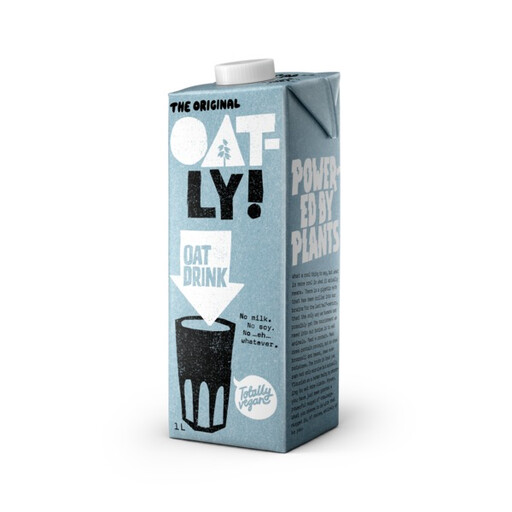 Image unavailable
If you’re using this drink in a recipe, check that its flavour and stated sugar content suit the dish. This is the Original variant, not No Sugars; check the allergens on the carton before serving it too.
 Image unavailable
This three-carton pack may be a good option if you need several portions for dinner. Check the variant, sugar and fat content, and allergens on the cartons before choosing it for your recipe and guests.
No: E.Leclerc’s listing for Bio Village uses this claim but shows 5.0 g of sugars per 100 ml. If this figure matters for your recipe, check the “of which sugars” line for the product you buy.
Of the products listed with values per 100 ml, Bio Village shows 1.2 g of fat, compared with 1.5 g for Oatly No Sugars according to Auchan and 1.8 g for Carrefour Sensation according to Carrefour. This alone doesn’t tell you about the sugar content, suitability for cooking or the exact variant you’ll buy.
Ask your guests about any relevant dietary requirements, then check the ingredients and allergens on every carton you plan to serve. France’s DGCCRF reminds consumers that allergens must be highlighted on the labels of prepacked foods sold in France.
No: follow the instructions for the product you buy, both before and after opening. A carton sold in the chilled aisle and a long-life carton may need different storage conditions before opening.