Anyone comparing sugar and energy content
If you pour oat drink into coffee, cereal or a smoothie, the figures per 100 ml and the amount you use tell you more than the claim on the front of the pack alone.


When choosing an oat drink as part of your weight-management shopping, compare the energy and sugars per 100 ml, then consider how much you actually pour. ‘No added sugars’ does not mean ‘sugar-free’. If you regularly use it instead of milk, check whether your chosen product is fortified too, as Public Health France points out that plant-based drinks have a different nutritional profile. Finally, check the net volume on the packaging: the words ‘4 pint’ alone do not confirm that it is a 2 L bottle.
If you pour oat drink into coffee, cereal or a smoothie, the figures per 100 ml and the amount you use tell you more than the claim on the front of the pack alone.
If oat drink often takes the place of milk, check the ingredients and fortification of each product. Public Health France points out that plant-based drinks and milk have different nutritional profiles.
A multipack may suit regular use if you have room to store the cartons and can follow the storage instructions once they’re opened. Check the actual pack format rather than assuming a larger quantity comes in a single bottle.
Start with the nutrition information and your usual serving size. Then check fortification if the drink is replacing milk, followed by whether your household can use the pack without opening several cartons at once.
| Criteria | What to check | Who is it for? |
|---|---|---|
| Sugars and energy | Compare the energy and ‘of which sugars’ figures per 100 ml, then consider how much you use. The claim ‘no added sugars’ does not, by itself, tell you the total sugar content. | When I make a large coffee or a smoothie, I want to know what I’m actually pouring. Around 40% of consumers put checking sugar and energy content at the top of their list. |
| Fortification | Check whether calcium and vitamins are listed for the specific product you’re buying. | If I often replace milk, I want to know what’s in my new drink rather than assume the two products are equivalent. Fortification is the top priority for around 30% of consumers. |
| Pack size and storage | Check the net volume of each container, the number of cartons and the instructions for storage after opening. | When my household uses it regularly, I prefer to space out shopping trips without opening more cartons than we can use. Around 30% of consumers prioritise this type of packaging. |
E.Leclerc’s Bio Village listing shows 5.0 g of sugars per 100 ml for its ‘no added sugars’ oat drink.
Check the ‘of which sugars’ and energy figures per 100 ml, then relate them to your serving size.
The instructions apply to each carton once opened: Auchan says the Natrue product on its listing should be kept in the fridge and used within 3 to 4 days of opening.
Check the instructions for each product and open cartons at the rate you use them.
If several cartons are open at once, you may have to throw them away if you can’t use them within the stated timeframe.
The wording alone does not specify the product’s net volume. A multipack of several 1 L cartons is not the same as a single bottle.
Check the product listing for the volume and number of containers before choosing a pack size for your household.
Public Health France explains that plant-based drinks have a different nutritional composition from milk, and fortification varies by product.
If you often replace milk, check the ingredients and nutrition information for the drink you choose.
These products illustrate some of the ingredients and pack formats you can compare. The details given apply to the named products, not every drink from each brand.
The Alpro Oat product listed by Auchan is a 1 L oat drink.
Oatly offers several 1 L oat drinks, including Original, No Sugars and Barista products.
Carrefour offers 1 L oat drinks including Carrefour Bio and Carrefour Sensation.
E.Leclerc offers a 1 L carton of Bio Village ‘no added sugars’ oat drink.
Auchan offers a 1 L Natrue oat drink.
On 30 September 2026, Lidl featured a Vemondo organic oat drink multipack of 8 × 1 L.
These products let you compare two multipacks of three 1 L cartons with a single 1 L carton. If you’re shopping with weight management in mind, check the nutrition information for each variant and the volume your household will use. None of these packs is a single 2 L bottle.
 Image unavailable
This multipack may suit your household if you use oat drink regularly and prefer to open the cartons one at a time.
Pack size listed: three 1 L cartons. To compare this variant with another, check its nutrition information per 100 ml and its storage instructions after opening.
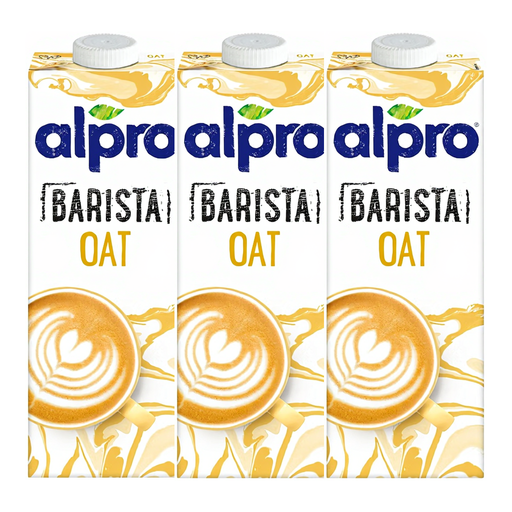 Image unavailable
This Barista multipack is for households that use oat drink regularly, particularly in coffee.
Pack size listed: three 1 L cartons. Check the nutrition information for the Barista variant itself rather than applying figures from another Alpro drink.
 Image unavailable
A single carton may suit you if you’d rather choose the quantity one at a time than buy a multipack.
The name indicates a 1 L pack. To understand what ‘0%’ means, check the label and nutrition information for this variant; don’t assume they’re the same as those for another Natrue drink.
No. The claim refers to added sugars, while the ‘of which sugars’ line gives the total amount declared. For example, E.Leclerc’s Bio Village listing shows 5.0 g of sugars per 100 ml for its ‘no added sugars’ oat drink.
Check the ingredients and fortification of the specific product, particularly the declared levels of calcium and vitamins. Public Health France points out that plant-based drinks have a different nutritional composition from milk, so the brand name alone doesn’t establish that they’re equivalent.
Follow the instructions on the carton you buy, as they vary by product. For the Natrue drink featured by Auchan, the listing says to keep it in the fridge and use it within 3 to 4 days of opening.
No. Ordinary oat drink should not replace breast milk or infant formula. ANSES highlights the risks of doing so from birth to 1 year old. Ask a healthcare professional for advice on feeding an infant.