People looking for a low-fat option
You want to compare the total fat per 100 ml, rather than relying on claims such as ‘plant-based’ or ‘no added sugars’.


To choose an oat drink that meets the ‘low fat’ criterion, check that it contains no more than 1.5 g of fat per 100 ml. This is the limit for liquids set by European Union Regulation (EC) No 1924/2006. If you’re shopping with an allergy in mind, also check the ingredients and relevant statements on the specific carton: a plant-based drink or one with no added sugars isn’t automatically suitable.
You want to compare the total fat per 100 ml, rather than relying on claims such as ‘plant-based’ or ‘no added sugars’.
You’re looking for an alternative to cow’s milk, but need to check the ingredients in each oat drink against the allergy in question and any other ingredients you need to avoid.
You need information that applies to the specific product you’re buying: seeing ‘oat’ in the product name alone isn’t enough to determine whether it contains gluten.
First check for ingredients you need to avoid because of an allergy. Then compare the fat content per 100 ml, and finally check whether the recipe suits how you plan to use it.
| Criterion | What to check | Who is this for? |
|---|---|---|
| Allergens | Read the ingredients, highlighted allergens and any ‘may contain’ statements on the carton you’re buying. | If I need to avoid a particular ingredient, I want to check the full recipe before considering the nutritional values. Around 50% of consumers put allergen checks first. |
| Fat | Compare the total fat per 100 ml with the limit of 1.5 g for liquids set by European Union Regulation (EC) No 1924/2006. | To choose a low-fat oat drink, I need a value I can compare from one carton to another. Fat content is the main consideration for around 30% of consumers. |
| Recipe and use | Check the ‘of which sugars’ line, any added ingredients and the storage instructions for the product you’ve chosen. | If I’m looking for a drink to have with cereal or use in a hot recipe, I want its recipe to suit that purpose too. Around 20% of consumers prioritise the recipe and how they’ll use it. |
These claims refer to different characteristics. The E.Leclerc Bio Village and Auchan Bio product listings each show 1.2 g of fat and 5 g of sugars per 100 ml, even though the drinks are described as having no added sugars.
Check the ‘fat’ and ‘of which sugars’ lines separately in the nutrition information.
The oat drinks reviewed contain oats, and depending on the recipe, other ingredients may also affect your choice. For example, the Auchan Barista drink contains pea protein according to its product listing.
Identify the ingredients you need to avoid based on your personal guidance, then check the ingredients and allergen statements for the product you’re buying.
The ‘low fat’ criterion for liquids under European Union Regulation (EC) No 1924/2006 applies to total fat, with a limit of 1.5 g per 100 ml. A statement that refers only to saturated fat doesn’t answer this question.
Compare the ‘fat’ line on the same per-100-ml basis. If a product listing gives a value per 100 g, check the carton’s labelling before comparing it.
The details below apply to the specific products listed, not every drink from each brand. If you have an allergy, the label on the product you choose is what matters.
Carrefour’s listing for Alpro Oat No Sugars states that oats are among the ingredients.
Carrefour’s listing for Oatly Oat No Sugars describes a recipe containing oats and rapeseed oil.
E.Leclerc publishes nutritional information for its Bio Village organic oat drink with no added sugars.
Auchan’s listings distinguish between an organic drink with no added sugars and an oat-based Barista drink.
Lidl offers an organic Vemondo oat drink.
These two oat drinks suit different uses: a plain drink for cereal or cooking, and a chai version to enjoy on its own or warm. Check their nutritional information and ingredients on the pack before choosing one to suit your needs.
 Image unavailable
For cereal or cooking, check the fat per 100 ml on the carton rather than treating ‘0%’ as a precise nutritional value.
Oats and possible traces of soya or nuts are indicated. If you need to avoid gluten, check the statement on the pack for this product.
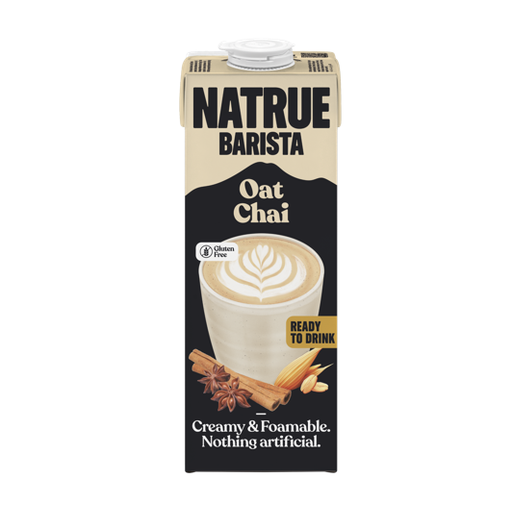 Image unavailable
If you’re looking for a chai drink to enjoy on its own or warm, compare its fat and sugars per 100 ml with those of an unflavoured drink too.
This recipe contains oats, spices and black tea extract; possible traces of soya or nuts are indicated. Check these statements against the ingredients you need to avoid.
Look for no more than 1.5 g of fat per 100 ml: this is the limit for liquids set by European Union Regulation (EC) No 1924/2006. Compare the ‘fat’ line in the nutritional information on the carton you’ve chosen, using the same unit.
No. Being plant-based doesn’t replace checking the ingredients for the allergy in question. In particular, check for ingredients you need to avoid, allergen statements and any guidance you’ve been given. The oat drinks reviewed contain oats.
No. Look for a clear statement that applies to the specific product and follow the guidance relevant to your situation. Carrefour’s listing for a Bjorg drink describes the oats among its ingredients as ‘gluten-free’, but this information doesn’t apply to other oat drinks.
No. E.Leclerc Bio Village and Auchan Bio listings describe oat drinks as having no added sugars, while still showing 5 g of sugars per 100 ml. Check the ‘of which sugars’ line if this value affects your choice.
Follow the instructions printed on the carton you’ve bought. Before opening, Oatly distinguishes between its products sold in the chilled aisle and cartons that can be stored at room temperature. This distinction doesn’t replace the instructions for each product once opened.