People making a dairy-free cake
You’re looking for an oat drink to replace the milk in your batter. Oatly lists its products as suitable for cooking and baking on the product pages reviewed.


To replace the liquid milk in a cake, start with an unflavoured oat drink that is listed as suitable for cooking or baking. Then check its sugar content, ingredients and, if necessary, whether it is labelled “gluten-free”. Two oat drinks can have different ingredients, and a Barista formula does not necessarily guarantee a better result in cake batter.
You’re looking for an oat drink to replace the milk in your batter. Oatly lists its products as suitable for cooking and baking on the product pages reviewed.
You want to choose how much sugar to add to your cake. The claims “no added sugars” and the “of which sugars” line in the nutrition information answer two different questions.
You need a product that is explicitly labelled gluten-free. The French Association for People with Gluten Intolerance also stresses the importance of avoiding cross-contamination during preparation.
| Criteria | What to check | Who is it for? |
|---|---|---|
| Replacing milk | Whether the product is listed as suitable for cooking or baking; the ingredients and allergens in the carton you buy. | If I’m replacing the liquid milk in my batter, I want a drink that’s suitable for that use and fits with my dairy-free diet. Around 36% of consumers put this need first. |
| Sugars in the drink | The exact claim, “sugar-free” or “no added sugars”, followed by the “of which sugars” line per 100 ml. | If I’m already controlling the sugar in my recipe, I want to know how much sugar the drink contributes before adding it. This is the top priority for around 29% of consumers. |
| Gluten and allergens | An explicit “gluten-free” claim if needed; allergens on the label and precautions to avoid cross-contamination. | If the cake needs to be strictly gluten-free, I can’t rely on the word “oat” alone. I also need to protect the cake during preparation. Nearly 21% of consumers prioritise this check. |
| Ingredients and texture | Compare the ingredients in the products you’re considering, then try them in a familiar recipe. | If I’m looking for a different texture in my batter, I’d rather compare the formulas than choose based on the word “Barista” alone. Around 14% of consumers put this criterion first. |
Bio Village’s no-added-sugars drink still contains 5.0 g of sugars per 100 ml, according to its E.Leclerc product page. So the claim on the front of the pack is no substitute for checking the nutrition information.
Compare the “of which sugars” line per 100 ml for the products you’re considering, then adjust your recipe if needed.
“Gluten-free” applies to specific products, such as the Bjorg drink described as gluten-free on its Auchan product page. It does not apply to all oat drinks.
If your cake needs to be strictly gluten-free, check the claim on the product you buy and avoid cross-contamination from ingredients, surfaces and utensils.
Auchan’s product pages show that its standard and Barista drinks have different ingredients. This difference alone doesn’t prove what the result will be in every cake.
Compare both ingredient lists and, if texture is important, try the drink in a familiar recipe without changing any other ingredients at the same time.
This description is no substitute for checking the product you actually buy. The DGCCRF reminds shoppers that allergenic ingredients in prepacked foods must be emphasised in the ingredients list.
Read the carton label, including any precautionary statements, before using it for someone with a milk allergy.
Oatly offers standard and Barista oat drinks. The products reviewed are listed as suitable for cooking and baking.
The range includes several oat drinks, including an Oat No Sugars product featured on a Carrefour product page.
Bjorg offers an organic oat drink explicitly labelled “gluten-free” on its Auchan product page.
Carrefour provides details of the ingredients in an oat-based plant drink from this brand.
This E.Leclerc brand offers an organic oat drink labelled “no added sugars”.
Auchan’s product pages let you compare the retailer’s standard oat drink with its Barista version.
These two oat drinks are options if you’re looking for a dairy-free ingredient for a cake recipe. Compare the variant and product details before choosing. They’re not presented here as options for a strictly gluten-free cake.
 Image unavailable
If you’re replacing the liquid milk in cake batter, this oat drink is suitable for baking according to Oatly. The pack contains three 1 L cartons. The product page states that it contains gluten. If you have a milk allergy, also check the labels and any precautionary statements on the cartons you buy.
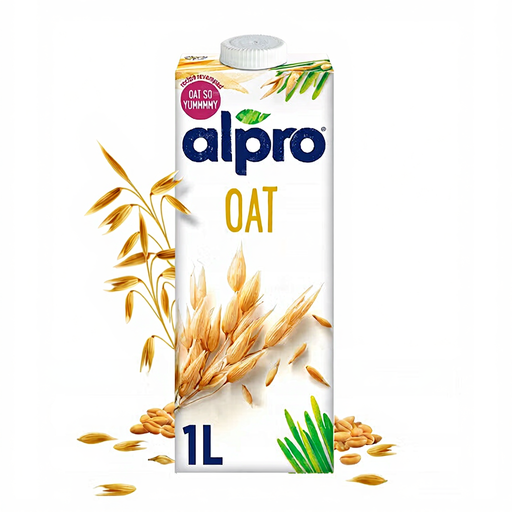 Image unavailable
This 1 L oat drink is described on Joybuy as a dairy-free ingredient for sweet and savoury recipes. Its product page states that it contains gluten-containing oats, so don’t choose it for a strictly gluten-free cake. If you have a milk allergy, check the label and any precautionary statements on the carton you buy.
You can start with the same amount when milk is used as a liquid in the batter. Oatly recommends its oat drink as a substitute for cooking and baking. However, try it out first if your recipe relies heavily on the richness or structure that milk provides, as formulas vary.
No. E.Leclerc’s product page for Bio Village’s no-added-sugars drink shows 5.0 g of sugars per 100 ml. To control the sugar in your cake, check the exact claim and the “of which sugars” line for the product you choose.
No. If your cake needs to be strictly gluten-free, choose a drink that is explicitly labelled as such, like the Bjorg product described on its Auchan product page. Also check your other ingredients and avoid cross-contamination during preparation.
Follow the storage instructions and use-by period given for the product you buy. Auchan’s product page for Bjorg’s gluten-free drink says to keep it in the fridge for four days after opening. This may not apply to other oat drinks.
Read the ingredients list, check any highlighted allergens and look for precautionary statements on the carton you actually buy. The DGCCRF sets out the allergen labelling rules for prepacked foods. The words “plant-based” or “lactose-free” alone don’t answer every question about a milk allergy.