Parents preparing snacks for several journeys
For the October half-term holiday, the number and weight of the bars can help you plan snacks to take with you. If they’ll be shared, check the ingredients and allergens for each recipe too.


To choose cereal bars with a lower fat content in mind, compare the figures per 100 g, then check sugars, salt, portion size and allergens separately. The Auchan listing for Nestlé Fitness Original gives 4.4 g of fat per 100 g, compared with 18 g per 100 g on the listing for Kellogg’s Croustille Avoine Miel. Comparing these figures alone isn’t enough to describe either product as “reduced fat”.
For the October half-term holiday, the number and weight of the bars can help you plan snacks to take with you. If they’ll be shared, check the ingredients and allergens for each recipe too.
Compare fat and saturated fat per 100 g, without assuming that this tells you anything about sugar or salt content.
If someone needs to avoid an ingredient, read the list and allergen information on the product you choose. A lower fat content doesn’t tell you whether it’s suitable for them.
The DGCCRF explains that nutritional values per 100 g make it easier to compare products. When planning snacks for the holiday, also check the portion size and ingredients of the recipe you intend to take with you.
| Criterion | What to check | Who it’s relevant to |
|---|---|---|
| Fat | Compare fat and saturated fat per 100 g for the exact recipes. | If I’m mainly looking for a lower fat content, I want to be able to compare bars with different nutritional profiles. Around 40% of shoppers prioritise this criterion. |
| Pack size for taking away | Check the number of bars, their weight and the pack details shown. | To plan several snacks during my stay, I need to know how much I’ll be taking with me. Pack size is the main consideration for around 30% of shoppers. |
| Nutritional profile | Also check sugars and salt per 100 g, then the portion size. | Fat content alone isn’t enough if I also want to compare other nutritional values. Around 20% of shoppers prioritise this broader overview. |
| Ingredients and allergens | Check the ingredients list and allergen information for the recipe you’re buying. | When sharing snacks with someone who needs to avoid certain ingredients, I check the recipe first. This is the priority for around 10% of shoppers. |
The listing for Kellogg’s Croustille Avoine Miel states that it contains 61% wholegrain oats, but also 18 g of fat per 100 g. So the proportion of oats alone doesn’t tell you about the bar’s fat content.
If this is a priority for you, check the “fat” and “of which saturates” figures per 100 g, then look at the other values that matter to you.
Ingredients and allergen information vary between recipes. Comparing fat content won’t tell you whether a bar is suitable for someone who needs to avoid a particular ingredient.
Before you set off, check the label on each product you buy, especially if the bars will be shared.
The Auchan listing for Fitness Original provides a point of comparison for overall fat content: it gives 4.4 g per 100 g.
The listing for Kellogg’s Croustille Avoine Miel describes a recipe containing 61% wholegrain oats, with 40 g bars.
Carrefour’s cereal bar selection includes several ranges and pack sizes, which should be compared recipe by recipe.
E.Leclerc offers, among other products, Eco+ and Grainea bars in boxes of six. Their recipes aren’t interchangeable.
To compare snacks to take with you on holiday, this selection includes a CLIF BAR energy bar and Nesquik cereal bars. These are two distinct categories, so check the nutritional information and ingredients for each rather than assuming they carry a “reduced fat” claim.
 Image unavailable
This pack of 12 × 68 g bars is worth considering when planning snacks to take with you. It’s an energy bar, not a cereal bar. If you’re prioritising a lower fat content, compare the figures per 100 g and check the ingredients in this recipe.
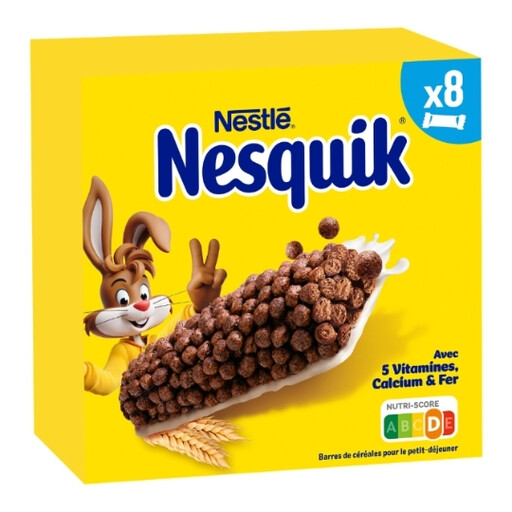 Image unavailable
This pack of eight 25 g bars makes it easy to plan portions to take with you. To choose based on fat content, check the figures for the whole bar per 100 g, then look at the sugars and allergens for the recipe. Information about one ingredient doesn’t necessarily describe the whole bar.
Start by comparing their nutritional values per 100 g, which the DGCCRF says makes comparisons easier. Then check the weight of each bar to understand how much you’ll get in a portion.
No. The listing for Kellogg’s Croustille Avoine Miel states that it contains 61% wholegrain oats and 18 g of fat per 100 g. To compare fat content, check the figures for each recipe rather than relying on the featured ingredient.
Because these figures tell you about different aspects of a recipe. The Auchan listing for Nestlé Fitness Original gives 4.4 g of fat and 7.1 g of sugars per 100 g. Check each figure against your own criteria; one doesn’t tell you the other.
Check the ingredients and allergen information on the packaging for each recipe you buy. Don’t assume the details for one flavour or brand apply to another, even if their fat content seems similar.