Parents preparing a snack to share
A bar that’s easy to break into portions can be handy, provided the nursery allows food from home and the ingredients are suitable for the children who will be sharing it.


White chocolate is a good choice if you’re looking for a mild, milky flavour. For a more pronounced cocoa taste, opt for dark chocolate, or choose a bar combining dark and white chocolate if that blend suits the children’s preferences. Before taking a bar to the nursery, check its policies, the exact product’s ingredients and allergens, and plan a suitable portion for snack time.
A bar that’s easy to break into portions can be handy, provided the nursery allows food from home and the ingredients are suitable for the children who will be sharing it.
White chocolate suits a preference for a milky taste, but it isn’t the same as a less bitter dark chocolate. A child’s preference matters more than an appealing product description.
A dark chocolate bar, or a product explicitly made with dark and white chocolate, is a better fit. You’ll still need to check that the children sharing it enjoy the flavour.
For a snack to share, making sure it meets the nursery’s guidelines and is suitable for the children involved matters more than choosing between white and dark chocolate.
| Consideration | What to check | Who is this for? |
|---|---|---|
| Allergens and sharing | The nursery’s guidelines; the ingredients, allergens and ‘may contain’ statements on the exact product’s packaging. | If I’m sharing a snack, I need to know whether the bar is suitable for every child involved. Around 42% of consumers put this first. |
| Portion and ingredients | Whether the bar can be broken into portions, and the nutritional information per 100 g, particularly the sugar content. | If I bring chocolate, I want to be able to serve a few squares rather than make the whole snack out of chocolate. This is a priority for around 33% of consumers. |
| Flavour preference | Whether it’s labelled ‘white’, ‘dark’ or ‘dark and white’; the type of recipe and any added ingredients. | A child may prefer the mildness of white chocolate or enjoy a more pronounced cocoa taste. For around 25% of consumers, matching taste preferences is the main priority. |
White chocolate typically contains cocoa butter, milk and sugar, as Lindt France explains. Its stated cocoa content doesn’t indicate the same profile as a dark chocolate bar. For a varied snack for children aged 4–17, Manger Bouger suggests bread with a few squares of chocolate, accompanied by a piece of fruit, fruit purée or a dairy product. This guidance doesn’t replace the nursery’s own rules for the children in its care.
The cocoa butter in white chocolate doesn’t give it the same flavour as the cocoa mass in dark chocolate. So, a cocoa percentage shown on a white chocolate bar doesn’t make it a dark chocolate recipe.
If you’re looking for a pronounced cocoa flavour, read the full product description and choose a dark chocolate bar. To combine both flavours, check that it’s specifically a dark and white chocolate recipe.
Praline, hazelnuts or biscuit change the bar’s ingredients. Auchan’s product listings for baking chocolate and the Lindt CREATION Blanc Praliné Rocher recipe show that ingredients and ‘may contain’ statements vary between products.
Check the nursery’s guidelines, then read the packaging of the product you’ve chosen, including any ‘may contain’ statements that are relevant to the children involved.
The Directorate-General for Competition Policy, Consumer Affairs and Fraud Control explains that displaying a Nutri-Score is optional. If there isn’t one, you still need to read the nutritional information.
To compare two products, look at their values per 100 g, particularly sugar and fat, and consider the portion you’ll actually serve.
Lindt France features EXCELLENCE Blanc Extra Velouté, which is described as containing ‘cocoa: 30% minimum’. Auchan also stocks a Lindt bar combining 70% dark chocolate and white chocolate: these are two different recipes.
Nestlé describes GALAK as a white chocolate with a milky flavour. Nestlé Dessert Blanc is a different product, described as a baking chocolate bar.
Carrefour offers several white chocolate products, including Carrefour Original and Carrefour Bio. Check the ingredients of each product individually.
Alongside products from other manufacturers, Auchan offers a white baking chocolate bar under its own brand.
E.Leclerc offers a Tablette d’Or white baking chocolate bar, as well as a four-pack of 100 g Éco+ bars.
These two bars show different options for snack time: a small dark chocolate bar for children who enjoy that flavour, and a white chocolate bar with tree nuts and coconut to consider only if its ingredients are suitable for sharing.
 Image unavailable
Worth considering if the children involved prefer dark chocolate to a milky flavour. The bar is labelled 70% and weighs 35 g; check its packaging for allergens and ‘may contain’ statements before sharing.
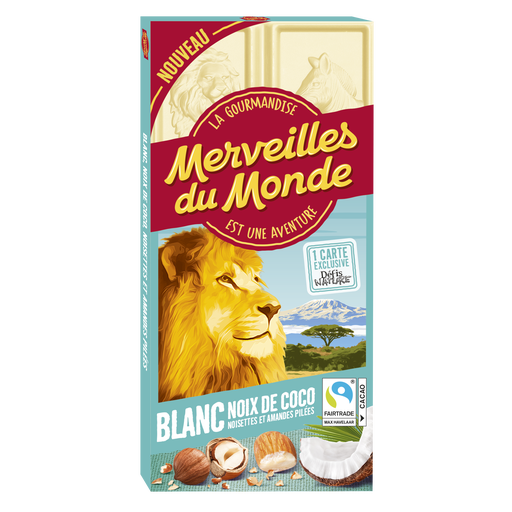 Image unavailable
A white chocolate option if this recipe with almonds, hazelnuts and coconut is suitable for the children and the nursery’s rules. The bar weighs 100 g, so plan to break it into portions and check all the ingredients, allergens and ‘may contain’ statements on the packaging.
No, they have different flavour profiles because they’re made with different recipes. Lindt France describes white chocolate as containing cocoa butter, milk and sugar, among other ingredients. A cocoa percentage shown on a white chocolate bar doesn’t mean it contains the cocoa mass found in dark chocolate.
First, ask which foods the nursery allows and what rules apply to the children involved. Then check the packaging of the exact bar you’ve chosen: ingredients, allergens and ‘may contain’ statements vary between recipes, including different white chocolates.
For children aged 4–17, Manger Bouger suggests bread with a few squares of chocolate, accompanied by a piece of fruit, fruit purée or a dairy product. For a nursery snack, adapt your choice and portion size to the nursery’s guidelines and the children in its care.
No. The Directorate-General for Competition Policy, Consumer Affairs and Fraud Control says that displaying a Nutri-Score is optional. To compare prepacked foods that require a nutrition declaration, check the nutritional information per 100 g, particularly the sugar and fat content.
No. The tax set out in Article 1613 ter of the General Tax Code, published by Légifrance, applies to non-alcoholic drinks, not chocolate bars. When choosing a bar for the nursery, check its ingredients and the rules for sharing snacks instead.