
Livraison le jour même ou le lendemain

Qualité garantie

Débloquez vos offres de bienvenue: Livraison GRATUITE | Jusqu'à -80 % | 30 jours d'essai gratuits à JoyPlus
Téléchargez l'application
A notebook or note pad can be used for following lessons, preparing for meetings, keeping a personal journal, organising lists or putting creative ideas down on paper. But an attractive cover alone is not enough to make a notebook enjoyable to use every day. The wrong format, paper that is too thin or an impractical binding can quickly turn an impulse purchase into an accessory forgotten at the back of a drawer.
Here are the key criteria to review before ordering, along with a selection suited to different types of users in France.
A textured cover, floral pattern or metallic finish may catch the eye, but says nothing about the paper weight or the durability of the binding. For regular use, start by checking the format, number of sheets and ruling style.
A product advertised as having “160 pages” may actually contain 80 sheets printable on both sides. This distinction matters when comparing the capacity of several notebooks. Ideally, the product listing should specify both figures.
A hardcover notebook offers better protection for its pages in a bag, but is generally heavier. By contrast, a spiral-bound notebook opens flat with ease, although its binding can be bulkier. The right choice therefore depends on your commute, your bag and how often you use it.
A larger format is better suited to extended writing and drawing. A small notebook takes up less space, but also leaves less room for organising a page.
A lined notebook is suitable for everyday writing, meeting notes and journaling. A grid notebook is better suited to tables, diagrams, calculations and structured note-taking.
In primary schools and many educational settings in France, the Seyès notebook remains a reliable choice. Its horizontal lines and vertical guides help position letters and maintain consistent handwriting. However, remember to check the format requested by the school before purchasing a pack of notebooks.
For drawing, sketching or mind maps, blank pages are the better option. 80 gsm paper is generally suitable for pencils and everyday pens. If you use heavily saturated inks, 100 gsm paper can reduce show-through from one side to the other, although it will not completely prevent marker ink from bleeding through.
A stitched or stapled binding remains discreet and lightweight. A spiral-bound notebook opens flat and makes one-handed writing easier. A hardcover, meanwhile, offers better protection for the pages while travelling.
A hardcover notebook with an elastic closure and ribbon bookmark can be particularly practical for everyday use: the cover is more resistant to scuffs, the elastic keeps the notebook closed and the ribbon helps you quickly find the right page. On smaller formats, a pen loop is a welcome addition—as long as it does not add unnecessary bulk.

Why it suits this profile: four compact notebooks for separating lists, ideas, lessons or everyday tasks, without having to carry a large notebook.
The A7 format keeps bulk to a minimum, while the multipack lets you divide different uses instead of overloading a single notebook.
Pack of 4, grid paper, top spiral binding and pages designed for quick note-taking.
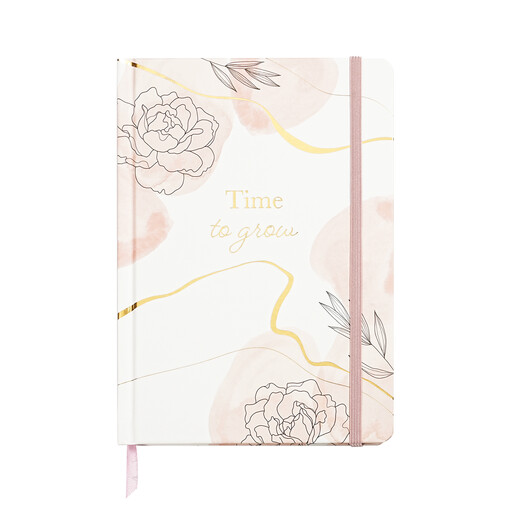
Why it suits this profile: its A5 format works equally well at the office, for studying or journaling. Its decorative finishes also make it an appealing stationery gift.
The product listing clearly details the format, 96 sheets, 100 gsm cream lined paper, ribbon bookmark and elastic closure.
A5 dimensions of 148 × 210 mm, 96 sheets, 100 gsm offset paper, ribbon bookmark and elastic band.
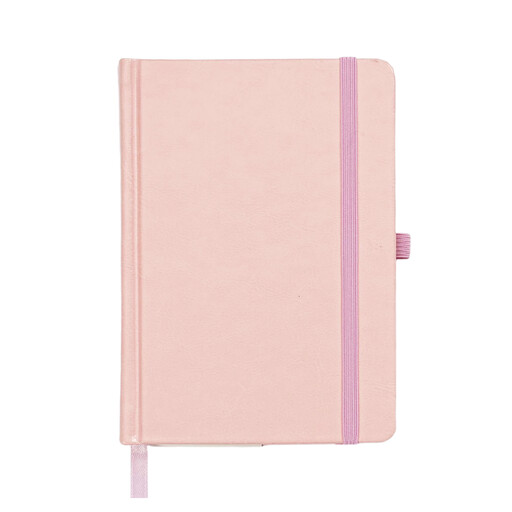
Why it suits this profile: its approximately 10.5 × 14.8 cm dimensions are ideal for commuting, appointments and jotting down notes between activities.
Its compact format reduces the weight you need to carry, while the elastic closure prevents the notebook from opening inside your bag.
80 sheets of 100 gsm lined paper, ribbon bookmark, elastic band and integrated pen loop.
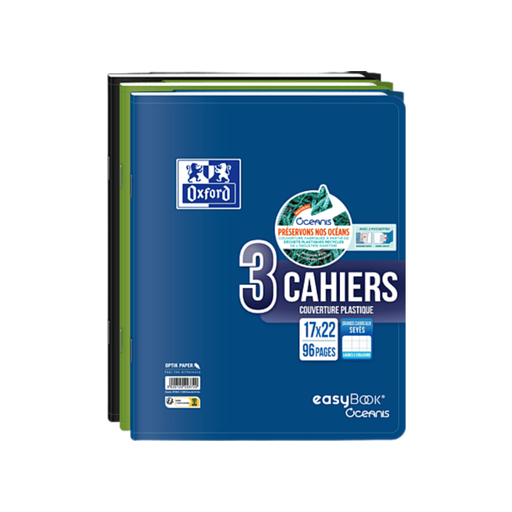
Why it suits this profile: the 17 × 22 cm format and Seyès ruling meet the everyday needs of schoolwork, homework and guided handwriting practice.
The three-pack makes it easy to allocate notebooks by subject and check how many are needed before the new school year begins.
Three 96-page notebooks, Seyès ruling and stapled binding in a 17 × 22 cm format.
Browse our selection of notebooks and note pads to compare the available formats, ruling styles, bindings and uses.
A5 offers an excellent balance between writing space and portability. For classes that require French ruling, choose a Seyès notebook in the format specified by the school. In the office, an A5 lined notebook is ideal for meeting notes and task lists.
100 gsm paper can reduce show-through compared with a lighter weight, but the result also depends on the ink, nib and pressure applied. When using a fountain pen or certain markers, check whether the product listing mentions compatibility and test a few pages before committing to intensive use.
Lifespan depends primarily on how the notebook is handled and transported. A hardcover offers better protection for the pages, while a spiral binding makes it easier to open flat. If your bag is often packed tightly, check the strength of the rings and avoid putting pressure on the binding. For stationary use at the office or at home, both options are broadly comparable—it ultimately comes down to your writing preference.