
Livraison le jour même ou le lendemain

Qualité garantie

Débloquez vos offres de bienvenue: Livraison GRATUITE | Jusqu'à -80 % | 30 jours d'essai gratuits à JoyPlus
Téléchargez l'application
Buying a notebook might seem straightforward. Yet the format, paper type and binding all have a direct impact on writing comfort and how long the product lasts. A Moleskine notebook for jotting down ideas, a Clairefontaine exercise book for lectures or an Oxford ring binder for organising documents each serve very different purposes.
Three mistakes crop up time and again when comparing notebooks and notepads:
Here are the points to consider before placing your order.
The A5 format is ideal for everyday notes, meetings, travel and journals. The Clairefontaine Nomaddict notebook shown below measures 14.8 × 21 cm, almost exactly standard A5 dimensions.
For lectures, homework and documents that need filing, it's better to go for a large-format notebook or an A4 notebook. At 24 × 32 cm, the Koverbook can hold A4 sheets while still leaving plenty of room for margins and annotations.
The A4+ format is handy for professional notepads, diagrams and documents that need to stay legible once detached. Just make sure it fits in your bag or the storage space you have in mind.
The right choice depends above all on how you work:
70 gsm paper is generally sufficient for ballpoint pen or pencil. For light felt-tips, lots of corrections or a firmer writing surface, 90 to 100 gsm will be more comfortable. Bear in mind, though, that paper weight alone doesn't guarantee no show-through. The manufacturer's specifications and the type of ink you use also matter.
Stapled binding works well for standard school exercise books. Sewn binding or a 180° lay-flat opening makes it easier to write across the full width of the page. Detachable pages are particularly useful for handing over a report, filing a note or reorganising a folder.
A notebook with a pocket lets you keep receipts, cards, loose sheets and documents close at hand. For a more flexible organisation system, a ring binder like the Oxford A4XL model can take dividers and plastic wallets. Check its capacity before buying: the model shown has a 40 mm spine and a four-ring mechanism.
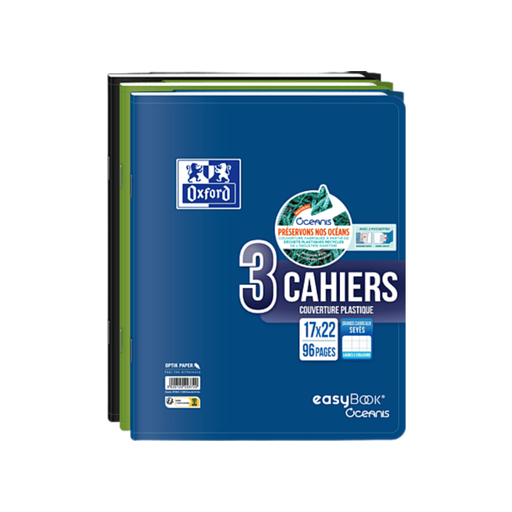
Why this choice suits this profile: This pack is ideal for students who need to cover several subjects without buying each notebook separately. At 17 × 22 cm, it slips easily into a school bag.
The three notebooks save you from having to make multiple purchases. The Seyès ruling is clearly stated, and each notebook's 96 pages offer a capacity that's easy to anticipate.
Pack of 3, Seyès ruling, 17 × 22 cm format and stapled binding suited to everyday homework.
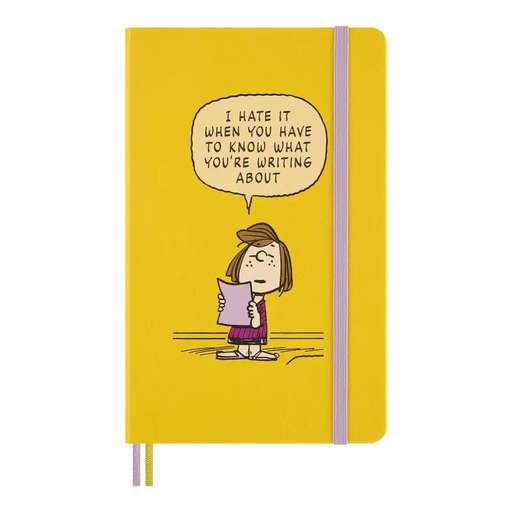
Why this choice suits this profile: Its format and presentation lend themselves to personal writing, creative journaling or as a gift, especially for fans of the Peanuts universe.
The product description specifies 100 gsm ivory lined paper, an elastic closure and 180° lay-flat opening – so it doesn't rely on looks alone.
Black matte hard cover, two bookmark ribbons, expandable inner pocket and acid-free paper as stated by the manufacturer.
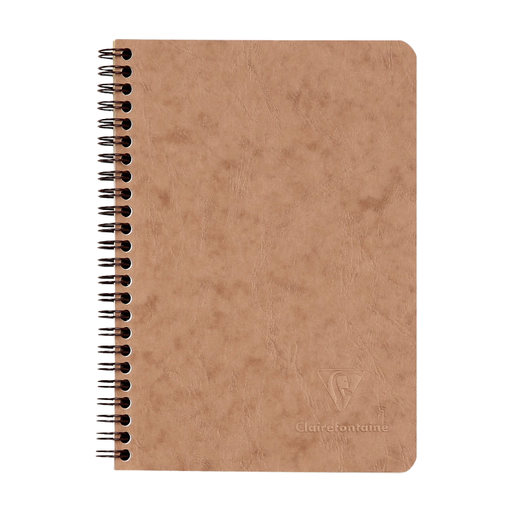
Why this choice suits this profile: This A5 notebook is designed for students, professionals and travellers who need to take notes, tear out pages and then file them away.
The micro-perforations let you remove sheets cleanly. The three integrated pockets also help reduce the risk of misplacing separate documents.
120 lined pages, 90 gsm Clairefontaine Velin Velouté paper, three pockets and a textured cardboard cover.
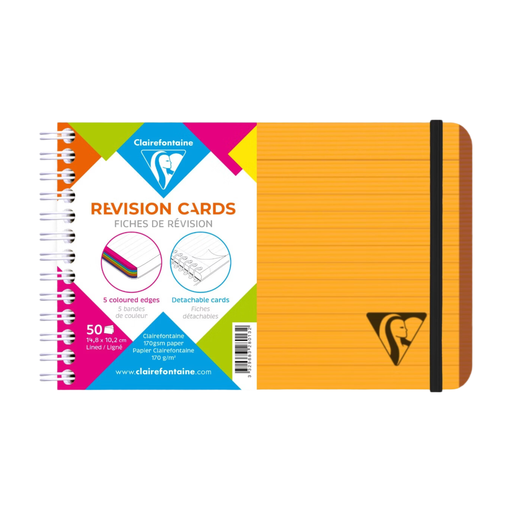
Why this choice suits this profile: Its compact format is ideal for students preparing revision cards by subject who want to carry their key notes everywhere.
The five coloured bands let you separate topics, while the lined cards prevent you from mixing up definitions, dates and examples.
50 lined cards, 170 gsm paper, lay-flat opening and grooved polypropylene cover.
We've put together a comprehensive, real-time updated list of products that meet these exacting criteria as well as European safety standards.
At primary school, Seyès ruling remains the standard when learning to write and presenting homework requires it. At university, a lined notebook, a grid notebook or an A4 ring binder will often be more practical, depending on the subject and the amount of documents to insert.
A notebook is generally designed for regular use, with a fixed binding and a set number of pages. A notepad is more portable and often more personal; it may feature a hard cover, a pocket, an elastic closure or detachable pages. The best choice really depends on how you carry it, the volume of notes you take and your filing needs.
Keep them away from damp and heat, avoid overfilling the pockets and don't stretch the elastic closure too tightly. Important documents can be filed in an Oxford ring binder or a dedicated plastic wallet using the detachable pages. This way you can separate the notes you use every day from the ones you want to keep for reference.