
Livraison le jour même ou le lendemain

Qualité garantie

Débloquez vos offres de bienvenue: Livraison GRATUITE | Jusqu'à -80 % | 30 jours d'essai gratuits à JoyPlus
Téléchargez l'application
A notebook or exercise book can be used for lessons, organising your working day, keeping a personal journal or making sketches. But buying one can quickly lead to disappointment if the format, paper or binding does not really suit its intended use.
Before adding one to your basket, keep an eye out for three common pitfalls:
The right format depends both on how much you travel and on the way you take notes.
A notebook with an elastic closure and bookmark stays securely closed in your bag. However, these accessories add a little extra thickness and may wear out before the pages do. So check the strength of the elastic, how securely the ribbon is attached and whether there is an inside pocket.
The ruling directly affects writing comfort and the notebook’s versatility.
For a school exercise book, check the line spacing and number of pages. For a sketchbook, the paper weight often matters more than the cover: felt-tip pens and ink can bleed through paper that is too thin. If possible, test it on an endpaper or a dedicated sheet.
Expressed in g/m², paper weight gives an indication of the paper’s thickness, but it is not enough to sum up its quality. 70 g/m² paper may be perfectly suitable for pencil and ballpoint pens. For fountain pens and light inks, 90 or 100 g/m² paper will generally provide greater comfort. However, the result also depends on the type of ink and the pressure applied to the page.
The binding should also be chosen according to how the notebook will be used:
Environmental labels such as PEFC or FSC provide information about the origin of certain materials within the scope of the certification. They do not remove the need to check the dimensions, paper and binding.
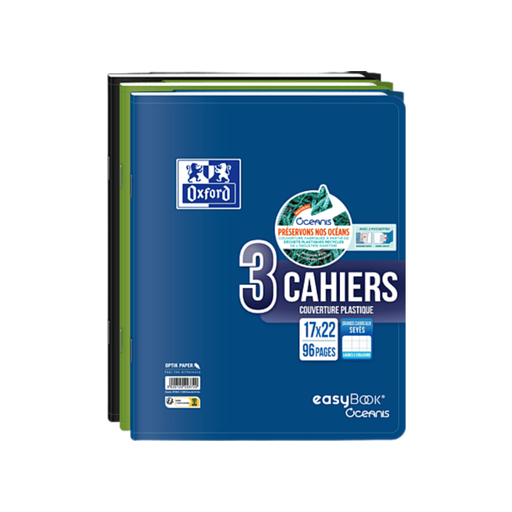
Why this choice suits this profile : This pack of three exercise books allows pupils to separate several subjects without having to make multiple purchases. At 17 × 22 cm, they fit easily into a school bag.
The number of exercise books and pages is clearly stated: three books with 96 pages each, featuring Seyès ruling suitable for school handwriting.
17 × 22 cm format, 96 pages per exercise book, staple binding and Seyès ruling.
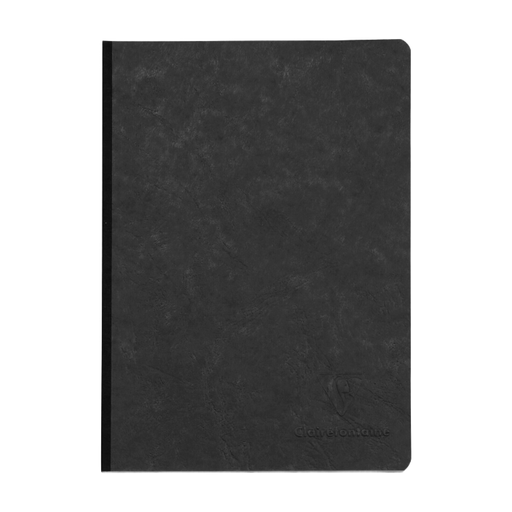
Why this choice suits this profile : This A5 notebook is ideal for anyone looking for a polished design, whether at work, while travelling or for personal writing.
The product details specify the A5 format, 192 pages, Clairefontaine Velin Velouté 90 g/m² paper and small squared ruling.
90 g/m² paper, tinted soft cover, canvas spine and lays-flat opening.
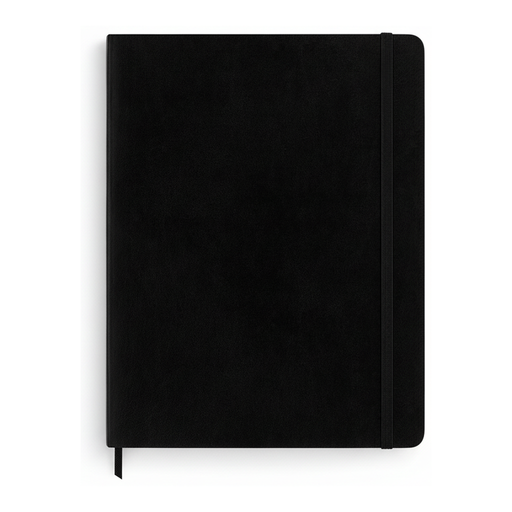
Why this choice suits this profile : Its generous squared surface is ideal for organising data, drawing diagrams, planning projects or recording extensive notes.
The format, squared ruling, 192 pages and lays-flat opening are all detailed, making it easy to compare with an A5 notebook.
Squared pages, elastic closure, bookmark, inside pocket and 180° opening.
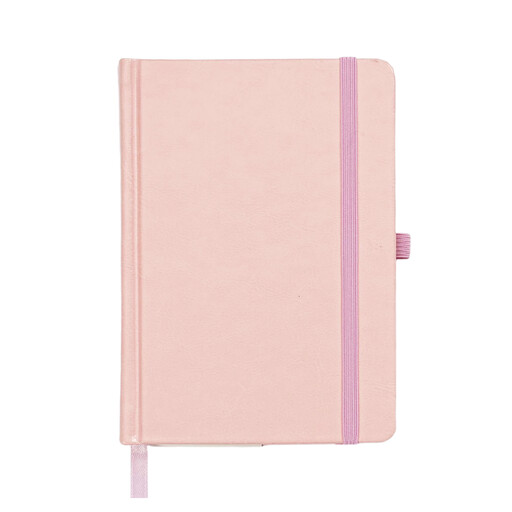
Why this choice suits this profile : This A6 notebook fits into a pocket or small bag, making it easy to jot down ideas, lists or appointments throughout the day.
The product details clearly distinguish between the A6 format, 80 sheets, 160 pages and 100 g/m² lined paper.
PU hard cover, elastic closure, ribbon bookmark and pen loop.
We have brought together a complete, real-time updated selection of products that meet these demanding criteria as well as European safety standards.
A5 offers the best balance between writing space and portability. An A6 notebook is suitable for quick notes, while a large-format exercise book is more comfortable for lessons, tables and documents that need annotating.
It all depends on how often it is used, the paper weight, the binding and the conditions in which it is carried. For intensive use, a hard cover, sewn binding or well-protected spiral binding will generally be more suitable. Keep the notebook away from moisture and avoid overfilling its inside pocket.
Yes, although comfort depends on the size of the squares and your personal habits. For reports, a lined notebook will generally be more comfortable to read. For diagrams, calculations, plans or tables, the grid provides particularly useful guidance.