
Livraison le jour même ou le lendemain

Qualité garantie

Débloquez vos offres de bienvenue: Livraison GRATUITE | Jusqu'à -80 % | 30 jours d'essai gratuits à JoyPlus
Téléchargez l'application
A notebook or notepad can accompany you to classes, help you prepare for a meeting, organise a personal journal or provide space for sketches. However, an unsuitable choice quickly becomes apparent: pages that are too thin, a format that is awkward to slip into a bag or a cover that becomes misshapen after a few weeks.
Before you let the design win you over, it is therefore worth checking the features that really matter. Here are the key criteria to consider, followed by a selection designed for different uses in France.
An attractive cover catches the eye, but says nothing about the quality of the paper or the strength of the binding. A hardback cover offers better protection for the pages, while a softcover is generally lighter and less bulky. The right choice mainly depends on how you carry it and how often you use it.
Product descriptions sometimes state the number of pages and sometimes the number of sheets. A sheet has two sides, whereas a page generally refers to a single usable side. This distinction matters when comparing two notebooks on an equivalent basis.
Thin paper may be perfectly suitable for a pencil or ballpoint pen, but allow more ink from a fountain pen or felt-tip pen to show through on the reverse. For comfortable everyday writing, the paper’s weight, texture and shade matter far more than simple claims such as “premium” or “superior quality”.
For a handbag or student backpack, A5 is a good compromise. At the office, in the classroom or when drawing, a larger format provides more space.
80 g/m² paper is generally suitable for taking notes with a pencil or standard pen. At 100 g/m², paper is denser and usually allows less ink to show through on the reverse, although this does not guarantee compatibility with every marker.
For drawing, 120 g/m² paper is better able to withstand repeated corrections and dry techniques. Clairefontaine paper is often distinguished by its very smooth surface, while fine-grain paper provides more texture for pencil, pastel or charcoal. Also look for acid-free, pH-neutral or PEFC/FSC certification claims : these refer to specific characteristics of the paper and its sourcing.
An elastic closure, bookmark or inner pocket can be useful, but these small accessories cannot make up for binding that is unsuitable for the intended use.
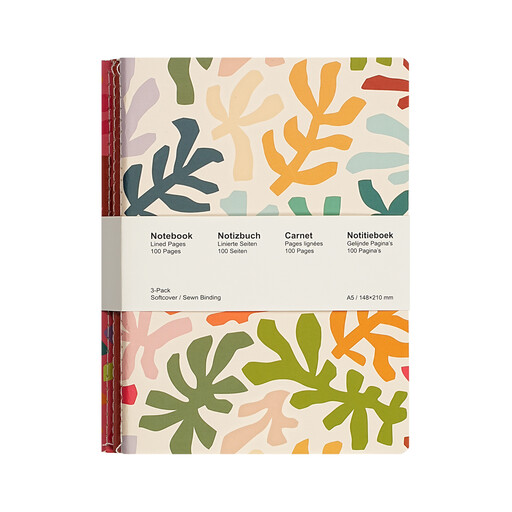
Why this choice suits this profile : This pack of three A5 notebooks lets you keep classwork, work and personal notes separate without having to make multiple purchases.
The pack size and price are clearly stated, with 50 sheets of 80 g/m² lined paper per notebook.
Pack of three notebooks, sewn binding and advertised lay-flat opening.
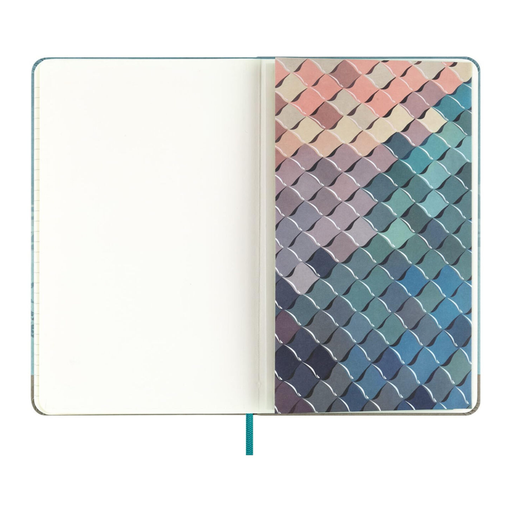
Why this choice suits this profile : This large lined notebook combines a hardback cover inspired by Casa Batlló with thoughtful details for journalling and professional writing.
The product details specify 100 g/m² ivory lined paper, an elastic closure, a bookmark and an inner pocket.
Acid-free paper, hardback cover and advertised 180° lay-flat opening.
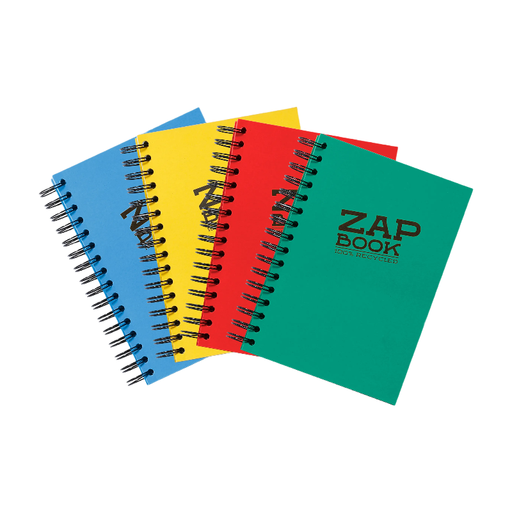
Why this choice suits this profile : With its A4 format and 160 sheets, this notebook is suitable for large volumes of notes, rough work and everyday drawing.
The product details specify the number of sheets, the 80 g/m² paper weight and the spiral binding along the long edge.
100% recycled, acid-free and pH-neutral paper, with a surface advertised as flat.
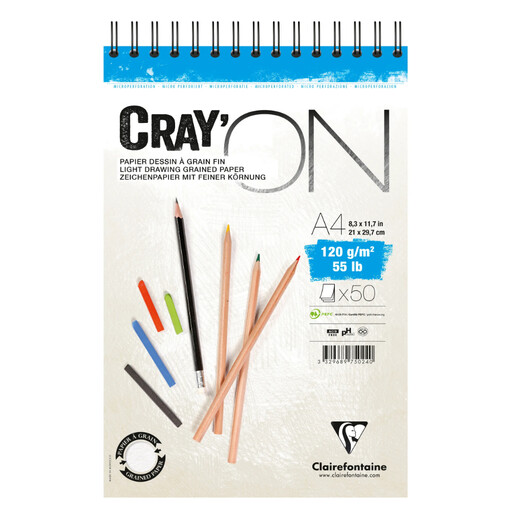
Why this choice suits this profile : This A4 drawing pad is designed for dry techniques, sketches, charcoal, pastels and coloured pencils.
The product details mention 120 g/m² acid-free paper, with one lightly textured side and one smooth side.
Surface designed for repeated corrections and advertised PEFC certification.
We have brought together a complete selection, updated in real time, of products that meet these demanding criteria as well as European safety regulations.
A notebook’s lifespan depends on the paper weight, binding, storage conditions and frequency of use. A hardback cover protects the pages better in a bag, while a spiral binding withstands repeated handling without putting strain on the notebook’s spine. Keep it away from moisture and heat, particularly if the cover is printed or if some accessories are made from paper or fabric.
A5 is suitable for short notes, meetings and everyday carrying. For lessons, tables, mind maps and documents that require plenty of writing space, an A4 notebook or a format close to A4 will be more comfortable.
At 100 g/m², paper is generally denser than 70 or 80 g/m² paper. It is still best to check the manufacturer’s information and choose paper that is compatible with the ink you use. For drawing, 120 g/m² is better suited to dry techniques and repeated corrections.
A lined notebook structures your writing and makes it easier to lay out paragraphs. A blank notebook offers more freedom to combine text, sketches, collages and diagrams. When giving a notebook as a gift, it therefore depends on the recipient’s habits : organised writing, drawing or creative journalling.