
Livraison le jour même ou le lendemain

Qualité garantie

Débloquez vos offres de bienvenue: Livraison GRATUITE | Jusqu'à -80 % | 30 jours d'essai gratuits à JoyPlus
Téléchargez l'application
Choosing a notebook for the back-to-school season, stocking your office, or simply treating yourself… it seems simple enough. Yet, once you're in the aisle or facing the jungle of online options, the choice can become a real headache. Make the wrong one, and you're in for guaranteed disappointment: pages that tear easily, ink that bleeds through to the other side, or a size that's completely wrong for your needs. Our mission: to help you see things more clearly and identify the criteria that truly matter, so you never regret a purchase again.
Before we get to our top picks, let's review the 3 common pitfalls that turn a simple purchase into a regret:
To avoid these setbacks, you just need to understand a few technical specifications. Far from being insider jargon, they are the true DNA of your future notebook.
Paper weight, expressed in grams per square metre (gsm), is the main indicator of the paper's thickness and opacity.
The ruling (the type of lines printed on the page) should be tailored to your use case.
The size and binding type determine your notebook's usability and lifespan.
To illustrate how these criteria apply in practice, here are a few of our recommendations for specific uses.
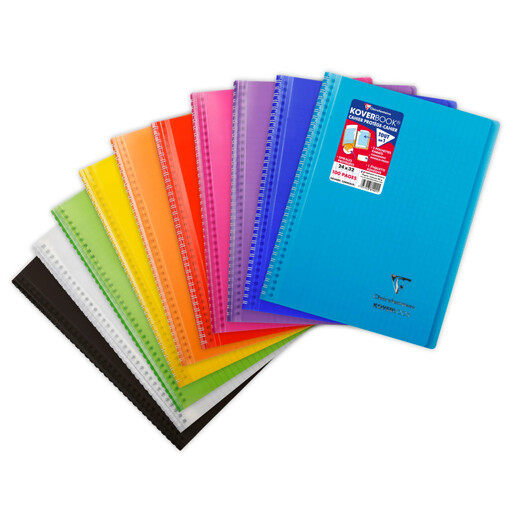
Why we chose it: It checks all the boxes for school life. Its 24x32 cm size is perfect for classes, its polypropylene cover protects the notebook all year long, and its flaps serve as a bookmark or a pocket for handouts.
Its Clairefontaine Vélin Velouté 90 gsm paper puts an end to ink bleed-through. Its sturdy cover and protected spiral binding make it virtually indestructible.
A 2-in-1 product (notebook + cover) that simplifies the back-to-school chore and effortlessly withstands the rigours of a school bag.
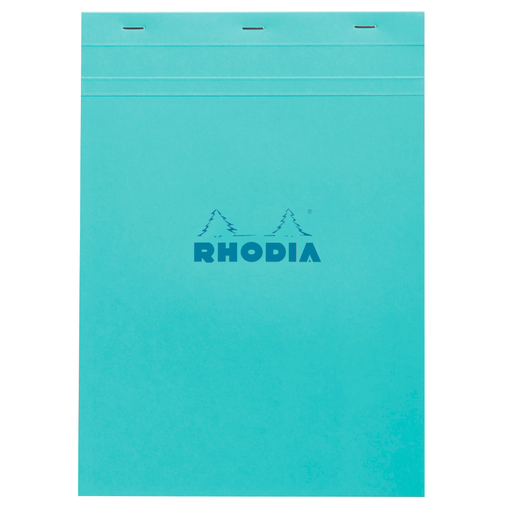
Why we chose it: A must-have for professionals in meetings or on the go, this notepad is a model of efficiency. Its ultra-rigid cardboard back allows for comfortable writing even without a surface, and its micro-perforated sheets tear out cleanly for sharing or filing.
Its rigid back solves the problem of taking notes on the fly. The 5x5 mm grid ruling is ideal for diagrams and structured notes, making it highly versatile.
The combination of its rigidity, detachable sheets, and A4 size makes it the ultimate portable workspace.
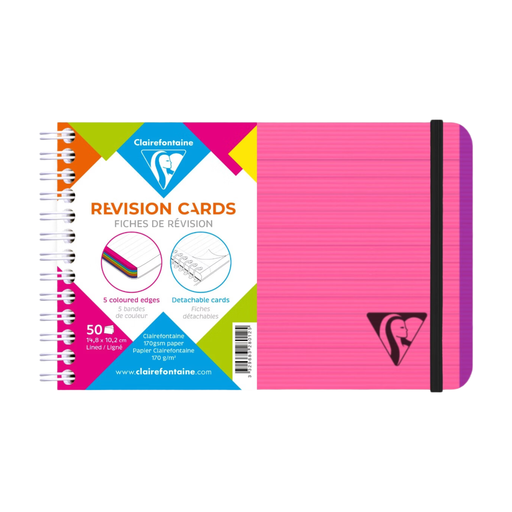
Why we chose it: During exam season, index cards are a student's secret weapon. This notepad format brings together ready-to-use **revision cards** that are incredibly practical to organise and carry.
Its ultra-stiff 170 gsm card stock prevents the nightmare of damaged and dog-eared cards. The coloured dividers allow for organisation by subject, which is far more effective than loose cards.
A tool designed for active recall. Its compact size and spiral binding make it the ideal portable study companion.
Explore our full selection of products that meet our quality criteria and the demands of every use case.
Although their dimensions are similar, their uses are quite distinct. The A4 format is an international standard, perfect for printing and filing in binders. The 24x32 cm format, often called the "school format," is slightly larger. Its main advantage: you can paste a full A4 sheet inside without it sticking out, a common requirement from teachers in France, from middle school to high school.
It all depends on your writing tools. For quick notes with a pencil, 70 or 80 gsm paper may be more than enough. However, if you're a fan of fountain pens, fine-liners, or highlighters, 90 gsm paper is a game-changer. It guarantees near-perfect opacity, preventing ink from showing through, and offers an incomparable glide that enhances the pleasure of writing. For revision cards, an even higher weight (160 gsm and up) is recommended for unbeatable durability.
Where a notebook encourages linear note-taking, revision cards are designed for active recall. Their sturdy, individual format allows you to handle them, sort them by topic, quiz yourself, and focus on the concepts that are giving you trouble. A pad of revision cards like the Linicolor model offers the best of both worlds: the convenience of a notebook (the cards are bound together) and the modularity of individual cards, which can be organised using dividers.