
Livraison le jour même ou le lendemain

Qualité garantie

Débloquez vos offres de bienvenue: Livraison GRATUITE | Jusqu'à -80 % | 30 jours d'essai gratuits à JoyPlus
Téléchargez l'application
Whether for a new project, the back-to-school season, or simply the desire to organise your thoughts, choosing a notebook or a notepad seems like child's play. Yet, who hasn't cursed at paper that bleeds ink, a binding that falls apart after three weeks in a bag, or a size that proves completely unsuitable for its intended use?
Choosing the right stationery online can quickly become a headache when faced with marketing descriptions that promise the world. Before you decide, it's best to know the common pitfalls that can turn a simple purchase into a daily frustration.
To avoid these disappointments, simply focus on a few objective technical criteria. These are what define the true quality and utility of a notebook.
To make an informed choice, you only need to master three fundamental criteria. This trio determines the performance, durability, and user comfort of your future writing companion.
Paper weight, expressed in grams per square meter (g/m?), indicates the density and therefore the thickness of the paper.
The ruling refers to the lines printed on the page. The choice depends entirely on your needs.
The way the pages are held together directly impacts the notebook's durability and ergonomics.
To help you see more clearly, here's how these criteria apply in practice with products tailored to each need.
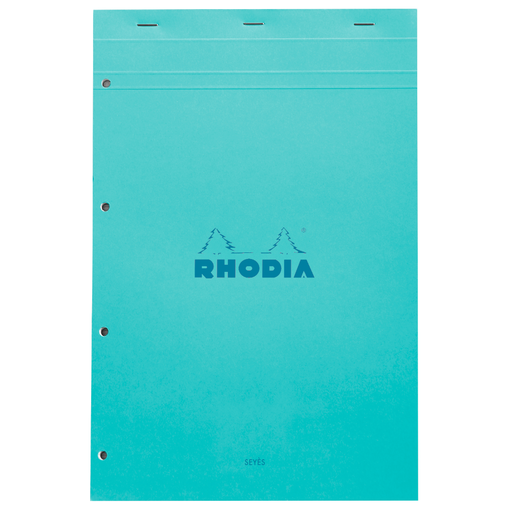
Why it's the right choice: Ideal for middle school, high school, and university students. This Rhodia pad combines the standard Seyès ruling with a format designed for organisation: the sheets are micro-perforated for clean removal and pre-punched with 4 holes for immediate filing in a binder.
It bypasses the trap of flimsy binding and impractical formatting. The rigid cardboard back allows for note-taking anywhere, and the detachable/punched combination saves you from needing to buy a hole punch or tear your pages.
The 80 g/m? vellum paper offers a smooth glide. Its all-in-one functionality (note-taking, detaching, archiving) makes it a powerful organisational tool for the school year.
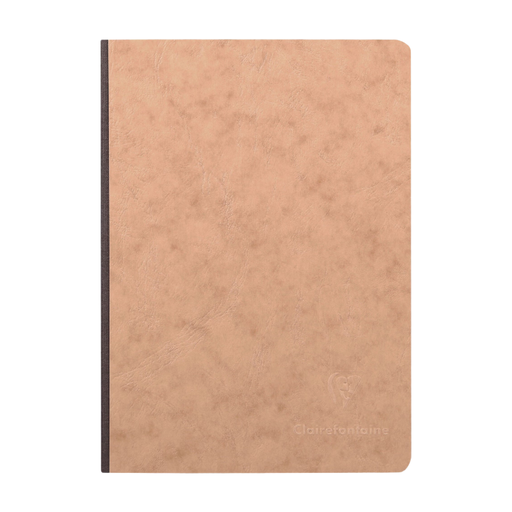
Why it's the right choice: For a professional, appearance matters as much as function. This A5 notebook features a understated textured cover and a cloth binding that gives it a classic and durable aesthetic. Its size is perfect for meetings and travel.
It directly solves the problem of paper being unsuitable for quality pens. The Clairefontaine 90g Velvety Vellum paper is a benchmark for its extra-smooth surface that prevents ink from feathering, even with a fountain pen.
The combination of premium 90 g/m? paper and a sewn binding that allows it to lay flat makes it both a high-performance and elegant writing tool. The 5x5 graph ruling is incredibly versatile.
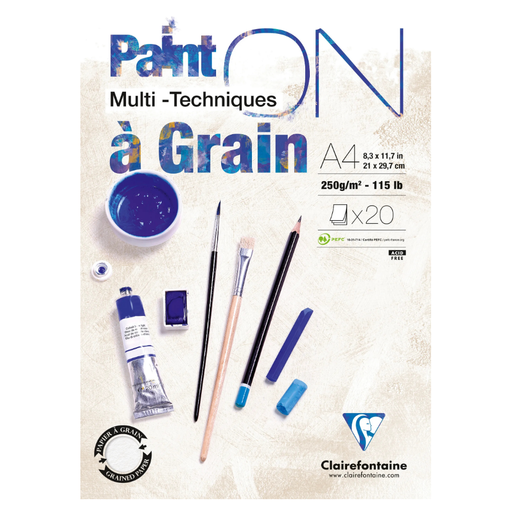
Why it's the right choice: For the artist or creative hobbyist who loves to experiment, this pad offers impressive versatility. Its thick 250 g/m? paper is designed as a true multi-technique surface, handling dry media (pencil, marker) as well as wet media (ink, gouache, acrylic).
It prevents the disappointment of a paper that can't handle the chosen technique. The heavy weight and paper treatment ensure good absorption and allow for corrections ("reworking") without the sheet degrading.
Its dual-sided surface is a major asset: one side with a pronounced grain for creating textural effects, and a fine-grained side for more detailed work. It's like having two types of paper in one.
Explore our full selection of products that meet all our criteria for quality and performance.
An 80 g/m? paper is the standard for everyday use and works well with ballpoint pens and pencils. However, with more liquid ink, it may exhibit slight show-through. A 90 g/m? paper offers better opacity, a superior feeling of smoothness, and greater resistance to ink bleed-through. It is the recommended choice for anyone who regularly uses a fountain pen or fine-tipped markers and seeks optimal writing comfort.
For fountain pen compatibility, two criteria are key: a paper weight of at least 90 g/m? and a smooth, non-porous surface finish. Look for terms like "vellum paper," "satin finish," or specific product lines like Oxford's Optik Paper or Clairefontaine's Velvety Vellum. These papers are treated to ensure ink stays on the surface, dries cleanly, and does not feather.
It depends on the manufacturing quality. A thin, single-wire spiral can get bent out of shape in a bag, but a double-wire metal binding is generally very robust. Its main advantage is the ability to open the notebook completely flat or fold it back on itself. A stapled (saddle-stitched) notebook is lightweight and simple, but it is less suited for notebooks with many pages and for intensive, long-term use. For maximum durability, a sewn perfect-bound notebook remains a top choice.