
Livraison le jour même ou le lendemain

Qualité garantie

Débloquez vos offres de bienvenue: Livraison GRATUITE | Jusqu'à -80 % | 30 jours d'essai gratuits à JoyPlus
Téléchargez l'application
A notebook can accompany your revision, help you prepare for a meeting, serve as a personal diary or keep track of your travel sketches. Yet all too often, we choose one based on its cover or a sale price. Once you start using it, the unpleasant surprises soon appear: paper that’s too thin, a size that’s impractical in your bag, or a binding that gets in the way of writing.
Here are the criteria to consider before making a purchase, along with a selection tailored to the main uses in the UK.
A notebook advertised as having “200 pages” may actually contain 100 sheets printed on both sides. To compare two models, make sure you check the difference between sheets and pages. The paper weight also deserves your attention: 70 or 80 gsm paper is generally fine for ballpoint pens and pencils, whereas 90 to 100 gsm paper will feel more pleasant with light felt-tips and some fountain pens.
At 14.8 × 21 cm, an A5 notebook is easy to carry while still offering a comfortable writing surface. An A6 notebook, measuring roughly 10.5 × 14.8 cm, slips easily into a pocket and is ideal for lists or quick notes, but leaves less room to develop an idea. At the other end of the scale, the A4 notebook is suited to diagrams, reports and drawing, at the cost of taking up more space in your bag.
A stitched or spiral-bound notebook can lie flat, which makes note-taking much easier. Stapled binding, which is lightweight and common on school exercise books, doesn’t hold the pages as well when the notebook is very full. As for the cover, a hardback version protects the contents better in a bag, whereas a soft cover prioritises lightness above all.
For school use, also check the size required by the school. The 17 × 22 cm dimensions are common in exercise books, while 24 × 32 cm offers more space for homework.
Paper weight refers to the weight of a one-square-metre sheet, not its exact thickness. 70 gsm paper keeps the overall weight of your notebooks down, but some inks may show through. With 90 or 100 gsm, the paper generally feels denser and offers a more pleasant writing experience.
Terms like acid-free, pH neutral, FSC or PEFC refer to specific characteristics when stated by the manufacturer. They don’t necessarily mean the notebook is suitable for all inks or for watercolour. For wet techniques, it’s better to choose a notebook advertised as compatible with mixed media, with a paper weight of at least 140 gsm, for example.
A spiral binding often allows you to open the notebook flat and fold the pages right back. However, it can catch on a ring binder or stick out further on the side. A bookmark, elastic closure and inner pocket are very practical for journaling and on the go, but these accessories can also add to the notebook’s thickness and weight.
To keep within your budget, a pack of notebooks lets you separate subjects, projects or topics. Always compare the number of sheets in each notebook, not just the number of units stated on the pack.
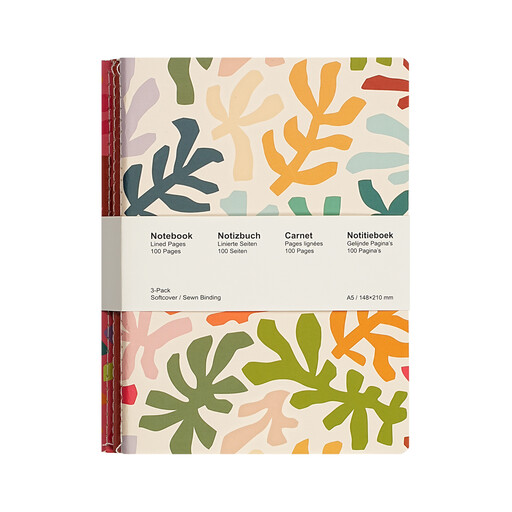
Why this choice suits this profile: This pack of three A5 notebooks is ideal for students, beginners and anyone who wants to spread their notes across several subjects or projects.
The listing specifies that each notebook contains 50 sheets of 80 gsm lined paper and features a stitched binding, rather than being vague about the page count alone.
An easy-to-carry A5 size, cream-coloured lined paper and three notebooks in one pack. The binding is designed to allow the notebook to lie flat.
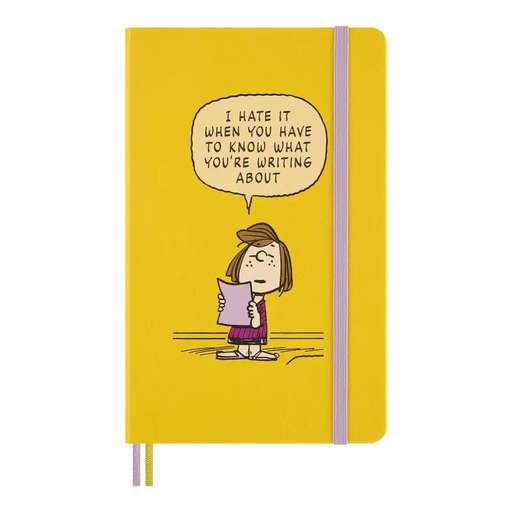
Why this choice suits this profile: This notebook, designed for journaling and personal notes, is aimed at those who value fine finishes and daily organisation.
Its features are clearly detailed: hard cover, 100 gsm ivory-coloured lined paper, 180-degree opening and elastic closure.
Two bookmarks, an expandable pocket and stickers are included. The paper is stated to be acid-free and FSC-certified.
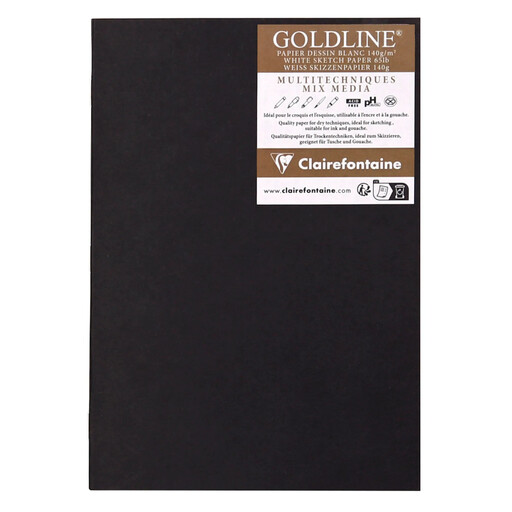
Why this choice suits this profile: Its large size is aimed at artists, illustrators and those who switch between pencil, charcoal, pastel or light watercolour.
The paper is stated as 140 gsm and described as suitable for mixed media. This is a more consistent choice for artistic practice than a standard lined notebook.
An A3 size, 140 gsm white paper and a stitched binding. The listing indicates compatibility with dry techniques and watercolour.
For lessons or meetings, an A5 spiral-bound notebook or a lined notebook is easy to carry and fits on a small desk. For maths, project management or diagrams, a grid notebook offers handy regular guides.
Children and teenagers may need a school exercise book with Seyès ruling, especially for handwriting practice. When travelling, an A6 notebook slips into a pocket, while an A5 offers a good compromise between writing space and portability.
If you want to keep your notes for a long time, a hard cover and acid-free paper can be good choices. To save on weight and cost, a soft cover or a recycled eco-friendly notebook will do the job, as long as you check its paper weight and intended use.
We’ve put together a comprehensive, real-time selection of products that meet these demanding criteria and comply with European safety regulations.
The A5 size suits most lessons: it offers enough space while remaining easy to store. A 17 × 22 cm exercise book with Seyès ruling is better suited to primary and secondary school needs. The A4 size is best reserved for extensive notes, tables and drawings.
For a ballpoint pen or pencil, 70 to 80 gsm paper may be sufficient. If you use a fountain pen, felt-tip or several colours, a weight of 90 to 100 gsm generally limits show-through. However, the result also depends on the ink: its fluidity varies from one model to another.
It all depends on humidity, light, how often it’s handled and storage conditions. Stored flat in a dry place away from sunlight, a notebook will keep its pages and cover in better condition. Terms like acid-free, pH neutral or forest certification describe the paper’s characteristics, but they don’t replace good storage conditions.