
Livraison le jour même ou le lendemain

Qualité garantie

Débloquez vos offres de bienvenue: Livraison GRATUITE | Jusqu'à -80 % | 30 jours d'essai gratuits à JoyPlus
Téléchargez l'application
A notebook can help you follow a lecture, prepare for a meeting, organise your thoughts or practise drawing. Yet some purchases turn out to be disappointing after just a few days: paper that’s too thin, an impractical binding, a size that won’t fit in your bag, or pages that can’t be filed away. To avoid unpleasant surprises, it’s better to focus on the notebook’s concrete features rather than just its design.
Manufacturers sometimes state the number of pages, sometimes the number of sheets. A sheet used on both sides generally corresponds to two pages. This difference directly affects the amount of space actually available for taking notes. Also check whether the pages are detachable, perforated or firmly held by the binding.
An A4 notebook offers a comfortable surface for lectures, tables and professional documents, but it takes up more room in your bag. Conversely, an A5 or A7 spiral notebook is easy to carry, at the cost of a more limited writing area. The right choice therefore depends on where you plan to use it and how much information you need to jot down.
A hard or colourful cover doesn’t guarantee a pleasant writing experience. For a student notebook or a lecture pad, check the paper weight, the ruling and compatibility with your pen. For drawing, watercolour or gouache, standard 70 or 80 gsm paper can buckle or let ink bleed through.
Paper weight refers to the weight of the paper per square metre. Paper of 70 to 80 gsm is generally fine for taking notes with a ballpoint pen or pencil. At 120 gsm, thicker paper stands up better to corrections, coloured pencils and certain dry techniques. For watercolour, it’s best to choose a support designed for wet techniques, such as 300 gsm watercolour paper.
Paper weight isn’t everything, though. The texture, absorbency and treatment of the paper also affect the final result. A certification like PEFC relates to responsible management of the forests that supply the paper industry; it doesn’t guarantee writing performance or the artistic quality of the support.
A spiral binding generally lets you open the notebook flat and turn the pages easily. A stapled binding, on the other hand, stays more compact. Perforated sheets make it easy to file in a ring binder, while a notebook with detachable pages is practical for passing on or archiving certain notes.
Remember to check the perforation standard: four holes and nine holes don’t match the same filing systems. For study or professional use, this detail can save you from buying an extra accessory.
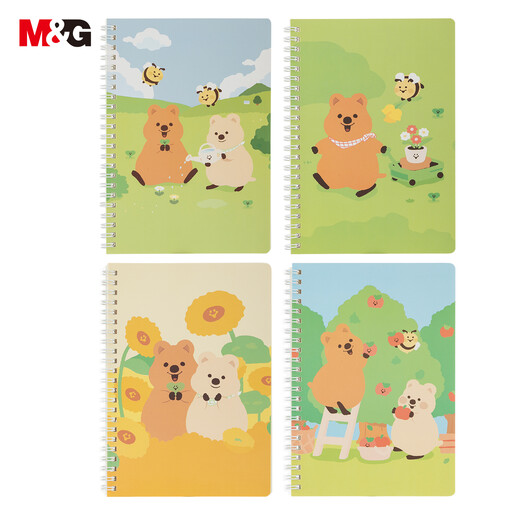
Why this choice suits this profile: The A5 format slips easily into a bag, whether at secondary school, university or the office. The pack of four notebooks lets you separate subjects, projects and personal use.
The format and quantity are clearly stated: four A5 notebooks of 60 sheets, with lined paper and spiral binding.
A practical A5 format, easy opening thanks to the spiral binding, and four illustrated covers.
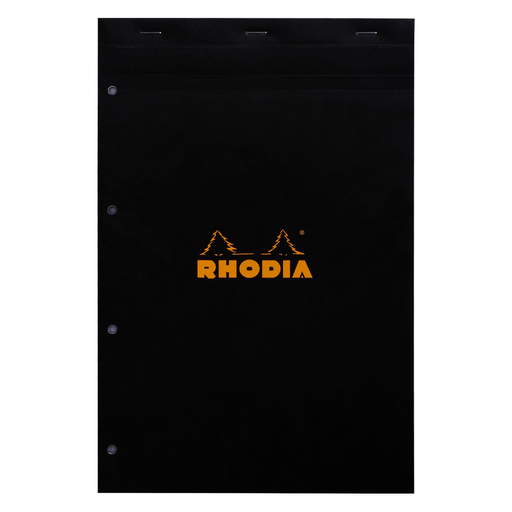
Why this choice suits this profile: This pad is aimed at those who want a structured surface for taking notes, drawing diagrams or doing calculations, whether at work or on the go.
The specifications state the 21 × 31.8 cm format, 80 micro-perforated sheets, 5 × 5 mm grid and four perforations.
80 gsm vellum paper, a rigid cardboard back and PEFC-certified paper, according to the information provided for the product.
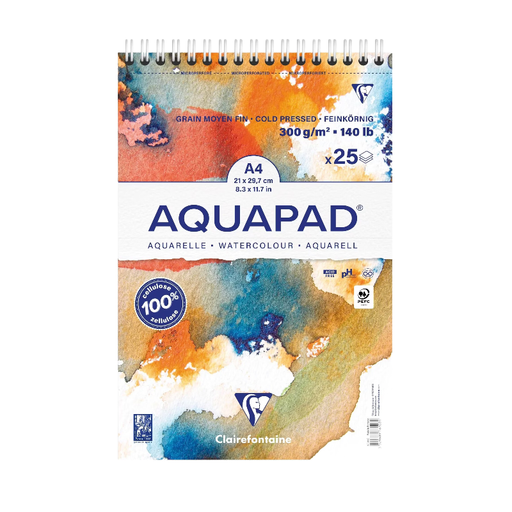
Why this choice suits this profile: This A4+ pad is suitable for amateur artists, art students and anyone working with watercolour, gouache or liquid ink.
This isn’t just a simple notebook: the paper is described as double-sized, acid-free and suitable for wet techniques.
300 gsm watercolour paper, a medium-fine grain, spiral binding and A4+ format.
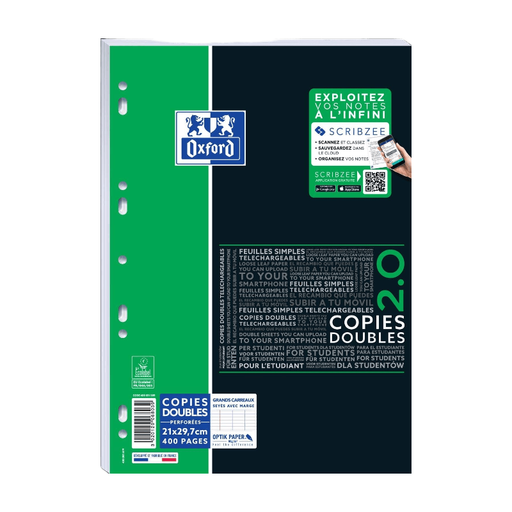
Why this choice suits this profile: Its A4 format and the stated volume make it suitable for students who take a lot of notes and want to file their sheets in a ring binder.
The product sheet mentions a 5 mm ruling, universal nine-hole perforations and Optik Paper designed to limit ink bleed-through.
An A4 format, 5 mm grid, 400 pages stated and compatibility with the SCRIBZEE app, according to the product description.
We’ve put together a comprehensive selection, updated in real time, of products that meet these strict criteria as well as European safety regulations.
An A4 or A4+ format offers more space for headings, diagrams and exercises. A 5 mm ruling is particularly suitable for subjects that involve tables or calculations. If you need to file your sheets, go for a model with perforations or detachable pages.
A Rhodia notepad is often designed for tearing out sheets cleanly, sometimes with perforations that make filing easier. A spiral notebook generally opens flat and keeps the pages together as one unit. The choice therefore depends on your priority: filing sheets separately or keeping all your notes in one place.
For pencil, charcoal or pastels, a drawing pad of 120 to 140 gsm offers a surface that’s more resistant to corrections. For watercolour, choose a dedicated paper, such as 300 gsm, and check its grain and sizing. An ordinary lecture notebook isn’t necessarily suitable for wet techniques.