
Livraison le jour même ou le lendemain

Qualité garantie

Débloquez vos offres de bienvenue: Livraison GRATUITE | Jusqu'à -80 % | 30 jours d'essai gratuits à JoyPlus
Téléchargez l'application
A notebook can be used to follow a lecture, prepare for a meeting, keep a diary or store sketches. But a smart appearance doesn't guarantee it will be a pleasure to use every day. Certain details, often overlooked, can turn an appealing purchase into an impractical accessory.
An A5 notebook offers a good balance between writing space and ease of transport, but it can quickly become bulky in a small bag. Conversely, an A6 or A7 notebook slips easily into a pocket, at the cost of more limited space for developing an idea or writing up notes.
The right choice therefore depends on your daily use: quick notes, homework, sketches, to-do lists or extended writing.
A notebook that boasts a high page count isn't necessarily the most practical. Check whether it's sheets or pages that are listed, as well as the paper weight. One sheet equals two pages when used on both sides. Spiral notebooks and micro-perforated pads can also show a different number of detachable sheets from the total number of pages stated.
A squared notebook is suitable for tables, diagrams and calculations, while a lined notebook more naturally accompanies writing. For drawing, a blank sketchbook offers greater freedom. The binding also deserves your attention: a spiral often allows it to lie flat, whereas a hard cover better protects the contents in a bag.
Here are the main sizes to compare:
Consider the dimensions of your bag, the space available on your desk and the amount of information you need to jot down each day.
Paper weight is expressed in g/m². A 70 g/m² paper is generally suitable for writing with a pen or pencil. An 80 to 100 g/m² paper offers a denser feel and can be more pleasant for sustained writing, depending on the ink used.
The terms acid-free, pH neutral, recycled, PEFC or FSC describe specific characteristics of the paper or its sourcing. They do not mean that all notebooks are compatible with all felt-tips, markers or fountain pens. For drawing, always check the weight and type of paper stated by the manufacturer.
Clairefontaine paper features in several references with weights between 80 and 90 g/m², notably in the Zap Book, Nomaddict and Koverbook ranges.
An elastic closure, a bookmark or an inner pocket can also help with organisation. However, these accessories do not replace choosing the right size.

Why this choice suits this profile: Their small size is ideal for lists, reminders and notes taken on the move. The pack of four allows you to separate subjects, tasks or projects.
The number of notebooks and the A7 size are clearly stated. The top binding makes one-handed note-taking easy.
Four notebooks, squared paper, soft cover and 50 sheets per notebook.
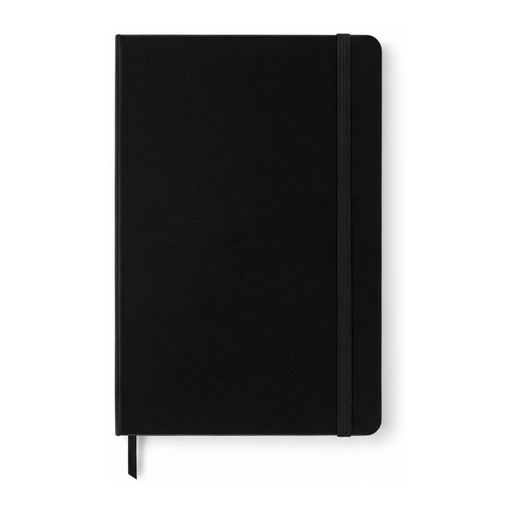
Why this choice suits this profile: This Moleskine notebook lends itself to journaling, professional ideas and sketches thanks to its hard cover with a sleek style.
The product page specifies the presence of a hard cover, 180° lay-flat opening, an elastic closure and an inner pocket.
Acid-free ivory paper, 70 g/m², bookmark, expandable pocket and elastic closure.
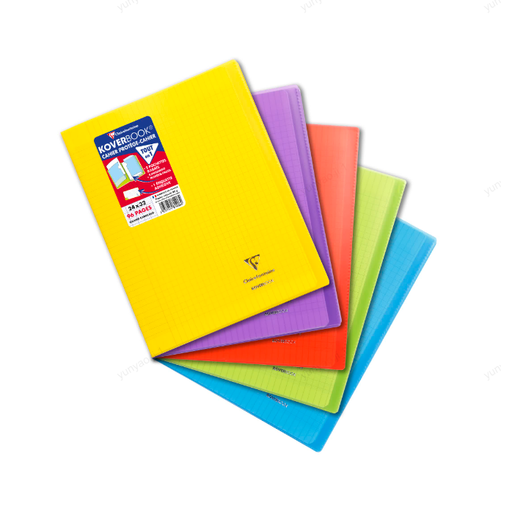
Why this choice suits this profile: The 24 × 32 cm size and integrated pockets are ideal for homework, folders and documents to keep with each subject.
The polypropylene cover protects the exercise book, while the two flaps allow you to store loose sheets.
96 pages, Clairefontaine Velin Velouté 90 g/m² paper, wide ruling, pack of five and made in France.
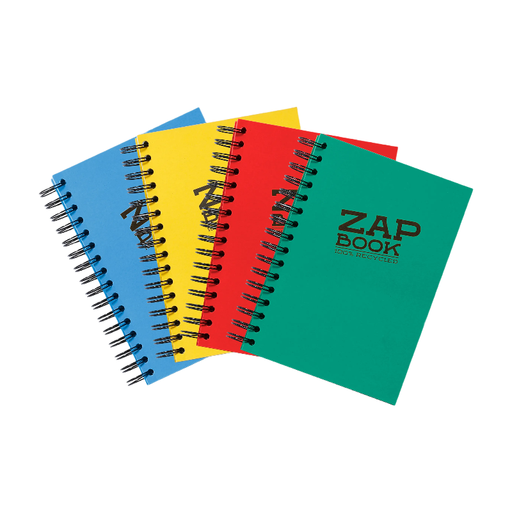
Why this choice suits this profile: The large-format blank pages give you plenty of room for sketches, plans, annotations and graphic compositions.
The product is presented as a sketchbook with blank pages, not as a squared or lined exercise book.
A4 format, 160 sheets, 80 g/m² 100% recycled paper, acid-free and pH neutral, with spiral binding.
We've put together a comprehensive list, updated in real time, of products that fully meet these strict selection criteria and European safety regulations.
The A5 notebook suits the majority of uses: meetings, lectures, journaling and personal organisation. To slip it into a pocket or jot down a quick reminder, go for an A6 or A7 notebook. The A4 size is better suited to diagrams, drawings and work that requires a large writing surface.
A lined exercise book makes writing and taking notes in class easier. A squared exercise book is more suitable for tables, calculations and diagrams. In French schools, the Seyès ruling remains a very common standard. Blank pages are better suited to drawing, mind mapping and sketchbooks.
It all depends on its storage conditions and how often it's used. Keep it in a dry place, avoid compressing the binding and protect it from moisture. A hard cover generally withstands repeated handling better, while a softcover notebook remains lighter and easier to carry.