
Livraison le jour même ou le lendemain

Qualité garantie

Débloquez vos offres de bienvenue: Livraison GRATUITE | Jusqu'à -80 % | 30 jours d'essai gratuits à JoyPlus
Téléchargez l'application
For back-to-school, the office, or simply for jotting down your ideas, choosing a notebook seems like child's play. And yet... who hasn't cursed at a notepad with ink that bleeds and ghosts through the pages, a binding that falls apart after a few weeks, or a size that turns out to be completely impractical? Faced with overwhelmingly stocked shelves, it's easy to make a mistake. This guide is here to help you see things clearly and make the right choice, once and for all.
Before we get technical, let's review the classic disappointments so you never fall into the same traps again.
To make the right choice, there are three points to examine closely: paper weight, binding type, and the size/ruling combination.
Expressed in grams per square metre (gsm), paper weight determines the thickness and opacity of the page. It's what makes all the difference.
The sturdiness and usability of your notebook depend directly on it.
The format is a trade-off between portability and storage capacity.
As for the ruling (the lines), it guides your writing: large squares (Séyès) for schoolchildren, small squares (5x5 mm grid) for scientists, or lined for those who prefer complete freedom.
Enough theory, let's get practical! To illustrate this advice, here are three products that check all the right boxes for three distinct user profiles.
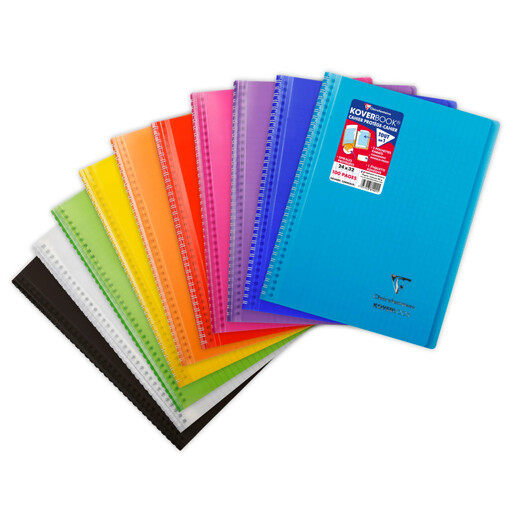
Why we chose it: It's the Swiss Army knife for middle and high school students. Its 24x32 cm format is a staple on school lists, and its polypropylene cover doubles as an ultra-durable protector.
Its 90 gsm Clairefontaine paper says no to ink bleed-through. It also eliminates the need for an extra cover that tears after a month.
Its two large pocketed flaps are brilliant for bookmarking your page or storing loose sheets without losing them.
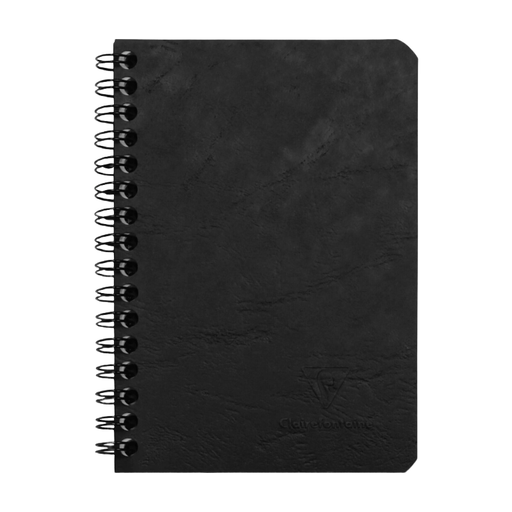
Why we chose it: Pocket-sized, a textured hardcover, an understated look... It's the ideal, elegant companion for professionals on the move, perfect for jotting down an idea between meetings.
Its sewn perfect binding is designed to last and opens perfectly flat (180°), unlike cheap bindings that break or bulge in the middle.
Experience the pleasure of 90 gsm "Vélin Velouté" paper in such a compact format. A delight, even with a fountain pen.
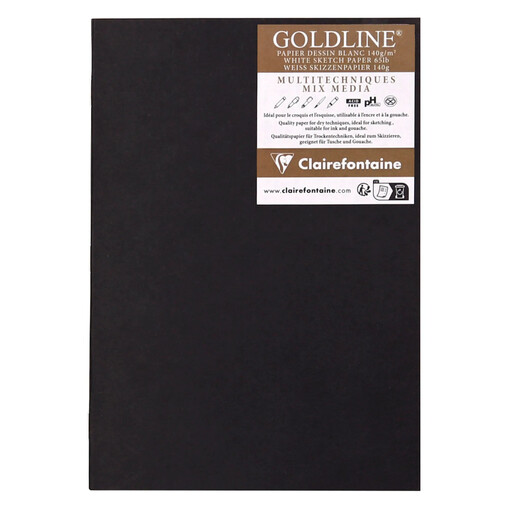
Why we chose it: Specially designed for creatives, this is the ultimate multi-technique surface. Its thick paper is an ideal compromise for juggling drawing and light wet media.
Thanks to its 140 gsm weight, you can say goodbye to paper that buckles at the first drop of water or tears after a couple of erasures. This is a true technical paper, not just a simple notebook.
Its versatility. It handles dry media (pencil, charcoal) just as well as India ink or a touch of watercolour, making it a perfect travel or study sketchbook.
Discover our full selection of notepads and notebooks that meet all our criteria for quality and durability.
For a simple ballpoint pen, 80 gsm paper may be sufficient. But if you're a fan of fountain pens, gel ink rollers, or markers, don't think twice: opt for a paper of 90 gsm or higher. Trusted brands like Clairefontaine or Rhodia are renowned for their bulletproof opacity.
The A4 format measures 21 x 29.7 cm. The 24x32 cm notebook, however, is larger. This is the standard size in the French school system, and for good reason: its dimensions allow you to paste in A4 sheets (handouts, assignments) without them sticking out and getting damaged. It's simply neater and more practical.
To make a more environmentally friendly purchase, look for certifications on the cover. The most reliable and common ones are PEFC (Programme for the Endorsement of Forest Certification) and FSC (Forest Stewardship Council). They guarantee that the paper is made from wood sourced from sustainably managed forests.