Joybuy Insights

How to Choose the Right Notebook: A Practical Buyer’s Guide

Finding the right notebook seems simple enough, yet the experience often ends in disappointment. Who hasn't been tempted by a beautiful cover, only to discover that ink bleeds through the pages, the binding falls apart after a few weeks, or the size is anything but practical? These minor annoyances can turn a simple purchase into a real headache, whether for school supplies, office stationery, or personal use like a diary.

To stop wasting money on a notebook that will end up forgotten in a drawer, let's review the most common pitfalls to avoid.

  • So-called "premium" paper that soaks up ink: Some manufacturers boast of "superior quality" paper without ever mentioning its weight. The result: a page so thin that ink bleeds or ghosts on the other side, rendering half your notebook unusable.
  • Binding that falls apart at the slightest provocation: A simply glued binding can quickly come undone, especially if the notebook travels frequently in a bag. Another deal-breaker: the inability to open it completely flat, which makes writing near the centre margin particularly difficult.
  • The falsely "rigid" cover that gets dog-eared in two days: A good cover is meant to protect your notes. But a low-quality hardcover will bend at the slightest impact in a bag, while a flimsy softcover will be dog-eared after its first use.

The Real Criteria for a Notebook That Suits You

To sort the good from the bad, rely on objective technical specifications. They are the best indicator of a product's true quality and its intended use.

Paper Weight: The Crucial Factor

Paper weight, expressed in grams per square metre (g/m? or gsm), is the main indicator of the paper's thickness and opacity.

  • 80 gsm: This is the standard for a lined notebook or office notepad. Perfect for ballpoint pens and pencils, it may still allow ink from gel pens or the most generous fountain pens to show through.
  • 100 gsm: This is a step up in quality. This weight offers a much better writing experience. Ink bleed-through is virtually eliminated, making it compatible with most pens, including fountain pens with moderate ink flow. An excellent compromise for a personal journal or for notes you want to keep.
  • 120 gsm and up: The heavyweight, ideal for creative uses like drawing, light watercolour, or using markers. The paper is thick, durable, and perfectly opaque. Think sketchbooks or Clairefontaine-style index cards.

The Binding: The Secret to Durability and Comfort

The way the pages are held together determines not only your notebook's sturdiness but also its ease of use.

  • Stitched Binding: Pages are grouped into small booklets, or signatures, which are then sewn together. This is the gold standard, as it guarantees a perfectly flat opening (known as lay-flat), ideal for writing across the entire width of both pages. It's the hallmark of a notebook built to last.
  • Spiral Binding: Extremely practical, it allows for a 360° opening, letting you fold the notebook back on itself. Perfect when space is limited. However, beware of low-quality spirals that tend to bend and snag on everything.
  • Perfect Binding (Glued Spine): Very common on inexpensive notepads, it's economical but fragile. With poor-quality glue, the pages will inevitably detach one by one.

The Format: A Size for Every Use

The format should match your primary use case.

  • A5 (14.8 x 21 cm): The ultimate all-rounder. Neither too big nor too small, the A5 notebook is the perfect companion for meetings, classes, or journaling.
  • A6 (10.5 x 14.8 cm): The pocket notebook size. It slips in anywhere, perfect for capturing an idea on the fly.
  • A4 (21 x 29.7 cm): The desktop format. Reserved for more stationary use, it offers a comfortable writing surface for project planning, complex diagrams, or long-form writing.

Our Top Notebook Picks for Every Need

To help you see more clearly, here are three models that tick all the right boxes, each in its own category.
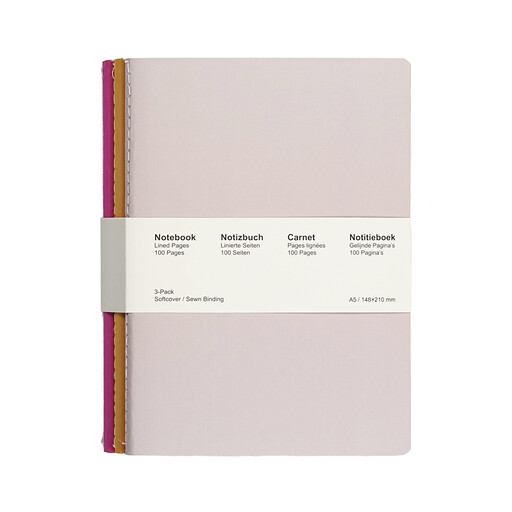
IDEAL FOR: EVERYDAY USE & STUDENTS
Jubiluu A5 Softcover 3-Pack Stitch Notebook - 50 Sheets (80g offset paper) - Classic Cream Ruled Journal for School, Office, Journaling, or Everyday Note-Taking-Vivid Pastel

Jubiluu A5 Softcover 3-Pack Stitch Notebook - 50 Sheets (80g offset paper)

Why we chose it: This pack of notebooks is a practical and budget-friendly solution. The A5 format is an all-rounder for classes and note-taking, while the stitched binding ensures a comfortable lay-flat opening—a real bonus for heavy use.

How It Avoids the Pitfall

Its 80 gsm paper is a good compromise for daily use, avoiding the ghosting effect of low-quality paper. The stitched binding is far more reliable than a simple glued spine that's likely to fall apart.

Key Advantage

Sold in a pack of three to organise subjects or projects. Lightweight and easy to carry.

IDEAL FOR: THE MOBILE PROFESSIONAL
Jubiluu A6 Premium PU Hardcover Pocket Notebook with Lined Pages - 80 Sheets (100g offset paper)

Jubiluu A6 Premium PU Hardcover Pocket Notebook - 80 Sheets (100g offset paper)

Why we chose it: Its A6 pocket-sized format and PU hardcover make it the ideal travel companion. The extra features (elastic band, pen loop, bookmark) are perfectly designed for mobility and flawless organisation.

How It Avoids the Pitfall

The PU hardcover effectively protects the pages and says goodbye to dog-eared corners. The thicker 100 gsm paper supports most inks without ghosting or annoying show-through.

Key Advantage

Durable and elegant cover. Integrated practical accessories for on-the-go use.
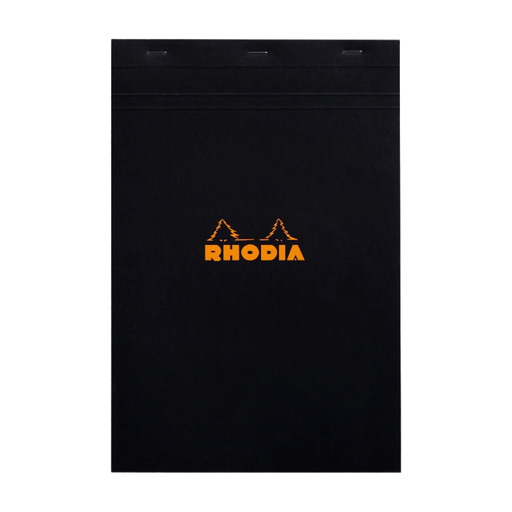
IDEAL FOR: TECHNICAL WORK & PLANNING
CLAIREFONTAINE Rhodia Black No. 19 Ring-Bound Notebook, 21 x 31.8 cm, 80 Sheets, 5×5 mm Squared Ruling, 80 g/m? Paper

CLAIREFONTAINE Rhodia Black No. 19 Ring-Bound Notebook, 21 x 31.8 cm

Why we chose it: Its large format (close to A4) and squared ruling are perfect for diagrams, charts, and detailed plans. Its ultra-rigid cardboard back even lets you write without a surface: a decisive advantage for architects, engineers, or project managers in the field.

How It Avoids the Pitfall

The Clairefontaine 80 gsm satin vellum paper is an absolute benchmark, guaranteeing a perfect glide and controlled opacity. The thick cardboard back provides a stable writing surface in any situation, even on your lap.

Key Advantage

Large format for large-scale projects. Micro-perforated pages for clean tear-out.

Want to explore more options?

Discover our full selection of products that meet our demanding quality standards.

Frequently Asked Questions about Notebooks

What paper weight should I choose for my notebook?

For everyday use with a ballpoint pen, 80 gsm paper is sufficient. If you're a fan of liquid ink, gel, or fountain pens, opt for a weight of 100 gsm or more to prevent the ink from bleeding through.

Spiral or stitched binding: which to choose?

A spiral notebook is very practical because it opens 360°, ideal for a cluttered desk or for writing while standing. A stitched notebook is more durable and offers a perfectly flat opening without interruption in the middle, which is more comfortable for writing or drawing across a two-page spread.

How do I know if a notebook is fountain pen friendly?

The number one criterion is paper weight: aim for at least 90 gsm, and ideally 100 gsm or more. Brands like Clairefontaine or Rhodia are renowned for the quality of their vellum paper, which ensures a perfect glide and low absorption. This limits feathering (ink spreading into the paper's fibres) and ghosting.