
Livraison le jour même ou le lendemain

Qualité garantie

Débloquez vos offres de bienvenue: Livraison GRATUITE | Jusqu'à -80 % | 30 jours d'essai gratuits à JoyPlus
Téléchargez l'application
Whether for the back-to-school season, organising your professional life, or simply unleashing your creativity, choosing a notebook is a significant decision. With a jungle of sizes, rulings, and paper qualities, it's easy to get lost.
Our mission is to help you navigate the options. This guide is designed to give you objective criteria, free from marketing hype, to find the notebook that perfectly meets your needs.
Before diving into our selection, let's review the key points that make all the difference.
The size of your notebook determines almost everything else.
The ruling (the lines on the pages) should primarily suit your writing style and intended use.
The quality of stationery is first judged by its paper weight. Expressed in grams per square metre (gsm), it defines the paper's thickness and opacity. A 80?gsm paper is a versatile standard, but a weight of 90?gsm or more will offer a far superior writing experience, preventing ink from bleeding through the page.
As for the binding (stapled, spiral, sewn), it plays a crucial role in the notebook's durability and handling. A sewn binding, for example, allows for a perfectly flat opening.
To guide you, we've selected three products that each excel in a specific category, from the classroom to the office.
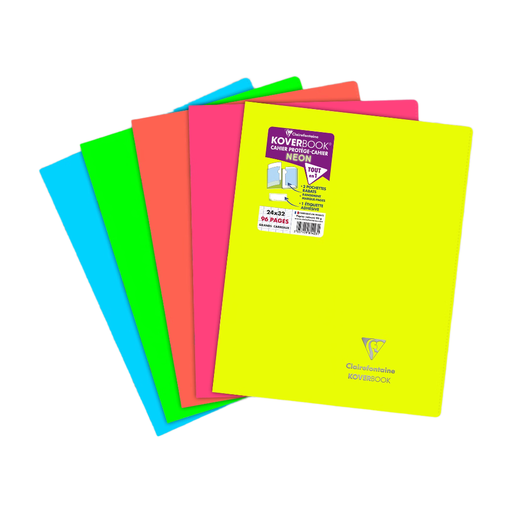
What sets it apart
The Koverbook is the ultimate all-in-one solution. Its sturdy polypropylene cover replaces a separate notebook cover—no need to buy one. Cleverly, its two large flaps serve as both bookmarks and pockets for slipping in a few documents. A functional and durable choice to tackle an entire school year.
Pros
Who is it for? Ideal for middle and high school students looking for a sturdy and smart 24x32 cm notebook that can withstand the rigours of a school year without a hitch.
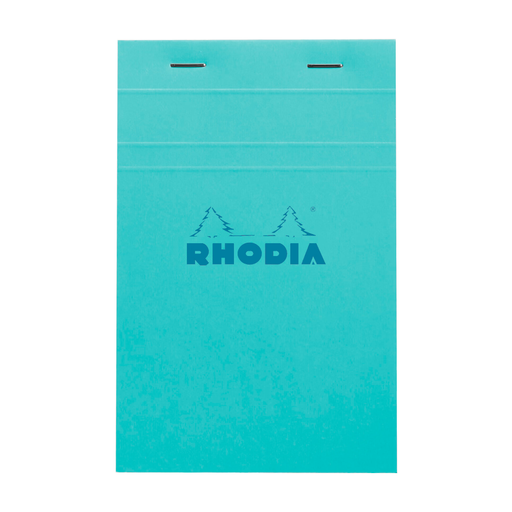
What sets it apart
A brand classic, this Rhodia notepad in A5 format comes in vibrant colours. Here, everything is designed for efficiency: the 80 sheets are micro-perforated to tear out cleanly, while the ultra-rigid cardboard back allows you to write anywhere, even without a surface. Its 5x5?mm grid is a real asset for technical notes.
Pros
Who is it for? For professionals, students in science or technical fields, and anyone who juggles diagrams, lists, and sketches on a daily basis.
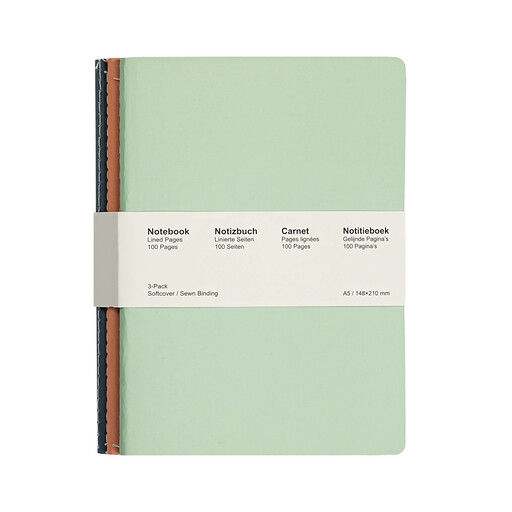
What sets it apart
This set of three notebooks focuses on aesthetics and a design tailored for personal writing. Its sewn binding allows it to open perfectly flat—superb comfort for writing or drawing across the entire double-page spread. The cream-coloured 80 gsm paper, which is easier on the eyes, and the lined notebook format make it a great daily companion.
Pros
Who is it for? Perfect for journaling enthusiasts, aspiring writers, creatives, and anyone who loves to organise their thoughts in notebooks that are as beautiful as they are practical.
Our selection is just a glimpse of the possibilities. If you're looking for a specific size, colour, or binding, the world of stationery is nearly endless.
Explore our complete collection of stationery notebooks to discover a wider range of products for all styles and budgets.
Although their dimensions are similar, they are not the same. An A4 sheet measures 21?x?29.7?cm. The slightly larger 24?x?32?cm format allows you to paste an A4 sheet inside without it sticking out or its corners getting damaged. That's why it remains the top favourite for French school supply lists.
It all depends on your writing tools. For standard use with a ballpoint pen or pencil, a 70 to 80?gsm paper is sufficient. However, if you're a fan of fountain pens, markers, or highlighters, a 90?gsm (or higher) paper is highly recommended. It will absorb ink better, prevent it from bleeding through the page, and offer you an unparalleled glide.
A lined notebook is perfect for pure writing (diaries, continuous note-taking). A graph notebook (Seyès or 5x5?mm), being more structured, is ideal for subjects requiring precision (maths, science) or for those who like their notes, tables, and diagrams to be perfectly aligned.