
Livraison le jour même ou le lendemain

Qualité garantie

Débloquez vos offres de bienvenue: Livraison GRATUITE | Jusqu'à -80 % | 30 jours d'essai gratuits à JoyPlus
Téléchargez l'application
A Nordlux designer pendant light can sometimes transform a dining room, kitchen or living room. But choosing the right light fitting involves more than appearance alone. An incompatible socket, insufficient illumination, an unadjustable cable or a misunderstood IP rating: some mistakes only become apparent once the pendant has been installed.
This 2026 selection is based on verifiable technical specifications to compare different styles, sizes and applications. The aim is to help you choose a Scandinavian pendant light, a contemporary design or an outdoor model without relying solely on photographs and marketing claims.
A metal-and-glass pendant light can be highly decorative, but the quality of its illumination depends mainly on the bulb, the shape of the shade and how the light is distributed. An enclosed model or one directed downwards produces more focused lighting, while opal glass or a white interior spreads brightness more evenly.
For a pendant light above a dining table, check whether the light is diffuse, direct or indirect. A highly attractive fitting that causes glare can quickly become frustrating in everyday use.
E27, E14, G9 and GU10 sockets are not interchangeable. You must also observe the maximum wattage specified by the manufacturer. Some Nordlux models, for example, accept an E27 bulb of up to 40 or 60 W, while G9 pendants may be limited to 5 or 25 W depending on their design.
The bulb is not always included. Make sure you allow for a compatible light source and check its colour temperature, wattage and compatibility with a dimmer.
An IP20 rating is suitable for indoor use in a dry environment. It is not appropriate for installation on a terrace exposed to moisture. For outdoor use, look for a higher level of protection, such as IP54, and ensure that the electrical connections are properly protected.
An IP54 rating does not mean that the fitting can be submerged or exposed to a direct jet of water. The manufacturer’s recommendations and French electrical installation regulations remain essential.
The socket determines which type of bulb you need to buy:
A dimmable LED pendant is not necessarily compatible with every wall dimmer. The Clyde, for example, features a three-level dimming function controlled via a standard wall switch, but its LED cannot be replaced.
Start by measuring the length of the table, island or area you want to illuminate. A 90 cm pendant, such as the Contina 3-light, will be better suited above a large table than in a compact dining area.
The cable length also deserves attention. The models presented often come with a 200 cm cable, but adjustability varies depending on the ceiling rose and mounting system. With the Orbiform, part of the cable can be concealed inside the ceiling rose, with a minimum visible length of 60 cm.
Before drilling, check whether a compatible ceiling hook is present, note the weight of the fitting and assess the type of ceiling. Some models attach to a ceiling hook, while others require a dedicated mounting system.
In a living space, an IP20 rating is generally suitable provided the pendant is installed in a dry area. For a conservatory, covered terrace or outdoor entrance, the Linton has an IP54 rating and a design suited to outdoor conditions, with a galvanised steel base.
However, an outdoor installation must preserve the watertight integrity of the connections. In France, it is best to call on a qualified electrician for any connection to the mains.
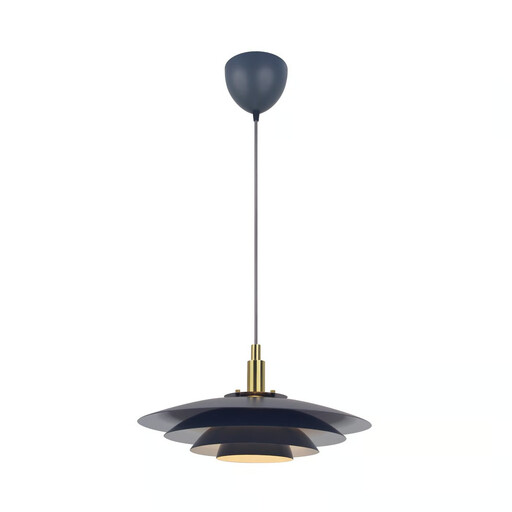
Why this model suits this profile: with its 38 cm diameter and Scandinavian lines, it fits easily into a dining room or living room of standard dimensions.
The product details specify a G9 socket, a maximum wattage of 25 W and indoor IP20 use. The bulb must nevertheless be purchased separately.
A multi-layer metal shade, a white interior and compatibility with a dimmable bulb.
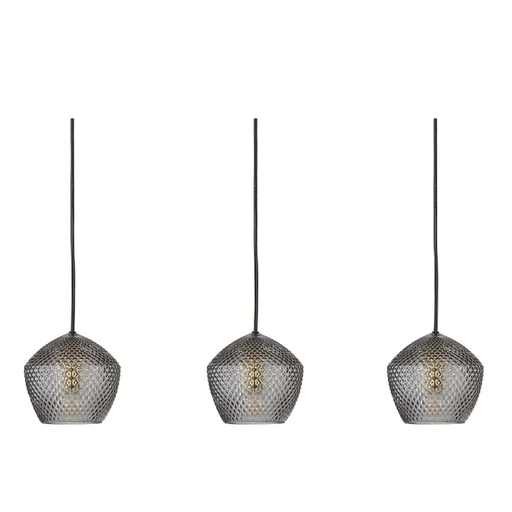
Why this model suits this profile: its three blown-glass globes and geometric pattern work equally well above a long dining table or alongside an Art Deco-inspired interior.
The height can be adjusted by storing the cable inside the ceiling rose, without cutting it. Variations in the bubbles and thickness of the blown glass are part of its handcrafted character.
Three E14 light sources, a ceiling rose for adjusting the cable and individually crafted blown-glass diffusers.
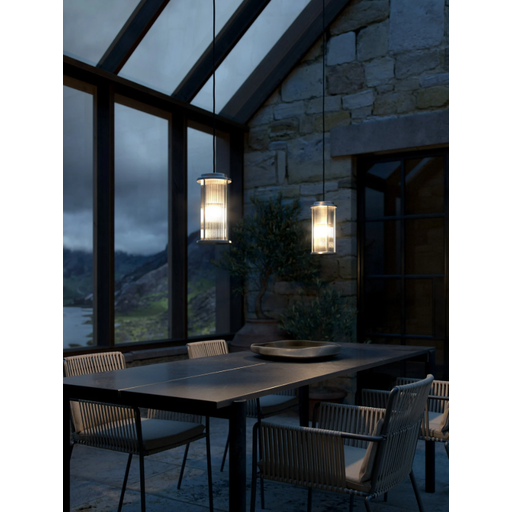
Why this model suits this profile: its lantern-inspired design and IP54 protection are made for covered terraces, conservatories and landscaped outdoor areas.
Its IP54 rating sets it apart from an indoor IP20 pendant. It does not, however, remove the need to protect the connections from water or to avoid submersion and direct jets.
An E27 socket, a galvanised steel structure and a ribbed diffuser to soften the light in a covered outdoor area.
Explore a regularly updated selection of metal pendant lights, with sizes and styles suited to every type of interior.
For a softer atmosphere, the Freya 35 beige combines an organic shape, a metal shade and an E27 socket. Also fitted with an E27 socket, the Cera in brass directs most of its light downwards and works well above a table or kitchen island.
Fans of vintage interiors may prefer the Franca 4-light, with four E14 light sources and white glass globes. For a more contemporary silhouette, the Contina 3-light combines three G9 sources with a sleek black profile spanning 90 cm. Finally, the Clyde 4-light features a non-replaceable LED, four 350-lumen light sources and a colour temperature of 2,700 K.
A distance of approximately 70 to 90 cm between the tabletop and the bottom of the pendant is a good starting point. Adjust it according to the size of the light fitting, the ceiling height and the level of visibility you want to maintain between diners.
It depends entirely on the bulb or integrated LED module. A low-wattage LED will generally consume less than a more energy-intensive bulb. Check the wattage, number of light sources and expected operating time. For the Clyde, the technical specifications state a total active power consumption of 16 W.
The mains connection must comply with French electrical standards. Always switch off the power before carrying out any work and check that the ceiling mounting is secure. For a fixed connection, a heavy light fitting or an outdoor installation, calling on a qualified electrician remains the safest option.