Hosts keeping an eye on salt across the whole meal
You’re making pasta for guests who want to limit salt, and you also want to choose the sauce, condiments and toppings accordingly.


For an Italian evening when you want to limit salt, start with plain pasta and compare the tomato base and toppings you plan to add, rather than looking only for noodles labelled ‘reduced salt’. Chopped tomatoes or passata with no added salt let you control the seasoning, but this claim doesn’t mean the product contains 0 g of salt: check the ‘salt’ line per 100 g and factor in any condiments, cheese and cured meats.
You’re making pasta for guests who want to limit salt, and you also want to choose the sauce, condiments and toppings accordingly.
You want to get dinner on the table quickly without letting a pre-seasoned sauce dictate the flavour of the whole dish.
You want to use chopped tomatoes, passata or tomato purée in several dishes and choose a pack size that suits how you’ll store it after opening.
For this dinner, first decide how you want to make the sauce, then compare the ‘salt’ line and ingredients of the products you’re considering. The French Directorate-General for Competition Policy, Consumer Affairs and Fraud Control (DGCCRF) says that nutrition information given per 100 g or 100 ml makes it easier to compare products.
| What matters | What to check | Who it’s for |
|---|---|---|
| Salt in your meal | Compare the salt per 100 g of sauce and check which salty toppings will be going into the dish. | I’m planning to serve cheese or cured meats with the pasta and want to keep an eye on the salt in the whole meal; around 42% of consumers prioritise this overall check. |
| Preparation time | Tell a ready-made sauce apart from chopped tomatoes or passata, then check which ingredients have already been added. | If dinner needs to be ready quickly, I want a sauce whose seasoning I can still adjust; around 33% of consumers prioritise speed while keeping that flexibility. |
| Pack size and leftovers | Check the amount in each pack and the storage instructions after opening. | For a small gathering, I want to open a suitable amount and plan how to use the rest; around 25% of consumers prioritise pack size and storage first. |
Egg noodles, ramen or instant noodles shown in the aisle viewed at Carrefour aren’t automatically right for an Italian menu, and their presence in that aisle tells you nothing about their salt content.
For this meal, choose pasta that suits your recipe, then compare the tomato base and the other ingredients you’ll be serving with it separately.
On Auchan’s product pages, Jardin BiO étic chopped tomatoes and passata carry the ‘no added salt’ claim, yet show 0.02 g and 0.03 g of salt per 100 g respectively.
Check the ‘salt’ line in the nutrition information for the exact product, even when the front of the pack highlights that no salt has been added.
Cheese, cured meats and condiments can also add to the salt in your meal, so choosing a low-salt tomato base won’t, by itself, take care of the toppings.
Decide how much to use as you put the dish together, add flavour to the sauce with herbs and spices, then taste before adding more salt.
Instructions vary by product: the pages for the Jardin BiO étic tomato bases mentioned here say to use them within 3 days of opening, compared with 5 days for the 500 g Mutti purée featured at Auchan.
Choose an amount to suit the number of guests and follow the storage instructions on the pack you open.
These examples relate to the specific products mentioned, not to every sauce or tomato base from each brand.
A 500 g carton of chopped tomatoes and a three-pack of 200 g passata cartons, both presented by Auchan as tomato bases with no added salt.
The 200 g Prosain tomato sauce with no added salt featured at Carrefour is a ready-made option if you don’t want to start with a plain tomato base.
Auchan features Mutti tomato purée with no added salt in a 500 g carton, which you can use as a base for a sauce and season to taste.
These tomato purées can be used as a starting point for a pasta sauce that you season yourself. If you’re choosing with the aim of limiting salt, compare the ingredients and the ‘salt’ line on each variant’s packaging: a range name or pack size alone doesn’t tell you what it contains.
 Image unavailable
This 500 g carton of tomato purée is a handy starting point for a sauce you can season yourself. Before choosing it for this meal, check the ingredients and salt content on the packaging.
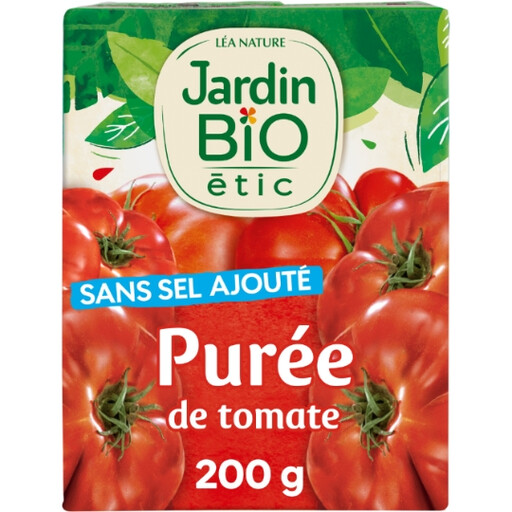 Image unavailable
The 200 g pack lets you choose a smaller amount of tomato base for a homemade sauce. Compare its ingredients list and salt per 100 g with those of the other products you’re considering.
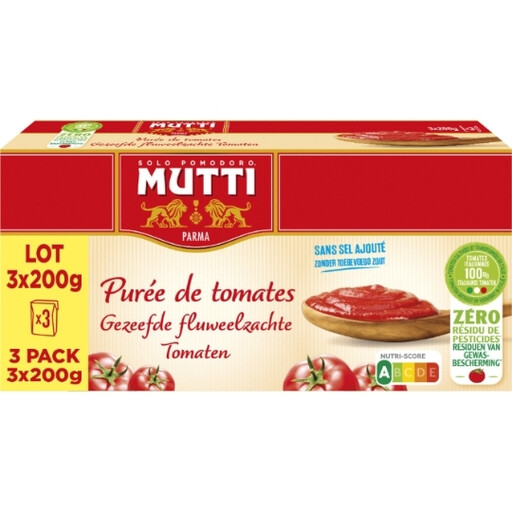 Image unavailable
This pack of three 200 g cartons lets you split the tomato base between several dishes. If salt content is important for your menu, check the ingredients list and nutrition information on the exact packaging before choosing this variant.
Compare the ‘salt’ line per 100 g, or per 100 ml where products are labelled that way, rather than looking only at the amount in each pack. The DGCCRF says that presenting nutrition information this way makes it possible to compare products on a like-for-like basis.
No. This claim on its own doesn’t mean 0 g of salt. Auchan’s product pages for Jardin BiO étic chopped tomatoes and passata show 0.02 g and 0.03 g of salt per 100 g respectively. Check the value shown for the product you’re buying.
You could use garlic, onion, basil, other herbs or spices, then taste the sauce before adding more salt. Remember to take account of the condiments and toppings you’re planning to serve with the dish too.
Follow the time limit on the packaging for the product you’ve opened: Auchan’s product pages for the Jardin BiO étic bases mentioned here say to keep them chilled and use them within 3 days, while the page for the 500 g Mutti purée says to refrigerate it and use it within 5 days. Choose a pack size based on how much you’ll use within that time.