
Livraison le jour même ou le lendemain

Qualité garantie

Débloquez vos offres de bienvenue: Livraison GRATUITE | Jusqu'à -80 % | 30 jours d'essai gratuits à JoyPlus
Téléchargez l'application
Choosing a new frying pan? It can be overwhelming. Between marketing promises of durability and sometimes vague safety labels, it's hard to know where to start. As a product expert at Joybuy, I'm here to help you see things more clearly. On paper, the nonstick ceramic pan has it all, especially if you're aiming for healthy cooking. But beware of the pitfalls that can turn a good investment into a real disappointment. Let's break down how to make the right choice together.
Marketing is king in the cookware aisle, but promises don't always stand up to the test of daily use. Here are the three most common traps to avoid so you don't regret your purchase.
To avoid these disappointments, it's best to rely on objective technical criteria. These are the true guarantors of your future pan's quality and longevity.
The coating is the core technology of a nonstick ceramic pan.
A good pan should be versatile. Two points to check absolutely:
passe au four): Very practical for finishing a dish or keeping it warm. Check two crucial points: the maximum temperature the pan can withstand AND its handle. For high temperatures (over 180°C / 350°F), a stainless steel or, even better, a removable handle is essential.Healthy cooking is more than a trend; it's an expectation. And it all starts with safe, inert materials.
Rather than an endless list, we've selected three products that meet specific needs while adhering to our performance and safety criteria.
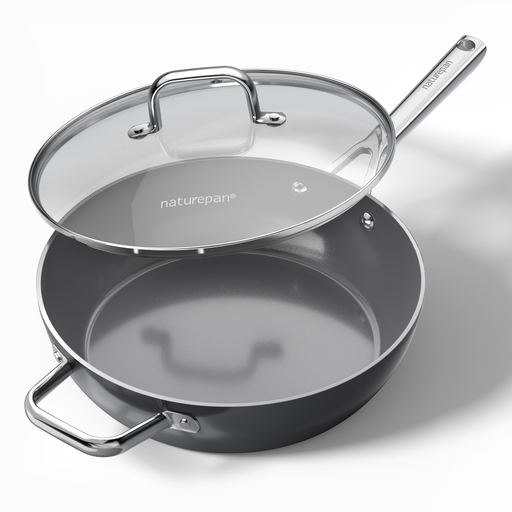
Why this model? Ideal for families, its 28 cm size and high sides make it a true nonstick sauté pan, perfect for saucy dishes, stews, or large batches of vegetables. The included lid is a real bonus that multiplies its versatility.
Its titanium and diamond-reinforced ceramic coating is designed to last, directly addressing the problem of pans that lose their effectiveness after a few months of use.
Guaranteed PFAS, PFOA, and PTFE-free. Its stainless steel handle allows it to go in the oven up to 260°C (500°F), for maximum versatility from stovetop to table.
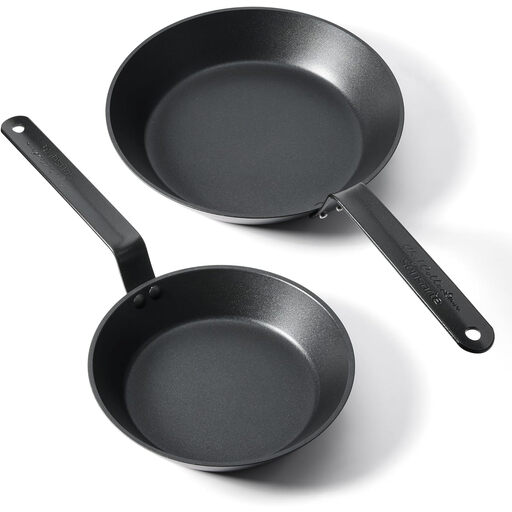
Why this set? This pan set is perfect as a starter kit or for replacing your basics without breaking the bank. The two sizes (20 and 25 cm) cover most needs, from morning eggs to an evening salmon fillet, while remaining easy to store.
It tackles the pitfall of vague labels by clearly stating the origin of its coating (Swiss ILAG) and its "PFOA/PFOS-free" guarantee. This transparency is a mark of trust for healthy cooking.
Compatible with all stovetops, including induction, and oven-safe up to 232°C (450°F). Its forged aluminium body ensures it heats up quickly while remaining lightweight and easy to handle.
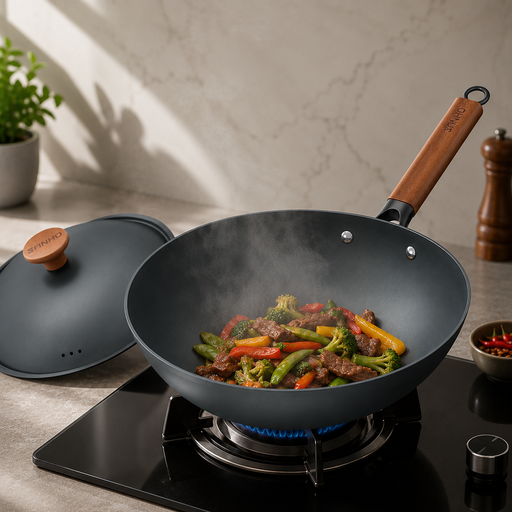
Why this wok? With its large capacity (4.7 L), this nonstick wok is designed for stir-fries, curries, and dishes to share (serves 3-6 people). Its deep shape and domed lid allow you to do everything from high-heat searing to gentle simmering.
It bypasses the pitfall of fragile conventional coatings. Its etched honeycomb structure protects the nonstick layer, even allowing for the use of metal utensils. A solution built to last.
Guaranteed PFAS, PFOA, and PTFE-free. Its beechwood handle stays cool to the touch, ensuring a comfortable and secure grip during cooking.
Discover our full selection of frying pans and sauté pans that meet our quality criteria and European safety standards.
What is the real-world lifespan of a ceramic pan? It all depends on the quality of the coating and how you care for it. An entry-level model can lose its nonstick properties in less than a year. Conversely, a well-maintained pan with a reinforced coating (used over moderate heat, washed by hand) can perform well for 3 to 5 years, or even longer.
How do I care for my ceramic pan to make it last? To maximize its longevity, follow these tips:
Is a "stone-effect" pan actually made of stone? No. The term "stone-effect" or "stone coating" is purely a marketing term. It refers to a standard nonstick coating (ceramic or otherwise) with an appearance that mimics granite. The performance does not depend on this visual effect at all, but rather on the quality of the underlying coating. Rely on the technical specifications (composition, PFAS-free guarantee, etc.), not the aesthetics.