
Livraison le jour même ou le lendemain

Qualité garantie

Débloquez vos offres de bienvenue: Livraison GRATUITE | Jusqu'à -80 % | 30 jours d'essai gratuits à JoyPlus
Téléchargez l'application
Buying a new non-stick pan? In theory, it's simple. But once you're in-store or on an e-commerce site, things get complicated amidst a jungle of technical terms and marketing promises. Your goal is clear: healthy cooking, food that doesn't stick, and a quick cleanup. But how can you be sure your purchase will last and truly meet your expectations?
As a product expert for Joybuy, my mission is to help you navigate the options. Before we get to our top picks, let's review the three common pitfalls that too often turn a good purchase into a disappointment.
The "PFOA-free" claim is everywhere. While perfluorooctanoic acid (PFOA) is indeed a problematic substance to be avoided, its absence doesn't mean your pan is free from other compounds in the same family: the notorious PFAS (per- and polyfluoroalkyl substances). For example, some PTFE (polytetrafluoroethylene) coatings are made without PFOA but are still considered PFAS. For total peace of mind, the real gold standard is the "PFAS-free" label.
The term "stone coating" sounds rugged, durable, and almost indestructible. The reality is often less impressive: it's usually just a standard non-stick coating decorated with a speckled effect. This name is by no means a guarantee of quality or longevity. True performance depends on the coating's composition (ceramic, titanium) and the number of layers, not its appearance.
It's a classic nightmare scenario: you proudly unbox your new pan, and... it's not detected by your induction hob. That's right, compatibility with "all hobs, including induction" isn't automatic. To work on an induction cooktop, a pan must have a ferromagnetic base. The smart move before buying? Look for the coil-shaped pictogram or do the magnet test.
To avoid these disappointments, focus on three key points that truly make a difference in the quality and versatility of a non-stick pan.
The choice of coating is crucial. Modern solutions go far beyond old-school coatings, focusing entirely on safety and performance.
A good pan should be able to keep up with you in the kitchen.
A pan's performance isn't just about its coating.
Because every cook is unique, here are models that meet specific needs, all selected according to the quality and safety criteria we've just covered.
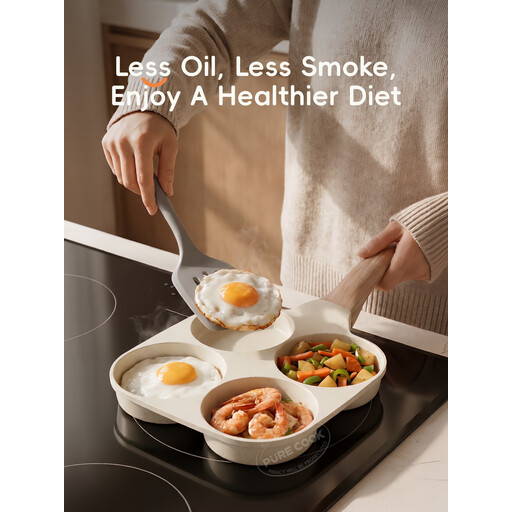
Why we chose it: Perfect for quick family breakfasts. Its four compartments allow you to cook fried eggs, blinis, or pancakes at the same time, saving you precious minutes in the morning.
Its induction compatibility is clearly stated, so there are no surprises upon unboxing. Its stone-effect coating is presented for what it is: a quality, food-grade non-stick surface, without misleading marketing jargon.
A clever multi-portion design to cook several items evenly and in record time.
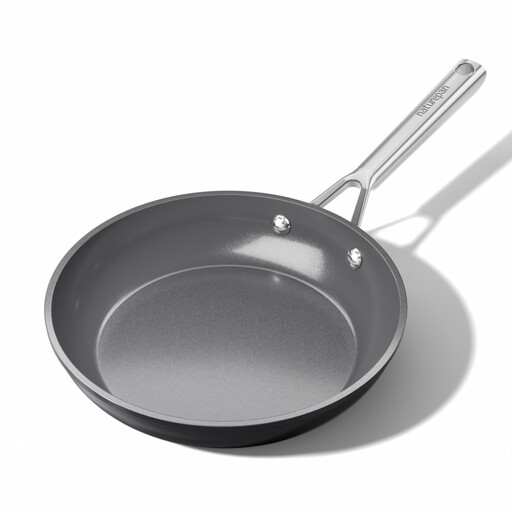
Why we chose it: This is the ultimate all-rounder pan. Its 24 cm diameter is ideal for meals for 2 to 3 people. Oven-safe up to 260 °C, it's perfect for searing meat before finishing it off gently in the oven.
This pan goes beyond just "PFOA-free": it's guaranteed to be PTFE/PFAS-free. The coating is no mystery: it's a ceramic reinforced with titanium and diamond—a clear spec sheet with no smoke and mirrors.
An ultra-durable coating and maximum versatility thanks to its all-hob and oven compatibility.
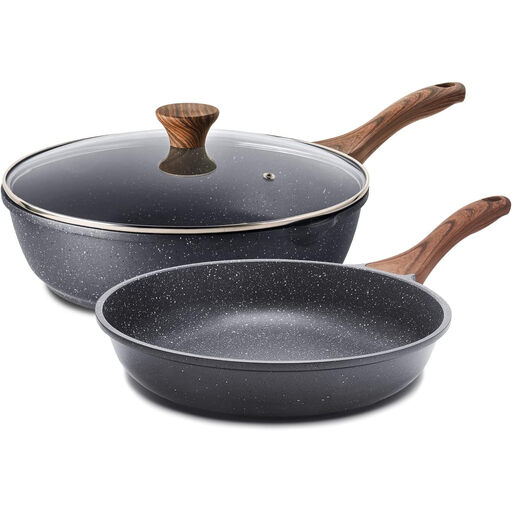
Why we chose it: The ideal duo for families and those who cook in large batches. It includes a 24 cm frying pan for daily cooking and a large 4.7 L non-stick sauté pan with a lid, perfect for slow-cooked dishes or vegetable stir-fries.
Transparency is key here: the Swiss coating is guaranteed to be free of intentionally added PFOA/PFOS. Its ultra-magnetic stainless steel base ensures flawless compatibility with induction hobs.
A frying pan + sauté pan duo that covers all your needs, from quick sears to family-sized meals, for total flexibility in the kitchen.
For even more specific needs, like cooking the perfect omelette or a simple fried egg, there are of course dedicated models like the omelette pan.
Discover our full selection of pans that meet all our criteria for quality, safety, and performance.
It all depends on how you take care of it! On average, a well-maintained, high-quality model can last for several years. Our tips to make it last:
It's not necessarily one or the other! Today, the best pans often combine both. A ceramic pan base can be reinforced with titanium particles to make it much more scratch-resistant. The most important thing isn't the name, but the construction: a multi-layer, reinforced coating will always outperform a simple one, whether it's called "ceramic" or "titanium".
The easiest way is to look for the induction pictogram (a coil-shaped logo) engraved on the bottom of the pan or on its packaging. The other foolproof trick: grab a magnet (a fridge magnet will do). If it sticks firmly to the bottom of the pan, you're good to go—it's compatible