
Livraison le jour même ou le lendemain

Qualité garantie

Débloquez vos offres de bienvenue: Livraison GRATUITE | Jusqu'à -80 % | 30 jours d'essai gratuits à JoyPlus
Téléchargez l'application
A non-stick saucepan compatible with induction hobs makes preparing sauces, milk, vegetables or small portions a breeze. But some purchases quickly disappoint: coating that deteriorates, a handle that isn't oven-safe, a diameter that doesn't match your hob, or a "free from controversial substances" promise that's hard to verify.
Before choosing an induction-compatible saucepan, it's worth sorting the genuinely useful information from the marketing hype. Here are the criteria to consider, whether you're a student, a parent, a weekend cook, or simply limited by your cupboard space.
A saucepan labelled "all hob types" isn't necessarily suitable for an induction hob. This technology requires a ferromagnetic base, usually made of magnetic stainless steel or a suitable multi-layer base.
Look for the words "induction" or "induction compatible". The simple "all hob types" symbol should be confirmed in the technical specifications. If in doubt, place a magnet under the base: if it sticks firmly, the pan likely has a magnetic base. However, only the manufacturer's documentation is truly reliable.
A non-stick coating makes cleaning easier and often allows you to cook with less fat. However, it remains sensitive to scratches, dry heating and metal utensils. As for longevity claims, take them with a pinch of salt when no objective comparison method is provided.
To preserve the surface, use a soft sponge, moderate heat and wooden, silicone or plastic utensils. A non-stick saucepan may be dishwasher-safe, but that isn't necessarily the best choice for prolonging the life of its coating.
The terms PFOA-free, PTFE-free and PFAS-free don't mean the same thing. PFOA is a substance distinct from PTFE, while the PFAS family includes many substances. A pan advertised as PFOA-free isn't necessarily free from PTFE or PFAS.
If this matters to you, check the manufacturer's precise declaration rather than relying solely on the marketing headline. Also read the information as a whole: body material, coating type and included accessories.
The base must be perfectly flat and designed for induction. An encapsulated or reinforced base can promote more even heat distribution, but results also depend on your hob's power and the diameter of the cooking zone used.
A small saucepan of 14 to 16 cm is suitable for sauces, reheating milk and individual portions. For two to four people, a diameter of 18 to 20 cm generally offers more comfort. Beyond that, it's better to opt for a larger saucepan or a stockpot if you regularly cook in quantity.
A saucepan with a lid limits splashes and makes gentle cooking easier. Glass allows you to monitor your preparation without lifting the lid, while a heavier model may retain heat better.
Also consider the weight, handle length and the presence of a pouring lip. A removable handle frees up space in a cupboard, but it must be properly locked before lifting the pan. Some models cannot go in the oven with the handle attached.
For preparing small quantities, a baby saucepan or a model of 1 to 1.5 litres may suffice. To equip an entire kitchen, a saucepan set offers several diameters, provided you check that each piece is compatible with your hob.
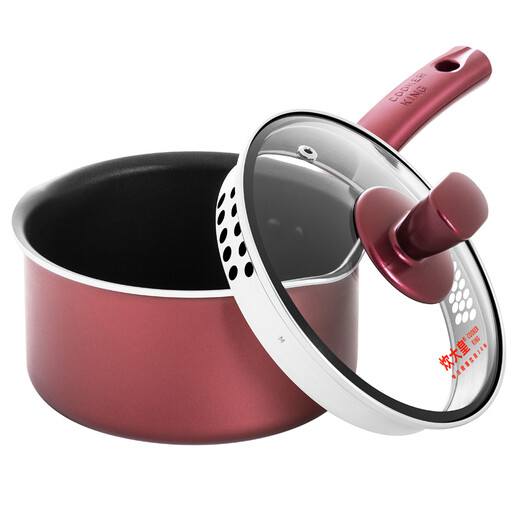
Why this choice suits this profile: This saucepan with lid covers the everyday needs of a student or a first kitchen set-up. It is advertised as non-stick and induction compatible.
The product sheet explicitly states induction compatibility and that it is PFOA-free. Two criteria that are often confused can therefore be verified separately.
A glass lid and a size suited to everyday cooking. Use moderate heat and non-metal utensils.
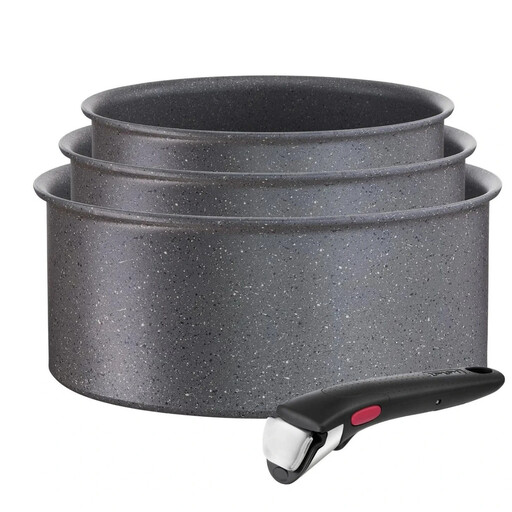
Why this choice suits this profile: The Ingenio system suits kitchens with several types of hob and households that want to store their utensils without wasting space.
The product sheet specifies that the Thermo-Fusion base is induction compatible and clearly distinguishes the removable handle, sold separately for this model.
A 16 cm format, stackable storage and a Mineralia+ coating advertised as free from PFOA, lead and cadmium in the manufacturer's product sheet.
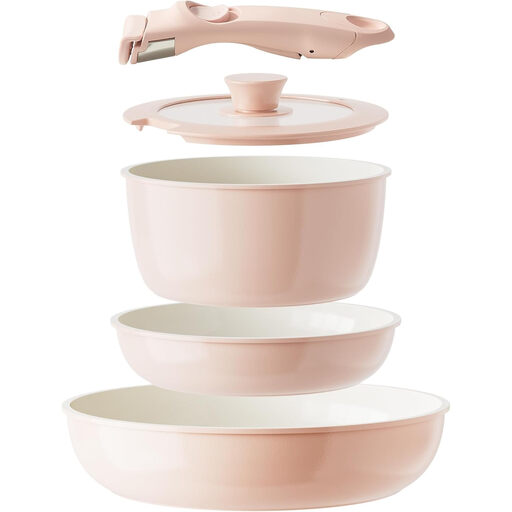
Why this choice suits this profile: This set includes a 20 cm saucepan with lid, two frying pans and a removable handle. A versatile set that suits smaller kitchens.
The description advertises a coating free from PFAS, PTFE and PFOA, as well as compatibility with induction hobs. However, check the instructions regarding oven and dishwasher use.
A stackable set with removable handle and included lid. The product sheet mentions compatibility with all hob types.
We've put together a comprehensive list, updated in real time, of products that meet these strict selection criteria and European safety regulations.
A stainless steel pan can withstand more robust utensils, but it doesn't offer the same non-stick convenience. The right choice therefore depends on your priority: quick cleaning, no coating, versatility or capacity.
Check the technical specifications and look for the word "induction". You can also hold a magnet to the base, but this test doesn't replace the manufacturer's instructions. The base must be flat, clean and close enough to the diameter of the cooking zone.
A model of 14 to 16 cm is suitable for milk, sauces, cereals and individual portions. For two to four people, a saucepan of 18 to 20 cm generally offers more comfort. The capacity stated in litres is more precise than diameter alone.
No. A PFAS-free saucepan may be made of stainless steel, enamelled cast iron or fitted with a coating described as ceramic. Check the coating composition, induction compatibility and care instructions separately. The terms "PFAS-free", "PTFE-free" and "PFOA-free" must be distinguished.