
Livraison le jour même ou le lendemain

Qualité garantie

Débloquez vos offres de bienvenue: Livraison GRATUITE | Jusqu'à -80 % | 30 jours d'essai gratuits à JoyPlus
Téléchargez l'application
Finding the right pan can feel like an uphill battle. On paper, the non-stick induction pan seems to have it all: healthy cooking with minimal oil and effortless cleanup. But in reality, disappointment is often just around the corner. A coating that deteriorates in a few months, lacklustre induction performance, vague marketing claims… it's a familiar story.
As a Product Specialist at Joybuy, my mission is to help you separate fact from fiction. Let's cut through the jargon and focus on what really matters. Here are the pitfalls to avoid and the essential criteria to ensure you never regret your purchase again.
To avoid these traps, you just need to check a few key points. These are the true indicators of the quality and longevity of your future pan.
The choice of coating has a direct impact on cooking and maintenance.
On an induction hob, the base of the pan is crucial. It must be perfectly flat and incorporate a thick, wide ferromagnetic disc. This base ensures perfect contact with the hob, rapid heating, and, most importantly, even heat distribution. A poor-quality base is the number one cause of cooking disasters: food burnt in the centre and raw around the edges.
The body of the pan, often made of aluminium, plays a key role in its handling and thermal performance.
Rather than an exhaustive list, here are options that meet specific needs, taking into account the quality and practicality criteria we've just discussed.
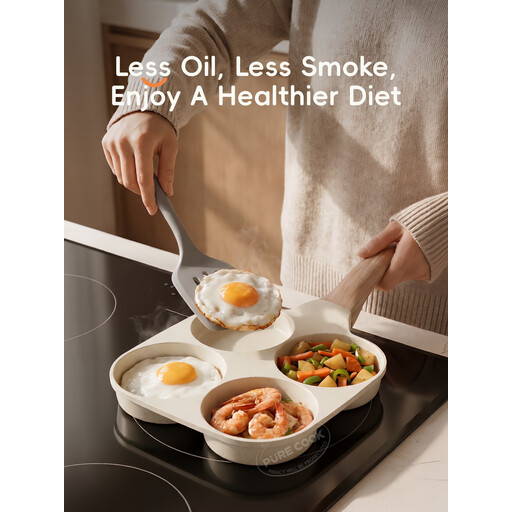
Why this choice: Perfect for quickly and simultaneously preparing multiple breakfast items (fried eggs, pancakes, blinis...). Its format streamlines preparation time for the whole family.
Its specific design meets a precise need without overselling its versatility. The stone-effect non-stick coating is well-suited for cooking eggs, a gentle process that preserves its longevity.
Lightweight aluminium alloy body for easy handling and rapid heating. Compatible with all hobs, including induction.
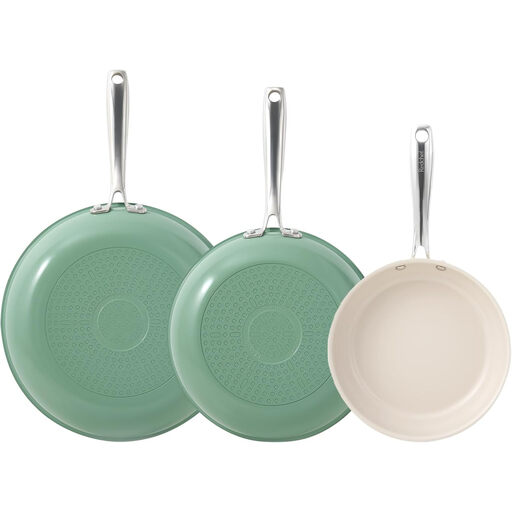
Why this choice: This pan set (20, 24, and 28 cm) covers all essential daily needs, from cooking a steak to preparing a vegetable stir-fry. A complete and practical solution to get equipped.
The forged aluminium body ensures even heat distribution, avoiding the "misleading induction compatibility" trap. The ceramic coating is a clear alternative for those wishing to avoid PTFE.
Versatile sizes and all-hob compatibility. The stainless steel handles allow for oven use, withstanding high temperatures (up to 450°C according to the manufacturer).
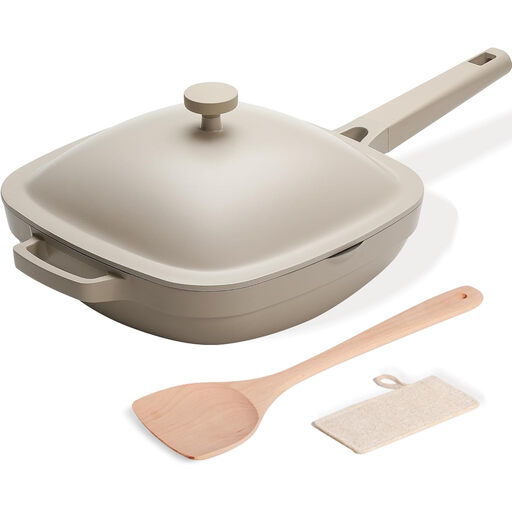
Why this choice: This sauté pan with lid is perfect for saucy dishes, large stir-fries, or slow-cooking. Its large capacity (3.6 L) and high sides prevent splatters and make it easy to cook for several people.
The die-cast aluminium body and Ti-Ceramic (titanium and ceramic) coating are designed for intensive use. The raised lid helps retain moisture, a functional feature that goes beyond simple marketing claims.
Large cooking surface and a clever design with pouring spouts. The coating is advertised as non-toxic and PFAS-free.
We have selected other products that meet our quality criteria and European safety standards.
The lifespan depends primarily on the quality of the coating and how it's maintained. A budget-friendly pan might lose its effectiveness in less than a year. A high-quality model, used and cleaned with care (no metal utensils, no abrasive scouring pads, hand washing recommended), can retain its properties for 3 to 5 years.
Modern coatings, whether ceramic or PTFE, are considered safe for home use when used according to the manufacturer's recommendations. PTFE coatings sold in the EU are mandatorily PFOA-free. The choice between a ceramic pan and a reinforced PTFE pan is therefore more a matter of cooking preference and individual sensitivity to product composition. The most important thing is to replace any pan with a scratched or damaged coating.