
Livraison le jour même ou le lendemain

Qualité garantie

Débloquez vos offres de bienvenue: Livraison GRATUITE | Jusqu'à -80 % | 30 jours d'essai gratuits à JoyPlus
Téléchargez l'application
Choosing a new frying pan can often feel like a daunting task. A non-stick induction pan has become a staple in our kitchens, but behind the marketing promises often lie significant disappointments. A pan that starts sticking after a few weeks, a base that warps on the induction hob, doubts about the material composition… the frustrations are many. This guide is here to give you clear benchmarks and help you make an informed decision, focusing on the technical criteria that truly make a difference.
Before you even start comparing models, let's learn how to sidestep the most common traps to avoid a bad purchase.
To make the right choice, focus on these three fundamental technical criteria.
The body of the pan is crucial for its performance and longevity.
For an all-hob pan to be truly effective on an induction hob, its base must be perfectly flat and incorporate a ferromagnetic disk. A thick, encapsulated base is a true mark of quality. It will not warp, will ensure perfect contact with the hob, and will diffuse heat evenly without creating hot spots.
The size of the pan should obviously match your needs.
Also, consider versatility: a pan with a stainless steel or, even better, a removable handle can go from the hob to the oven, thus multiplying the possible recipes.
Here are three models that meet specific needs, selected based on our performance and safety criteria.
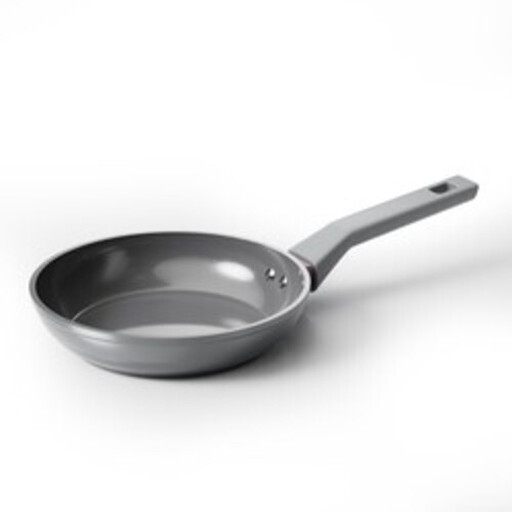
Why we recommend it: Perfect for a single person or small cooking tasks, this pan puts food safety first. Its compact size is ideal for omelettes or sautéed vegetables, without needing excess fat.
This model goes beyond simply being "PFOA-free" by guaranteeing a composition that is free of PFAS, lead, and cadmium. A clear answer to the demand for healthy cooking.
Its ceramic coating, reinforced with titanium and diamond particles, ensures excellent release and a surface that is very easy to clean, and even dishwasher-safe.
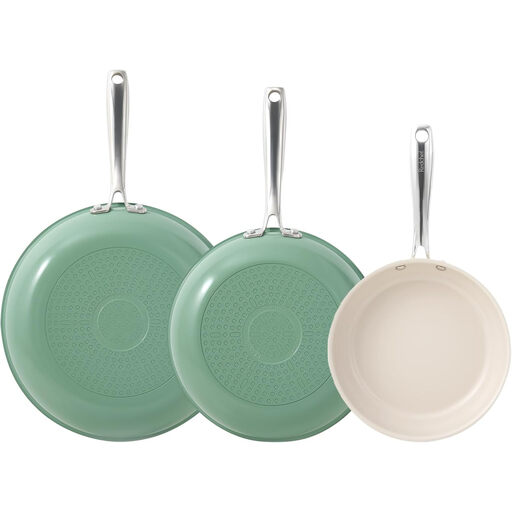
Why we recommend it: This pan set (20, 24, and 28 cm) covers all of a family's needs, from a fried egg to a simmered dish. The ability to put them in the oven makes them ultra-versatile for browning a dish or finishing a cook.
Its forged aluminium construction ensures even heat distribution, which prevents the base from warping and hot spots from forming—a common problem on induction hobs.
A complete and versatile set, compatible with all hobs and oven-safe up to 450°C, a feature quite rare for non-stick pans.
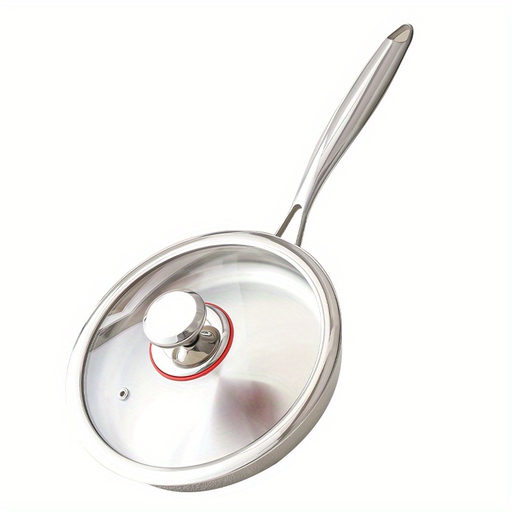
Why we recommend it: For searing meat to perfection, deglazing pan juices, and building a sauce, this stainless steel pan offers a level of temperature control and responsiveness that non-stick coatings simply cannot match.
It bypasses the trap of coating wear-and-tear... by not having one! Its triple-ply construction (stainless steel-aluminium-stainless steel) ensures unbeatable durability and perfect resistance to warping on induction.
Rapid and perfectly uniform heating for cooking with precision. Its surface is scratch-resistant and allows for the use of metal utensils.
Discover our complete selection of pans that meet our quality criteria and current safety standards.
It all depends on the quality of the coating and, above all, its care. On average, with careful use (no overheating, no metal utensils, preferably hand-washed), a good ceramic coating will maintain its non-stick properties for 2 to 3 years.
To maximize the life of the coating, follow a few golden rules:
A stainless steel pan does not have a non-stick coating. However, by mastering the heating technique, you can make it naturally non-stick. Simply preheat it to the right temperature with a fat (like oil or butter) to create a protective barrier (this is the Leidenfrost effect) that prevents food from sticking. It takes a bit of practice, but it's incredibly effective for searing meats.