
Livraison le jour même ou le lendemain

Qualité garantie

Débloquez vos offres de bienvenue: Livraison GRATUITE | Jusqu'à -80 % | 30 jours d'essai gratuits à JoyPlus
Téléchargez l'application
Choosing a new non-stick induction pan can quickly become a headache. Between promises of "scratch-proof" coatings, various compatibility claims, and "healthy cooking" arguments, it's hard to know what to believe. The end result? Uneven cooking, food that starts sticking after a few weeks, and ultimately, a purchase you have to replace far sooner than expected.
To help you see things more clearly, we've broken down the common pitfalls to avoid and the technical criteria to check before you buy. The goal: to find THE durable, high-performance pan for your induction hob that's perfectly suited to your cooking style.
Manufacturers use all sorts of clever marketing to tout features that often don't stand up to daily use. Here are the 3 key things to watch out for:
To make an informed choice, forget the marketing jargon and focus on the few technical features that truly make a difference in quality and durability.
The effectiveness of a non-stick pan, unsurprisingly, depends on the quality of its coating.
Performance on an induction hob is directly linked to the design of the pan's base.
Rather than an endless list, we've selected models that meet specific needs, always keeping our criteria of durability and performance in mind.
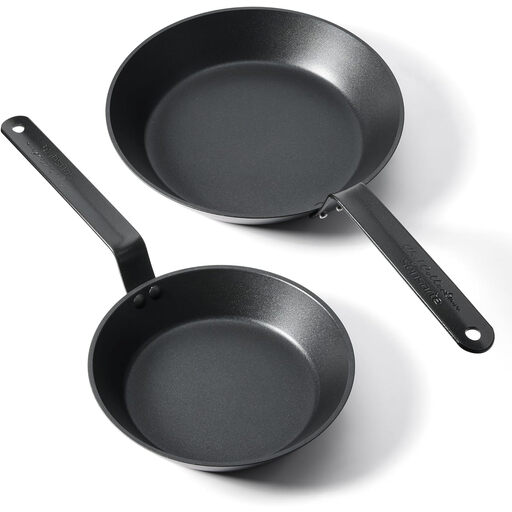
Why we chose it : This induction pan set covers 90% of daily needs, from a fried egg in the morning to a fish fillet in the evening. A practical and budget-friendly solution to get equipped without cluttering your cupboards.
The thick, magnetic stainless steel base ensures rapid heating and efficient heat distribution on induction hobs, thereby avoiding the "false compatibility" trap.
Its PFOA/PFOS-free non-stick coating and oven-safe design (up to 232 °C / 450 °F) give it a highly appreciated versatility for daily use.
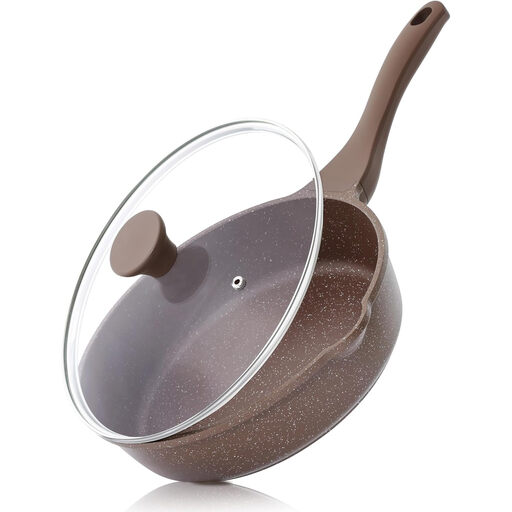
Why we chose it : With its large 28 cm pan diameter and high sides, this non-stick sauté pan is designed for saucy dishes, generous vegetable stir-fries, or large cuts of meat. The glass lid is a real bonus for monitoring cooking and simmering with peace of mind.
Its sauté pan shape is designed for large volumes. No more spills and splatters—a common problem when trying to use a standard frying pan that's too small for the recipe.
Its stone-effect coating (PFOA-free) is robust, and its wood-effect bakelite handle stays cool to the touch, ensuring a safe and comfortable grip even during intense cooking.
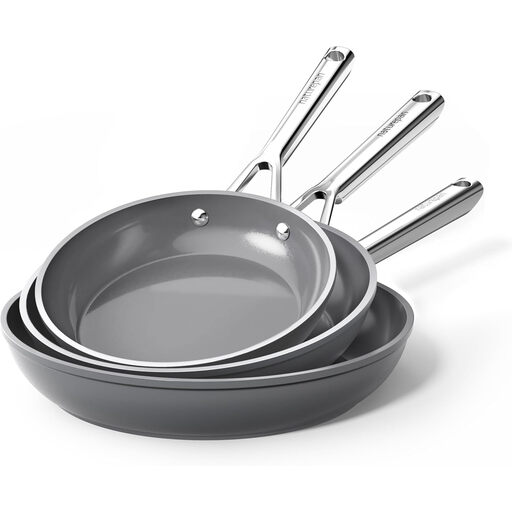
Why we chose it : This set is for those seeking alternatives to PTFE and who want to cook with minimal oil. The ceramic coating is clearly advertised as free of PTFE, PFOA, and PFAS, a direct response to the growing demand for cookware considered healthier.
It sidesteps the pitfall of "vague health claims" by providing a transparent composition, free from the most scrutinized substances. The titanium and diamond reinforcement helps counter the fragility sometimes associated with first-generation ceramic coatings.
Their high heat resistance (oven-safe up to 260 °C / 500 °F) and stainless steel handles make them ultra-versatile and durable tools, moving seamlessly from the hob to the oven broiler.
We've prepared a complete selection of pans that meet our quality criteria and current safety standards.
It all depends on the quality of the coating and how you care for it! A good, well-maintained model can last between 3 and 5 years. To maximize its lifespan, follow a few golden rules: never overheat it while empty, only use wooden or silicone utensils, and prefer hand washing (even if it's dishwasher-safe).
The easiest way is to look for the coil symbol (a horizontal spring) on the bottom of the pan. Alternatively, do the magnet test: if a magnet sticks firmly to the outer base, you're good to go—your pan will work on an induction hob.
Each has its pros and cons.