
Livraison le jour même ou le lendemain

Qualité garantie

Débloquez vos offres de bienvenue: Livraison GRATUITE | Jusqu'à -80 % | 30 jours d'essai gratuits à JoyPlus
Téléchargez l'application
A new non-stick induction pan promises food that slides right off and perfectly cooked meals. But let's be honest: how many times has that promise faded after just a few months? The coating gets scratched, food starts to stick, and cleanup becomes a nightmare.
As a Product Expert at Joybuy, my mission is to guide you through the jungle of options to make the right choice. Before you jump on the first model you see, let's break down the common pitfalls that lead to buyer's remorse.
To avoid these disappointments, let's focus on three technical parameters that make all the difference.
An induction cooktop generates a magnetic field that directly heats the vessel. For the magic to happen, the pan's base must be ferromagnetic.
The non-stick quality is the heart of the matter, but not all coatings are created equal. The two main families are stone-effect and ceramic.
The pan's core material determines how it heats up and distributes that heat. Cast aluminium stands out as an excellent choice. Denser and more robust than the stamped aluminium found in entry-level pans, it is far more resistant to warping (the infamous bulging base) and guarantees perfectly even cooking across the entire surface.
To help you make an informed decision, here are a few models that cater to different needs and user profiles.
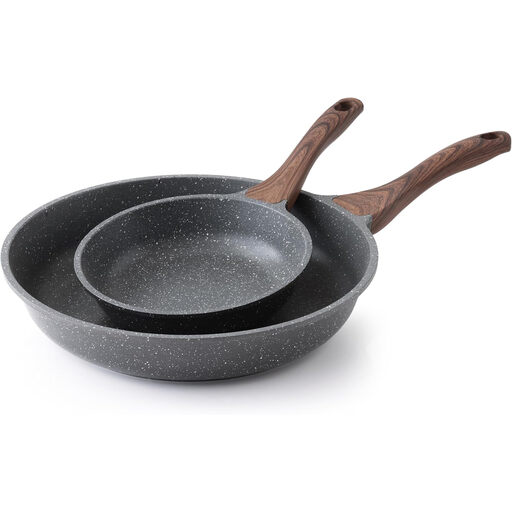
Why this choice? This pan set covers the diverse needs of a family. The small one is perfect as an omelette pan, while the large one can sear a nice cut of meat or simmer a dish for several people.
Its cast aluminium body won't warp, while its stainless steel base guarantees ultra-responsive heating on induction. Goodbye to the "all-stovetop" pan that lags behind!
The granite-effect coating, made without PFOA, offers excellent durability for daily use. Bonus: the Bakelite handle always stays cool.
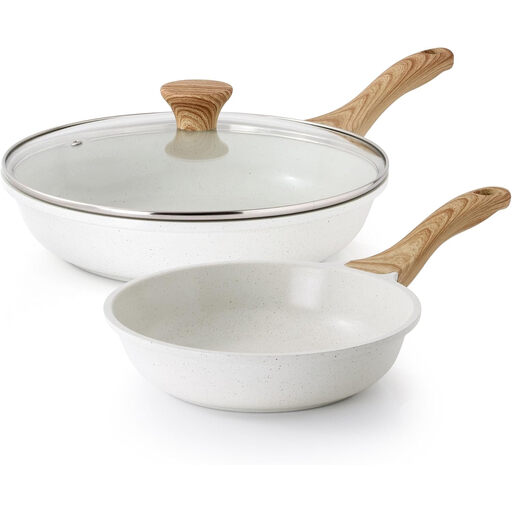
Why this choice? For those who want to avoid fluorinated compounds (PFAS, PTFE) at all costs, this ceramic pan is the ideal solution. It allows for healthy cooking with minimal oil.
There's no confusion about "healthy" labels here. The ceramic coating is explicitly guaranteed to be made without intentionally added PFAS, PTFE, PFOA, lead, or cadmium.
The coating releases no potentially harmful fumes, even if accidentally overheated. The cast aluminium body ensures exemplary heat distribution.
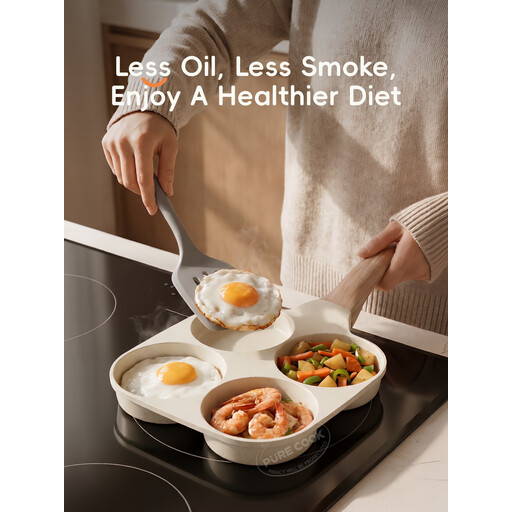
Why this choice? Perfect for busy mornings, this pan simultaneously cooks four perfectly-sized fried eggs, pancakes, or blinis. It's a precious time-saver that delivers a flawless presentation every time.
This utensil doesn't get lost in vague marketing promises; it focuses entirely on a concrete and ultra-practical function. Its design meets a simple need: efficiency.
Its 4 compartments allow you to prepare a complete breakfast all at once. The lightweight aluminium alloy body ensures fast and uniform heating.
We have selected a full range of products for you that meet our quality criteria and current regulations.
A few simple habits will extend its lifespan. Opt for hand washing with a non-abrasive sponge. Forget metal utensils in favour of wood, silicone, or nylon. Most importantly, never heat it while empty and avoid thermal shock (like running a hot pan under cold water).
The term "stone-effect" primarily refers to the look and robustness of the coating, which is reinforced with mineral particles. To judge its safety, the only objective criterion is the list of substances excluded from its manufacturing. The PFOA-free label has become the standard, but for complete peace of mind, you can look for products guaranteed to be PFAS-free or opt for a ceramic pan.
Beyond the symbol and the magnet test, make sure the diameter of its base matches the size of your cooking zone. A thick and perfectly flat base is also a mark of quality that will promote optimal contact and efficient heating.