
Same-day & Next-day Delivery

Quality Guaranteed

Unlock Your Welcome Offers: FREE Delivery | Up to 80% OFF | Free 30-day JoyPlus trial
Download the APP
Choosing a new non-stick pan for an induction hob seems simple. Yet, caught between marketing promises and the test of daily use, you can quickly end up with a pan that starts sticking after just a few months. As the Head of Product Recommendations at Joybuy, my role is to help you understand the key factors for a smart, durable purchase, far from the siren song of marketing.
Before looking at specific models, it's crucial to sidestep the common traps that lead to disappointment and buyer's remorse.
To avoid these pitfalls, focus on these three objective parameters, which are the true guarantees of quality and durability for your future non-stick induction pan.
There are two main families of coatings:
For an induction hob, the pan's base is the most critical part. It must be perfectly flat and rich in ferromagnetic material (steel, cast iron). A thick, encapsulated base is the guarantee of two essential points:
Think about your cooking habits. A 24 cm pan is the all-purpose size, ideal for 2 to 3 people. If you often cook dishes with sauces or stir-fries, a non-stick sauté pan with higher sides will be more practical. For dishes that need to be finished in the oven, choose an oven-safe pan and check that its handle can withstand high heat.
Here is our selection, designed for different user profiles and ticking all the boxes on our checklist.
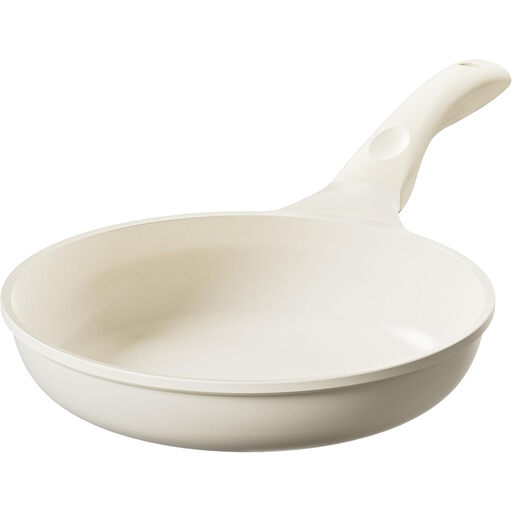
Why it's a match: Perfect for those looking for a reliable and easy-to-use pan for daily cooking. Its 24 cm size is ideal for frying eggs, searing meat, or sautéing vegetables for two. Its ceramic coating checks the boxes for healthy cooking and effortless cleanup.
Its ceramic coating, guaranteed free of PTFE/PFOA/PFAS, and its thick base designed for fast, even heating on induction, eliminate the risk of "false compatibility."
Cleaning is a breeze (a simple wipe with a sponge is enough) and its ergonomic Bakelite handle stays cool, preventing burns.
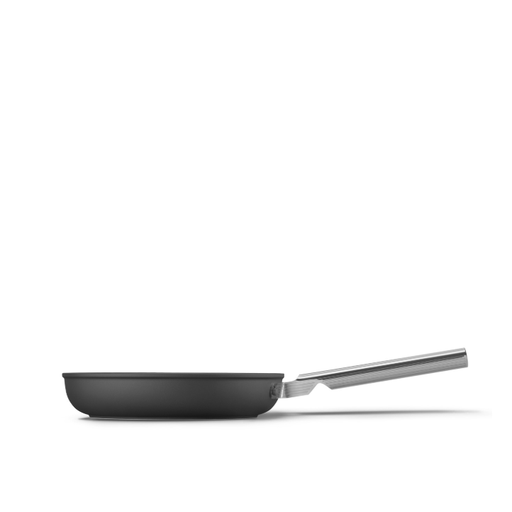
Why it's a match: For those who see their cookware as true design objects. SMEG's iconic Italian design is combined with high-end materials for an experience that blends beauty and efficiency.
Its patented base ensures perfect heat distribution on induction, while its non-stick coating (PFAS-free) is built to last.
It's oven-safe up to 250 °C, perfect for starting a dish on the hob and finishing it under the broiler. Its stainless steel handle ensures a secure, professional grip.
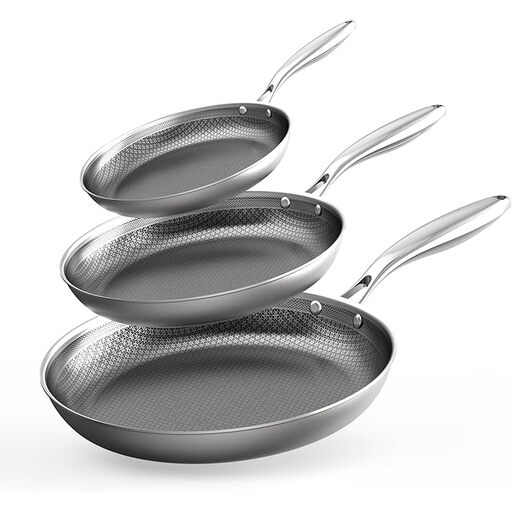
Why it's a match: A set of three sizes (20, 25, and 30 cm) to handle any situation. It's the smart bundle to get fully equipped at once with durable cookware that can handle any daily recipe.
The stainless steel body guarantees perfect induction compatibility and unbeatable durability, preventing any warping over time.
Oven and dishwasher safe for maximum convenience. The riveted handles stay cool for safe handling, even at high temperatures.
Discover our full selection of pans that meet our strict criteria and European safety standards.
Proper care is everything. Golden rule: avoid thermal shock (never put a hot pan under cold water!). Use wooden, silicone, or nylon utensils to avoid scratching the coating. For cleaning, a little hot water and the soft side of a sponge are usually sufficient. Even if the manufacturer allows it, limit dishwasher use: its detergents are too aggressive in the long run.
The term "stone-effect" is mostly about marketing and aesthetics. It's usually a coating (ceramic or PTFE) speckled to imitate granite. Sometimes, mineral particles are actually added to reinforce the structure, and the scratch resistance may be slightly better. But it's not an absolute guarantee of durability. Rely more on technical specifications ("titanium-reinforced," "diamond particles") than on the simple "stone-effect" claim.