
Livraison le jour même ou le lendemain

Qualité garantie

Débloquez vos offres de bienvenue: Livraison GRATUITE | Jusqu'à -80 % | 30 jours d'essai gratuits à JoyPlus
Téléchargez l'application
Navigating the jungle of kitchen utensils can quickly become a daunting task. Buying a non-stick induction pan seems simple, yet many users end up disappointed with a pan that warps, a coating that peels after a few months, or lacklustre heating on their hob. To avoid these setbacks, it's crucial to know how to decipher labels and understand what separates a quality utensil from a short-lived gadget.
This guide is here to help you cut through the marketing noise and give you the keys to choosing a model that fits your real needs, without being fooled by unrealistic promises.
The market is flooded with products making tempting claims, but not all of them deliver. Here are the three most common pitfalls that lead to a purchase you'll regret.
To make the right choice, focus on three technical characteristics that make all the difference in performance and longevity.
Non-stick capability is, of course, the heart of the matter. There are two main families of coatings:
For a non-stick induction pan, the mere presence of the coil-shaped pictogram is not enough. The real criterion is the quality of the pan's base. Look for a thick, fully ferromagnetic base. A thick base ensures good thermal inertia and even heat distribution, preventing hot spots that damage the coating and burn food. It also guarantees that your pan will not warp over time.
The body of the pan is most often made of aluminium or stainless steel.
The size should match your household and your habits: a small 16-20 cm non-stick saucepan for a sauce or a fried egg, a 24-28 cm pan for everyday meals, or a wok for your stir-fries.
Rather than an endless list, we have selected products that meet specific user profiles and needs, taking into account performance and durability criteria.
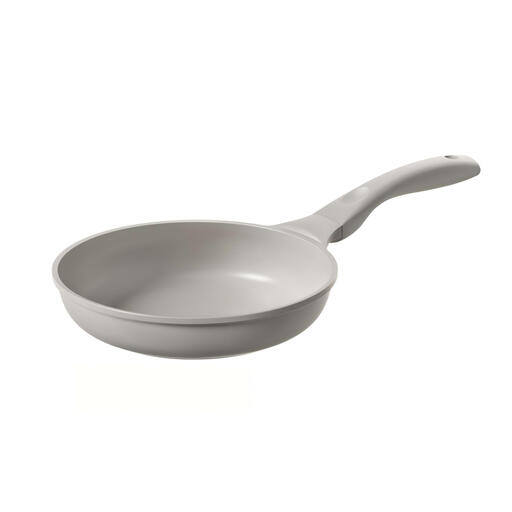
Why this one? Ideal for one or two people, this 24 cm pan is perfect for daily cooking: fried eggs, sautéed vegetables, or a steak. Its ceramic coating meets the expectations of health-conscious consumers and simplifies cleanup.
Its coating is explicitly formulated without PTFE/PFOA/PFAS, which clarifies the health question. Its base is designed for fast, even heating on all hobs, including induction, which prevents hot spots.
Non-toxic ceramic coating and an ergonomic, heat-resistant handle for a comfortable and safe grip.
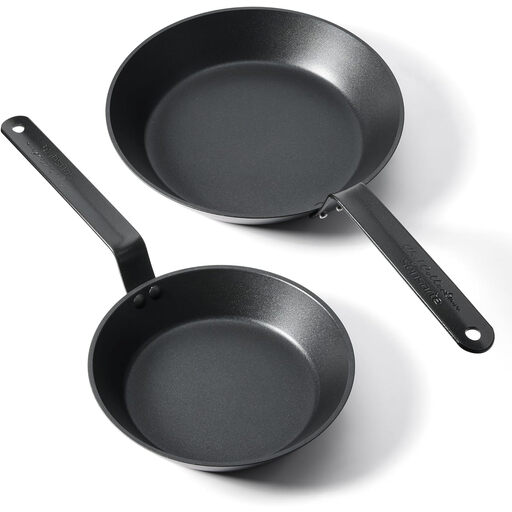
Why this set? This **pan set** offers ideal versatility for families. The small pan is perfect for side dishes, while the larger one handles main courses. Its oven-safe compatibility up to 230°C allows you to finish cooking or keep a dish warm.
The thickened magnetic stainless steel base ensures excellent performance on induction. The Swiss coating is advertised as durable and is PFOA/PFOS-free, giving you peace of mind while cooking.
Two practical sizes for maximum flexibility and oven compatibility that expands your cooking possibilities.

Why this wok? This **non-stick wok** is designed for those who demand versatility and longevity. Its large 30 cm capacity is ideal for stir-fries, stews, or even deep-frying. Its 3-ply composite structure ensures optimal heat conduction.
This model directly tackles the problem of coating wear with its honeycomb texture. This design protects the non-stick ceramic layer from scratches, thereby extending its lifespan.
The combination of a robust composite steel structure and a protected ceramic coating offers a solution built to last, even with intensive use.
Discover our complete and up-to-date selection of products that meet our performance criteria and safety standards.
A pan's lifespan depends on the quality of its materials, its design, and, most importantly, how you care for it. An entry-level model will show signs of wear after 1 to 2 years. A quality, well-maintained pan can last for 3 to 5 years, or even longer. If food consistently sticks or if the coating is scratched or peeling, it's time to replace it.
A few simple steps will significantly extend its life:
Both PTFE and ceramic coatings sold in Europe are considered safe for food contact when used according to instructions. PTFE coatings are required to be PFOA-free. The main advantage of a ceramic pan is its complete absence of fluoropolymers (PFAS, which includes PTFE). The choice, therefore, comes down to personal preference. The most important thing is to never cook with a pan that has a damaged coating, regardless of its material.