
Livraison le jour même ou le lendemain

Qualité garantie

Débloquez vos offres de bienvenue: Livraison GRATUITE | Jusqu'à -80 % | 30 jours d'essai gratuits à JoyPlus
Téléchargez l'application
A shiny new pan, the promise of fried eggs that slide right off... and then the disappointment, a few months later, when even a simple omelette turns into a sticky mess. Sound familiar?? It should. The market is saturated with marketing promises that make choosing a good non-stick induction pan unnecessarily complex.
As a product expert at Joybuy, my mission is to help you cut through the noise. Let's skip the technical jargon and get straight to the point. Here are the 3 pitfalls you must avoid.
To make a truly informed choice, ignore the slogans and focus on objective technical criteria.
Before you pull out your credit card, scrutinise these three points. They determine 90?% of the performance and lifespan of your future healthy cookware.
This is the heart of your pan. In the market, two main technologies compete?:
For a pan to work with your induction hob, its base must be ferromagnetic. A simple test?? Take a magnet?: if it sticks firmly to the bottom of the pan, you're good to go.
But compatibility isn't everything. The thickness and design of the base are crucial. A thick, solid base (not just a bonded disc) ensures rapid heating and uniform heat distribution. This is what separates a pan that's ready in 30 seconds from one that struggles for several minutes. A good base is the secret to an all-hob pan that truly shines on induction.
The material of the pan's body affects its weight, heating speed, and sturdiness.
Rather than an endless list, we've matched user profiles with models that specifically meet their needs, applying the criteria we've just discussed.
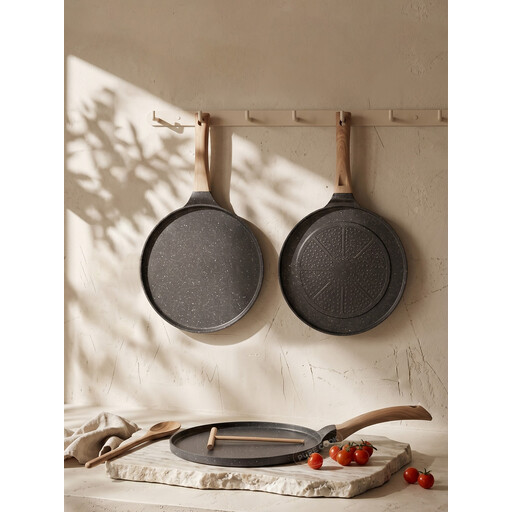
Why we love it : With its feather-light aluminium body and versatile 26 cm diameter, this is the perfect pan for daily meals. It heats up fast, is effortless to handle, and saves the day for impromptu weeknight dinners.
Its aluminium alloy body and well-designed base guarantee rapid and even heating on induction. Goodbye to the 'slow compatibility' trap!
Lightweight and a breeze to clean. Its stone-effect non-stick coating allows for healthy cooking with very little oil and wipes clean with a simple sponge.
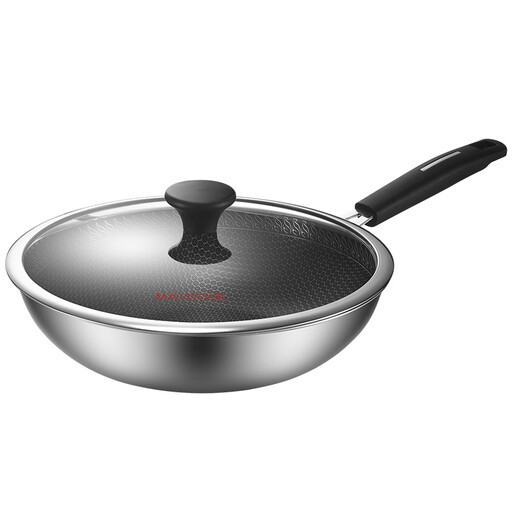
Why we love it : This 30 cm **induction wok** is built to last. Its 3-ply stainless steel structure gives it unbeatable sturdiness and perfect heat distribution. Its XXL capacity is ideal for stir-fries, saucy dishes, and large family meals.
It shatters the 'fragile coating' trap thanks to its honeycomb interior texture. This protects the non-stick layer from scratches, even when using metal utensils.
Extreme durability and versatility. Its composite steel construction and reinforced coating make it an investment for years of intensive, worry-free cooking.
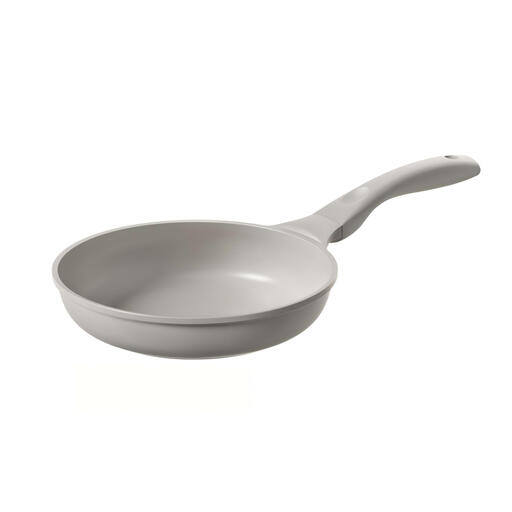
Why we love it : For those who make healthy cooking a priority, this pan is a clear choice. Its ceramic coating is guaranteed free of PTFE, PFOA, and PFAS, for absolute peace of mind. Its compact 24 cm size is perfect for controlled cooking, like a poached egg or a fish fillet.
It sidesteps the 'vague health claims' trap by being completely transparent about its composition. This is the choice for serenity, with no controversial compounds.
A 100 % healthy ceramic coating. Its perfectly smooth surface allows food to release effortlessly and ensures easy cleaning, while being compatible with all hobs, including induction.
We have curated a complete selection of pans that meet our performance criteria and the strictest safety standards.
Let's be honest?: even an excellent non-stick pan has a lifespan of between 2 and 5 years. It all depends on how often you use it, the type of coating, and, most importantly, how well you care for it. Systematically overheating it or using a metal fork on an unsuitable coating can cut its lifespan in half.
A few simple habits can literally double your pan's lifespan?:
The coatings on a ceramic pan are indeed made without PTFE, PFOA, or PFAS. For consumers who wish to avoid these substances as a precautionary measure, it is therefore an excellent alternative. However, it's worth noting that health authorities (both French and European) consider modern PTFE coatings (without PFOA) to be perfectly safe for normal food use. Ultimately, the choice comes down to your personal convictions.