
Livraison le jour même ou le lendemain

Qualité garantie

Débloquez vos offres de bienvenue: Livraison GRATUITE | Jusqu'à -80 % | 30 jours d'essai gratuits à JoyPlus
Téléchargez l'application
A pan that sticks, a coating that wears out too quickly, concerns about the materials used... Choosing new cookware can quickly become a headache. Faced with a jungle of options, it's hard to know which non-stick induction pan will tick all the boxes for performance, durability, and ease of use.
This guide is here to help you see things more clearly. As a Product Recommendation Manager at Joybuy, my role is to separate fact from fiction and give you the keys to making an informed choice, cutting through the marketing noise. We'll break down the essential criteria and present a selection of models that have caught our eye.
Before we start comparing models, let's review the three criteria that will truly make a difference in the long run.
The heart of a pan that doesn't stick is, of course, its coating. Today, alternatives to traditional PTFE-based (Teflon) coatings dominate the market.
In any case, for consumers concerned about the composition of their cookware, it's advisable to choose products labelled as "PFOA-free".
An induction pan must have a ferromagnetic base for the hob's magnetic field to generate heat. To check, the trick is simple?: hold a magnet to the bottom of the pan. If it sticks firmly, it's induction-compatible.
The quality of the base is also crucial. A thick, perfectly flat base ensures even heat distribution, which prevents hot spots (fatal for the coating) and guarantees uniform cooking. A good all-hob pan will perform just as well on an induction hob as it will on gas or ceramic cooktops.
Here are a few models that have caught our eye, each with its own unique strengths.
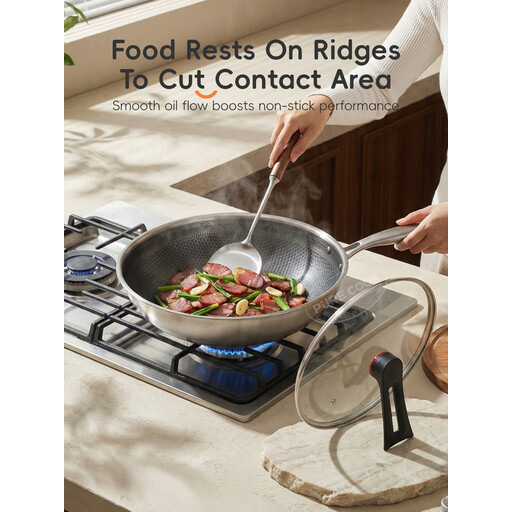
Why it stands out?: Its main advantage lies in its "physical" non-stick technology. The interior is engraved with a honeycomb texture that creates a thin layer of air between the food and the steel surface. The result: sticking is minimised without any chemical coating. Its triple-layer 304 stainless steel construction ensures fast and even heating.
Key features?:
Who is it for? Ideal for fans of Asian cuisine and large family meals. It's a smart choice for anyone looking for a durable alternative to traditional coatings and who appreciates the robustness of stainless steel.
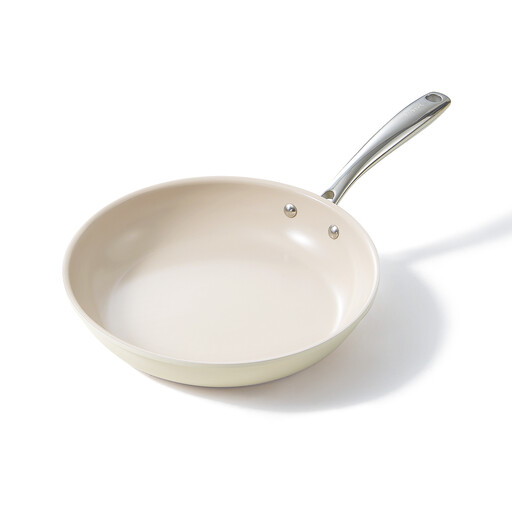
Why it stands out?: This pan combines a lightweight forged aluminium body with a triple-layer ceramic coating. Its real advantage? Exceptional heat resistance. It is oven-safe up to 450°C, a rare feat for a non-stick pan. The stainless steel handle is riveted for rock-solid durability.
Key features?:
Who is it for? Perfect for everyday cooking: fried eggs, pancakes, sautéed vegetables... It's the ultimate all-rounder, easy to clean and able to go from the hob to the oven to finish a dish with a gratin top.
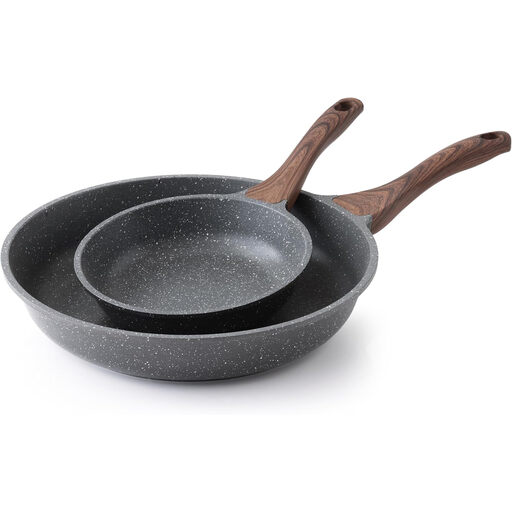
Why it stands out?: This non-stick pan set is an excellent starter kit. It features a Swiss "granite-effect" non-stick coating, guaranteed free of intentionally added PFOA, PFOS, lead, or cadmium. The die-cast aluminium body is robust and warp-resistant, while the stainless steel base ensures induction compatibility.
Key features?:
Who is it for? A turnkey solution for those setting up a new home or looking to upgrade their cookware. This duo covers most needs, from a small morning omelette to more generous family meals.
This guide focuses on pans for induction hobs, but every kitchen is different. If you cook with gas and are particularly interested in ceramic coatings, we have just what you need.
? Discover our selection of ceramic gas pans
The lifespan of a non-stick pan depends primarily on its care. To preserve the coating, follow a few golden rules?:
By following these best practices, a quality pan can maintain its effectiveness for several years.
The foolproof trick: the magnet test. Place a magnet on the bottom of the pan. If it sticks firmly, you're good to go! Manufacturers also indicate this compatibility with a spiral-shaped symbol, engraved on the bottom of the pan or on the packaging.
Both are excellent options for a PFOA-free pan. The ceramic coating, which is silica-based, offers a very smooth surface and perfect food release. The stone-effect coating is a non-stick material (often PTFE-based) reinforced with mineral particles to boost its wear resistance. The choice, therefore, depends on your priorities: the slickness of ceramic or the robustness of the stone-effect.