
Livraison le jour même ou le lendemain

Qualité garantie

Débloquez vos offres de bienvenue: Livraison GRATUITE | Jusqu'à -80 % | 30 jours d'essai gratuits à JoyPlus
Téléchargez l'application
A non-stick induction frying pan can make everyday meals much easier, but not all models are created equal. Between claims of “ultra-resistant” coatings, vague compatibility details and sometimes misleading dimensions, the wrong choice can result in uneven heating, time-consuming cleaning or premature replacement.
Before buying a 28 cm induction frying pan, a ceramic non-stick frying pan or a frying pan and saucepan set, there are three common pitfalls to look out for.
A frying pan that works on gas, electric or ceramic hobs will not necessarily work on an induction hob. This technology requires a base containing a ferromagnetic material. So check that the product listing clearly states induction, IH or suitable for all hobs, including induction.
Also check the diameter of the magnetic base. A 28 cm frying pan may have a genuinely heated base that is much smaller, which directly affects cooking speed and evenness.
Terms such as “mineral”, “stone”, “titanium” or “diamond” may describe the coating’s composition or reinforcement, but they do not guarantee a specific lifespan. Durability also depends on the temperature used, the utensils and how the pan is cleaned.
Even a PFAS-free or PFOA-free frying pan must be used in accordance with the manufacturer’s recommendations. Prolonged heating while empty, abrasive sponges and metal utensils can quickly damage a non-stick surface.
A large stainless steel or carbon steel frying pan can be heavy, while a lightweight aluminium model will be easier to handle. A fixed handle also takes up more space in a cupboard than a removable one.
In a small kitchen, a stackable system can be far more practical than a bulky set. However, check the box contents: some Tefal Ingenio models are sold without a handle, or with just one handle for several pieces of cookware.
The claims “PFOA-free” and “PFAS-free” do not mean the same thing. PFOA is a specific substance, while PFAS refers to a much broader family of substances. To compare models properly, it is better to look for a detailed statement from the manufacturer than rely on a vague phrase such as “non-toxic”.
The stated diameter often refers to the upper rim rather than the cooking surface. Check the technical specifications if you are looking for a 28 cm induction frying pan with a wide base that is genuinely heated.
A frying pan that is easy to clean is not necessarily designed for every use. Check the instructions regarding dishwashers, ovens, grills and compatible utensils.
To protect a non-stick coating :
Carbon steel requires different care: quick washing, immediate drying and applying a thin layer of oil after every use.
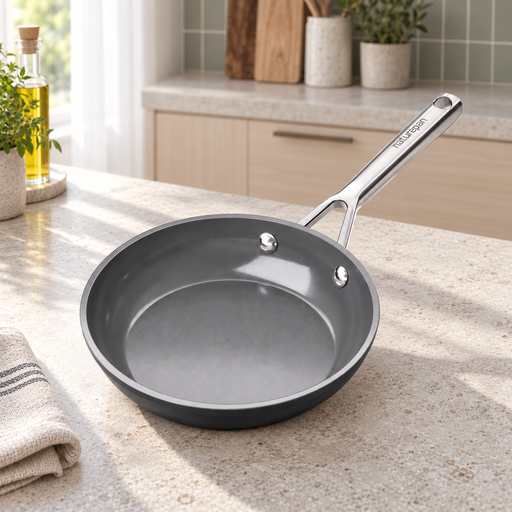
Why this choice suits this profile : Its compact size is ideal for a first kitchen set-up, small kitchens and individual portions. The product listing states that it is suitable for induction, gas, electric and ceramic hobs.
Induction compatibility is clearly stated, and the manufacturer mentions a ceramic coating free from PTFE, PFAS and PFOA. Even so, use moderate heat and non-metal utensils.
20 cm size, stainless steel handle, oven-safe up to 260 °C according to the product listing, and stated dishwasher-safe cleaning.
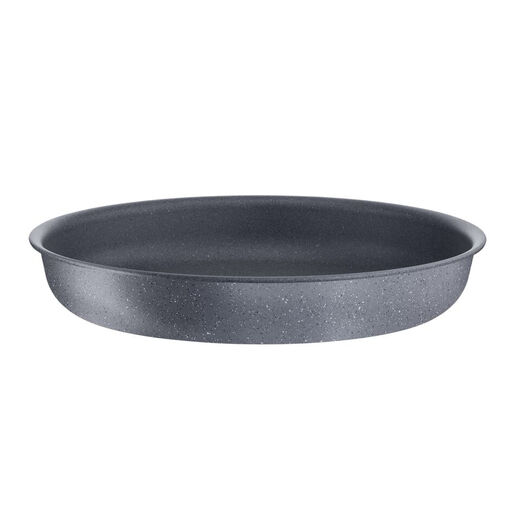
Why this choice suits this profile : The 26 cm size is suitable for everyday meals, while the removable handle makes storage easier and allows you to move the pan from the hob to the fridge.
The product listing specifies compatibility with induction and other hob types. It also states that the removable handle is sold separately : a detail to check before ordering.
Made in France according to the product listing, Thermo-Fusion base, Thermo-Signal indicator and mineral-reinforced Mineralia coating.
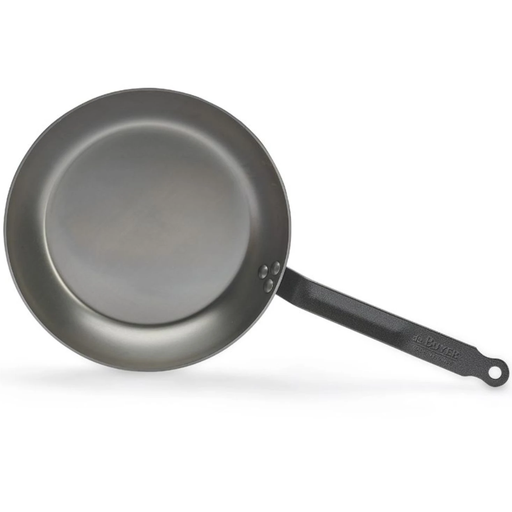
Why this choice suits this profile : Its diameter is suitable for family meals, while its 3 mm iron construction is designed for searing, grilling and high-temperature cooking.
It does not promise a permanent non-stick coating : the surface develops gradually through seasoning. The required care, particularly drying and oiling, should be taken into account.
3 mm steel, induction compatibility and made in France according to the product listing. This model handles high-heat cooking and weighs 2,15 kg.
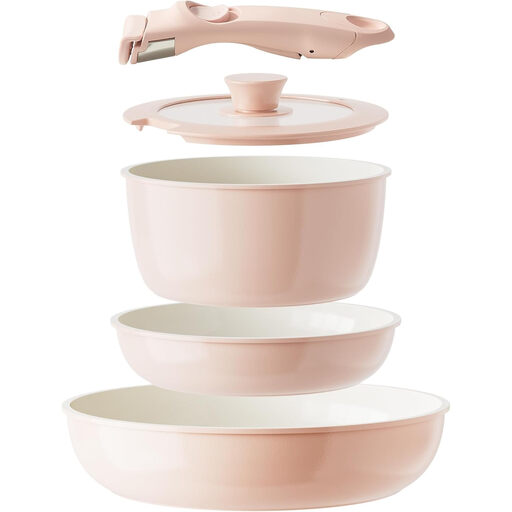
Why this choice suits this profile : The two frying pans, saucepan, lid and removable handle cover a range of uses while allowing the set to be stacked neatly in a small cupboard.
The set contents are clearly detailed and the product listing states that it is suitable for induction. However, check the stated maximum oven temperature and the specific instructions for the handle.
Ceramic coating stated to be free from PFAS, PTFE, PFOA, lead and cadmium, removable handle and stated dishwasher-safe cleaning.
Only if its base is ferromagnetic and the product listing explicitly mentions induction or compatibility with all hob types. A simple non-stick coating is not enough. As an initial check, hold a magnet against the underside of the frying pan if the manufacturer permits this, then check the diameter of the cooking zone.
It depends on the material, how often it is used, the hob’s power setting and how it is cared for. Avoid overheating, thermal shock, metal utensils and abrasive cleaning products. If the surface develops deep scratches, starts to peel or sticks much more than it used to, it is better to replace the frying pan rather than continue using it.
It can last for many years if properly cared for, but it takes time to build up the seasoning and to dry after washing. It will not suit those looking for quick cleaning or regular dishwasher use. For fast everyday cooking, a non-stick or ceramic model will often be less demanding.