
Livraison le jour même ou le lendemain

Qualité garantie

Débloquez vos offres de bienvenue: Livraison GRATUITE | Jusqu'à -80 % | 30 jours d'essai gratuits à JoyPlus
Téléchargez l'application
Equipping your kitchen with a new induction cookware set can quickly become overwhelming. Between marketing jargon and technical spec sheets, it's easy to get lost and end up regretting your purchase. As a product expert at Joybuy, I'm here to help you make sense of it all. Let's break down the pitfalls to avoid and the criteria that truly matter to ensure you make the right choice.
The market is flooded with options, but they are not all created equal—far from it, especially when it comes to induction. Here are the most common mistakes that could cost you dearly.
The "all stovetops compatible" label in no way guarantees optimal performance on an induction cooktop. If the base of your pan lacks sufficient ferromagnetic material, heating will be slow and uneven, and your electricity bill will skyrocket. A low-end model might work, but without any efficiency or daily cooking pleasure.
"Stone effect," "granite style," "diamond-infused"... Behind these marketing terms, you'll often find conventional non-stick coatings (PTFE-based), simply enriched with mineral particles for aesthetics and slightly better durability. What matters isn't the name, but the composition. The key is to ensure you choose a non-toxic cookware set, and most importantly, that it is certified PFOA-free, a chemical compound that is now strictly regulated.
This is the classic hidden defect of low-quality cookware sets. Under the rapid temperature spikes of induction cooking, a base that is too thin or poorly designed will warp. The pan or pot then becomes wobbly, loses contact with the cooktop, and cooking turns into a nightmare. This is a deal-breaking flaw that renders the utensil useless.
To avoid these traps, simply focus on a few key technical points.
Induction compatibility relies on a simple principle: a magnetic field generated by the cooktop directly heats the vessel. For this to work, the base of the pot must contain a ferromagnetic material.
Opting for a healthy, PFOA-free cookware set has become a priority. Here are the main types of coatings to know:
A 15-piece induction pan and pot set might seem like the deal of the century, but will you really use every single item? Ask yourself the right questions: Are you cooking for one person, a couple, or a family? What dishes do you prepare most often? Sometimes, a more compact but higher-quality set is a much better long-term investment.
To move from theory to practice, here are a few products that perfectly illustrate these criteria, tailored to different profiles.
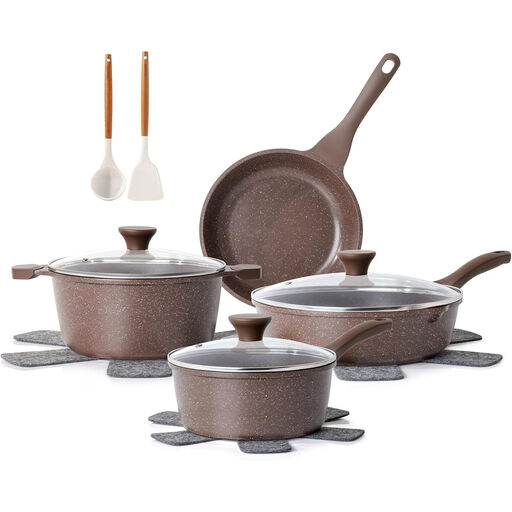
Why it's a great choice: Perfect for families or for a complete kitchen overhaul. This ultra-comprehensive set meets all everyday needs, from quick sauces to slow-simmered dishes, with utensils and protectors included.
Its quality aluminum body and thick base ensure perfect heat distribution on induction and excellent resistance to warping. The coating is explicitly guaranteed free of PFOA, PFOS, lead, and cadmium.
A very complete set with an unbeatable features-to-price ratio to get fully equipped once and for all. The removable handles are a real bonus for storage.
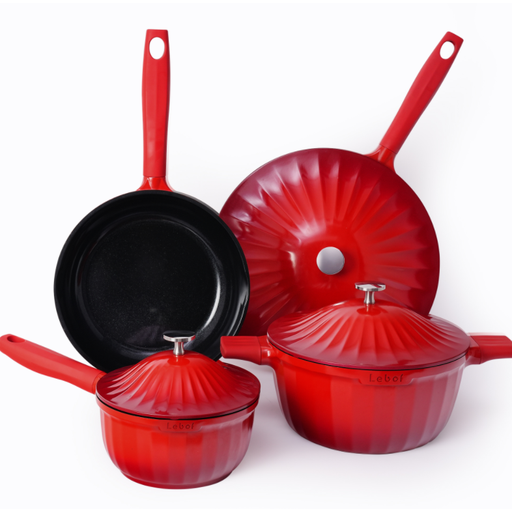
Why it's a great choice: Designed for those who prioritize non-toxic materials and seek an alternative to PTFE. This set gets straight to the point with a healthy composition and meticulous construction.
It sidesteps the trap of vague names with a clear certification: free of PFAS, PFOA, and PTFE. Its die-cast aluminum structure and ceramic-titanium coating are built to last.
The Ti-Ceramic coating ensures healthy cooking on a highly scratch-resistant surface. Compatibility with all stovetops (including induction) is guaranteed by a high-purity aluminum alloy core.
Discover our full selection of products that meet our quality standards and the strictest regulations.
The lifespan of a non-stick pan primarily depends on its care. With minimal maintenance, a quality coating will last 3 to 5 years. To preserve it, never overheat it while empty, only use wooden or silicone utensils, and opt for hand washing with a non-abrasive sponge.
The easiest way is to look for the coil symbol (a series of horizontal loops) engraved on the bottom of the utensil. The other foolproof test is the magnet test: if a magnet sticks firmly to the bottom of your pan or pot, you're good to go! It is 100% compatible.
Both types of coatings are now considered perfectly safe for food contact, provided you follow the usage instructions. The historical mistrust of PTFE came from PFOA, a component no longer used in the manufacturing of quality cookware. Ceramic remains an excellent alternative for those who, as a matter of principle, want to avoid all fluorinated compounds (PFAS, of which PTFE is a member). Ultimately, it's a matter of personal preference.