
Livraison le jour même ou le lendemain

Qualité garantie

Débloquez vos offres de bienvenue: Livraison GRATUITE | Jusqu'à -80 % | 30 jours d'essai gratuits à JoyPlus
Téléchargez l'application
Equipping your kitchen for an induction hob can quickly become a headache. Between the promises of perfect cooking and the harsh reality of pans that warp or lose their non-stick properties after a few months, it's easy to make a purchasing mistake. To ensure you don't regret your investment, let's review the most common pitfalls to avoid.
The first trap is the simple "induction compatible" label, which in no way guarantees optimal performance. A base that is too thin or has an unsuitable diameter often results in slow, uneven heating, wasted energy, and compromised recipes. Another major issue is the durability of the non-stick coating. A pan that starts sticking after a few dishwasher cycles or an unfortunate scrape from a fork is a source of frustration and an unnecessary expense. Finally, be wary of health claims like "PFOA-free," as they can sometimes hide the presence of other substances from the same family (PFAS).
To choose non-stick induction cookware that will deliver on its promises long-term, three technical points deserve your full attention.
Induction compatibility is more than just a simple pictogram. The entire performance hinges on the quality of the ferromagnetic base.
The choice of coating has a direct impact on your cooking enjoyment, ease of cleaning, and the lifespan of your equipment.
A complete pan and pot set is not always the best solution. Take stock of your habits: do you cook for one or for the whole family? Are you a fan of slow-cooked dishes that call for an enamelled cast iron Dutch oven, or do you prefer quick stir-fries that demand a good wok? It's often better to invest in a few high-quality cornerstone pieces, like a good 26 cm all-hob non-stick pan and a saucepan, rather than a ten-piece set where half the items will gather dust in the back of a cupboard.
To guide you, we have selected products that tick all the boxes, each meeting a specific need for daily use.
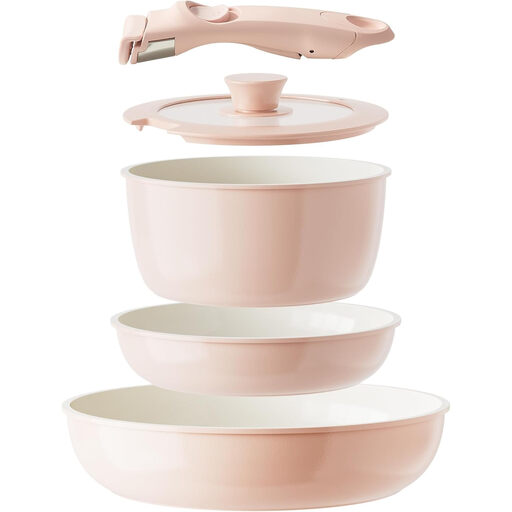
Why it's a great choice: Perfect for students or small apartments. The removable handle and stackable design free up precious cupboard space. The set covers the essentials (two pans, one saucepan) for everyday cooking.
Its ceramic coating, guaranteed free of PFAS, PTFE, and PFOA, meets the demand for healthier cookware. The removable handle also bypasses a classic problem: handles that become loose over time.
Maximum space-saving: the stackable system with a removable handle is a real asset for small kitchens. Versatility: compatible with all hobs (including induction) and oven-safe (without the handle).
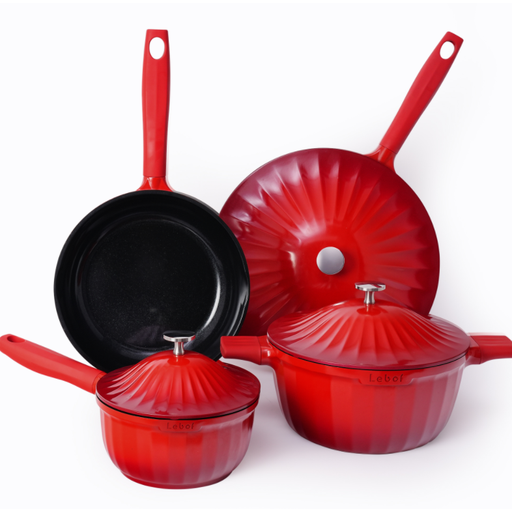
Why it's a great choice: This complete set is designed for a family's daily routine. With its pans, saucepans, and casserole of different sizes, it makes preparing full meals easy. Its understated design fits into any kitchen.
Its cast aluminium structure ensures excellent conductivity, sidestepping the "false compatibility" induction trap. The titanium-reinforced ceramic coating, guaranteed free of PFAS, PFOA, and PTFE, alleviates concerns about controversial substances.
Complete and versatile set: it covers the majority of cooking needs. Healthy coating: the PFAS-free guarantee provides total peace of mind for family cooking.
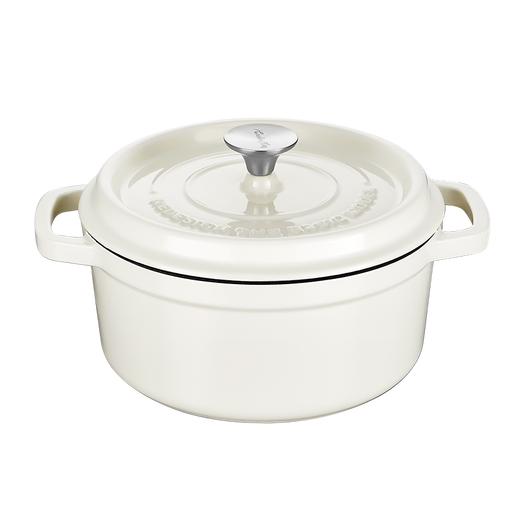
Why it's a great choice: Essential for lovers of stews, soups, or even no-knead bread. Cast iron is the gold standard for slow, gentle cooking: it stores and releases heat with perfect uniformity. It's a durable investment, designed for a specific purpose.
Naturally induction-compatible and virtually indestructible, cast iron sweeps away performance and durability issues. The interior enamel acts as a protective and slightly non-stick layer, without the fragility of synthetic coatings.
Exceptional heat retention: perfect for simmering and serving directly at the table. Unbeatable durability: a piece of cookware designed to last for decades with minimal maintenance.
Explore our full selection of products that meet our quality criteria and current regulations.
The easiest trick is the magnet test. Take a magnet (a simple fridge magnet will do the trick) and place it on the bottom of your pan or pot. If it sticks firmly to the base, the cookware is ferromagnetic and will work on an induction hob. If it doesn't stick, it's not compatible.
The lifespan varies from 1 to 5 years on average, depending on the quality of the coating and how you maintain it. To extend its life, never overheat it while empty, use wooden, silicone, or plastic utensils, and preferably wash it by hand with a soft sponge. Also, avoid thermal shock (running a hot pan under cold water), which can warp the base and damage the coating.
Ceramic coatings are an excellent alternative because they contain no PTFE or PFAS. Stable at high temperatures, they don't risk releasing controversial compounds in case of accidental overheating. However, "healthy" cooking primarily depends on using fats in moderation and cooking at the right temperature, regardless of the coating.